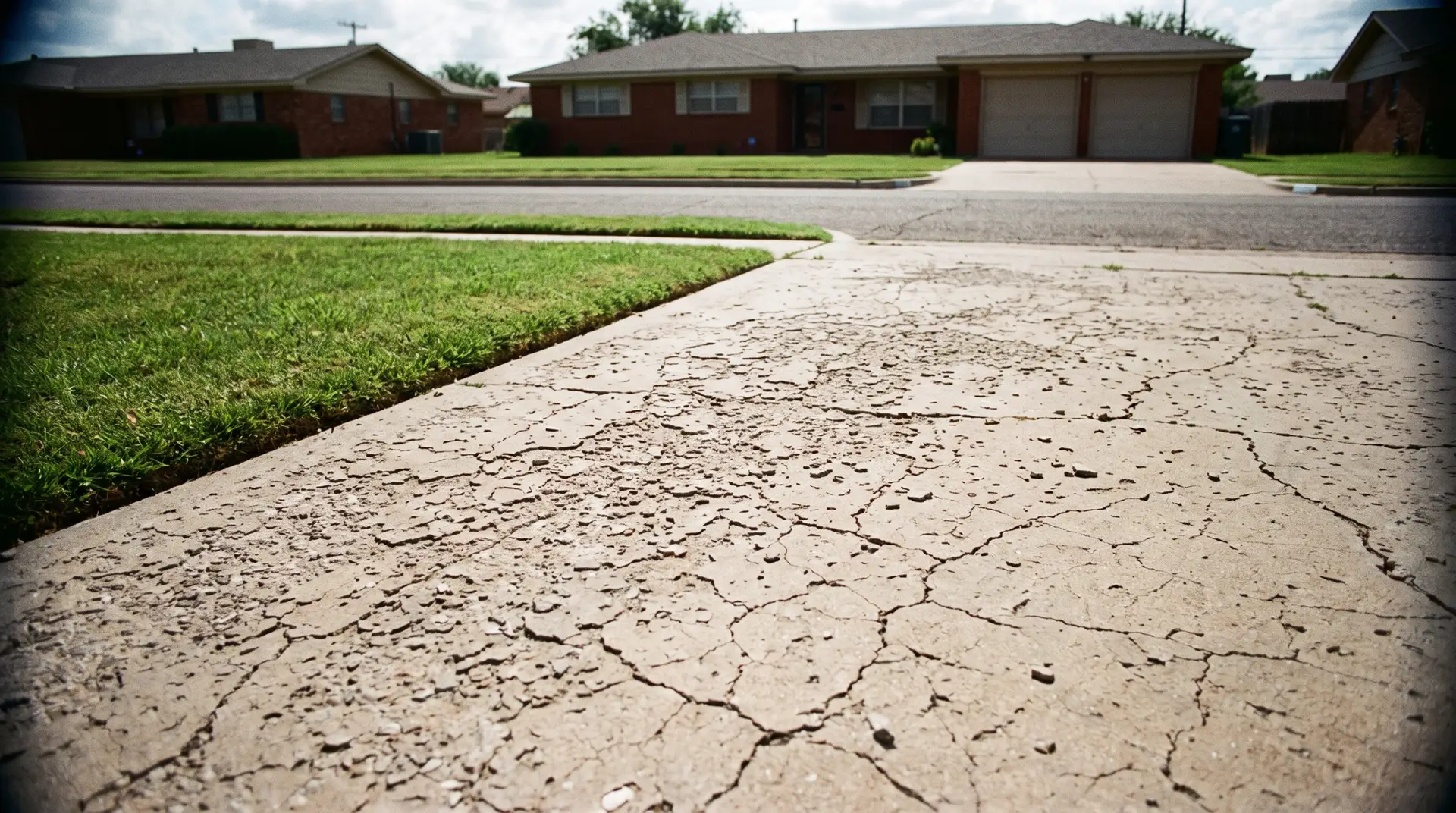
Concrete resurfacing is the option most Lubbock homeowners have never heard of, standing on a driveway that looks terrible but is structurally fine. The surface has spalled, crazed or gone chalky, the colour is patchy, and every quote so far has been for tearing the whole thing out and starting again.
Resurfacing puts a new cementitious layer over the existing slab. Done on the right slab it costs a fraction of replacement, takes a day or two rather than a week, and comes out looking better than the original ever did.
It is a common job in older Lubbock neighbourhoods, where driveways poured in the 1970s are still perfectly solid underneath and simply look their age.
Done on the wrong slab it fails within a couple of years, and the money is gone. The difference is entirely about what is wrong underneath, which is what this guide is about.
On this page, a complete guide to concrete resurfacing in Lubbock, TX:
- Quick Answer: What Concrete Resurfacing Costs in Lubbock
- When Concrete Resurfacing Is the Right Call
- How Concrete Resurfacing Actually Works
- Why West Texas Is Hard on Resurfaced Concrete
- Concrete Resurfacing Versus Replacement
- Final Word: Getting Concrete Resurfacing Right
- Frequently Asked Questions About Concrete Resurfacing
Quick Answer: What Concrete Resurfacing Costs in Lubbock
In Lubbock, concrete resurfacing typically runs $4 to $9 per square foot for a standard overlay, compared with $6 to $12 per square foot to tear out and replace a plain slab. Decorative finishes such as stamped or stained overlays run $8 to $15 per square foot.
On a typical 600 square foot two-car driveway that works out to roughly $2,400 to $5,400 resurfaced, against $4,000 to $8,000 for full replacement. On a 300 square foot patio, expect $1,200 to $2,700.
The saving is real, but it only applies when the slab underneath is sound. Resurfacing is a surface treatment, not a structural repair. If the base has washed out, the slab has settled, or panels have broken into separate pieces, an overlay will crack in the same places within a year or two.
The test is simple: if the problem is on the surface, resurface. If the problem is under the slab, replace.
Concrete resurfacing costs $4 to $9 per square foot in Lubbock, roughly a third less than replacement, and works well on slabs with surface damage. It is not a fix for settling, base failure or broken panels, where an overlay will simply crack again.
When Concrete Resurfacing Is the Right Call
The honest way to think about this is that an overlay copies the slab underneath. Anything moving below will telegraph through. Anything that is purely cosmetic gets covered permanently.
Start by looking at what kind of damage you actually have. Surface problems look like texture and colour: flaking, pitting, a chalky bloom, worn patches where tyres turn. Structural problems look like geometry: panels at different heights, cracks you can put a finger into, edges that have dropped.
Then check whether the slab moves. Stand on either side of a crack and rock your weight. If the two sides move independently, that crack is active and an overlay will not hold it together.
Also consider thickness and drainage. Adding a quarter to half an inch of material changes the level at door thresholds, garage slabs and where a driveway meets the street. It also changes how water runs, and a slab that already ponds will still pond afterwards unless the overlay is used to correct the fall.
Where the slab is sound and the surface is tired, resurfacing is one of the best value jobs available in this market.
- Good candidate, surface spalling: Flaking or scaling where the top layer has popped off, usually near downspouts or the garage apron. The slab below is intact, the damage is shallow, and an overlay covers it permanently.
- Good candidate, crazing and discolouration: Fine hairline cracking across the surface like dried mud, plus patchy colour and chalky residue. Almost entirely cosmetic here, and exactly what resurfacing was designed for.
- Good candidate, worn or stained patches: Tyre marks, oil staining, and the polished tracks where vehicles turn. These do not affect strength at all, and an overlay gives a uniform new surface.
- Poor candidate, settled or heaved panels: If one panel sits higher or lower than its neighbour, the ground underneath has moved. Resurfacing cannot correct level, and the joint will reappear through the overlay.
- Poor candidate, wide or active cracks: Cracks over about a quarter inch, or any crack whose sides move independently, indicate a slab that is no longer acting as one piece. An overlay will crack along the same line.
- Poor candidate, broken-up panels: Concrete that has fractured into multiple pieces, or where you can see base material through the cracks, needs removal and a new base rather than a new surface.
Be cautious with any contractor who recommends resurfacing without first checking whether cracks are active, and without discussing what caused the damage. An overlay applied over a drainage problem or a washed-out base is money spent on postponing the same conversation by eighteen months.
How Concrete Resurfacing Actually Works
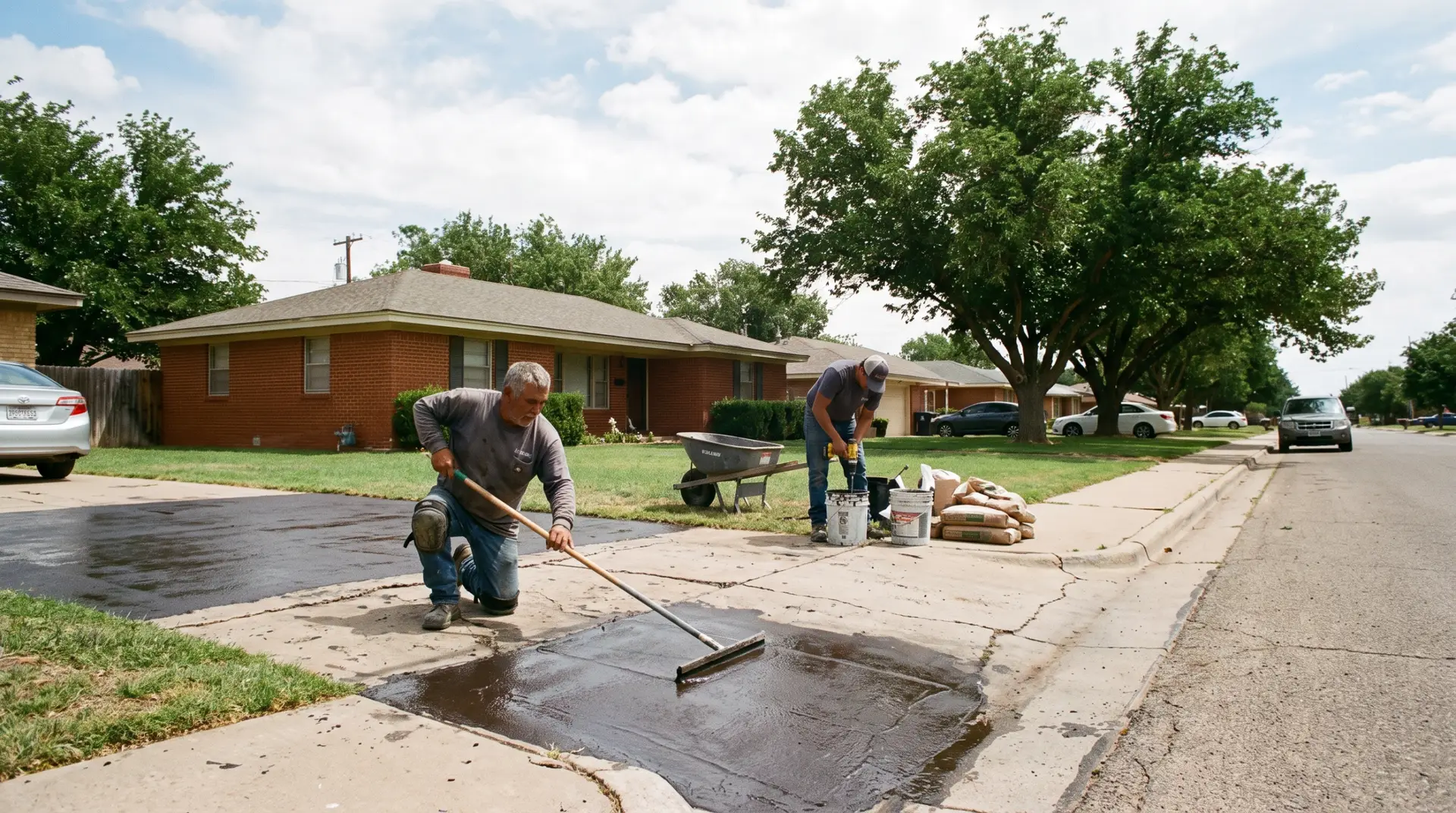
Preparation is most of the job and most of the cost, and it is where good work separates from bad. The existing slab has to be cleaned thoroughly, usually by pressure washing and often by mechanical grinding or shot blasting, to open the surface so the overlay can bond. A slab that has been sealed, or that has oil soaked into it, needs more aggressive preparation than one that has simply weathered.
Existing cracks are then treated rather than ignored. Static cracks get filled and, on a good job, the overlay is reinforced across them. Active cracks are either honoured with a control joint in the new surface or are a reason not to proceed at all. Control joints in the original slab are normally carried through the overlay, because concrete will crack somewhere and it is better to decide where.
A bonding agent or primer goes down next, then the overlay itself. Polymer-modified cementitious overlays are the common choice, typically applied between an eighth and half an inch thick depending on the product and the finish. They are considerably stronger and more flexible than plain concrete at that thickness, which is what allows such a thin layer to work at all.
Finish options are broad. A broom finish matches most Lubbock driveways. Stamped overlays can reproduce stone or tile patterns, and integral colour or acid staining changes the appearance entirely. Our guide to stamped concrete patio costs covers the decorative side of that decision.
Curing matters enormously here and gets rushed constantly. The Portland Cement Association publishes the placement and curing standards behind all of this, and the short version for our climate is that a thin overlay drying too fast in dry wind is the most common cause of early failure.
Why West Texas Is Hard on Resurfaced Concrete
Our climate creates both the damage that makes resurfacing attractive and the conditions that make it difficult to do well. Three local factors decide whether an overlay lasts fifteen years or two, and all three are about what happens in the first 48 hours after placement as much as about the years afterwards.
Evaporation during curing
A spring afternoon here can pull water out of fresh cementitious material faster than the mix can supply it to the surface. On a thin overlay, which has very little water to give up in the first place, that causes surface crazing, weak bonding and sometimes delamination within the first season. This is why competent crews will refuse to place an overlay on a hot, dry, windy day, or will work early morning, use evaporation retarders and keep the surface damp while it cures. A contractor who treats the weather forecast as irrelevant is telling you something.
Expansive clay underneath
Lubbock sits on soil that swells when wet and shrinks hard when dry, and that cycle moves slabs through the year. An overlay is bonded to the slab, so it moves with it. Where that movement is uniform, nothing happens. Where one part of a slab is on moist soil near a downspout and another is baked dry, differential movement opens joints and cracks that come straight through the new surface. Managing water around the slab is part of making an overlay last.
Freeze-thaw and de-icing damage
We get enough hard freezes for water in the surface pores to expand and pop the top layer off, which is what caused the spalling on most driveways here in the first place. A new overlay is vulnerable to exactly the same mechanism, and de-icing salt tracked off the road makes it worse. Sealing the finished surface and keeping salt off it is the difference between an overlay that lasts and one that starts flaking in its third winter.
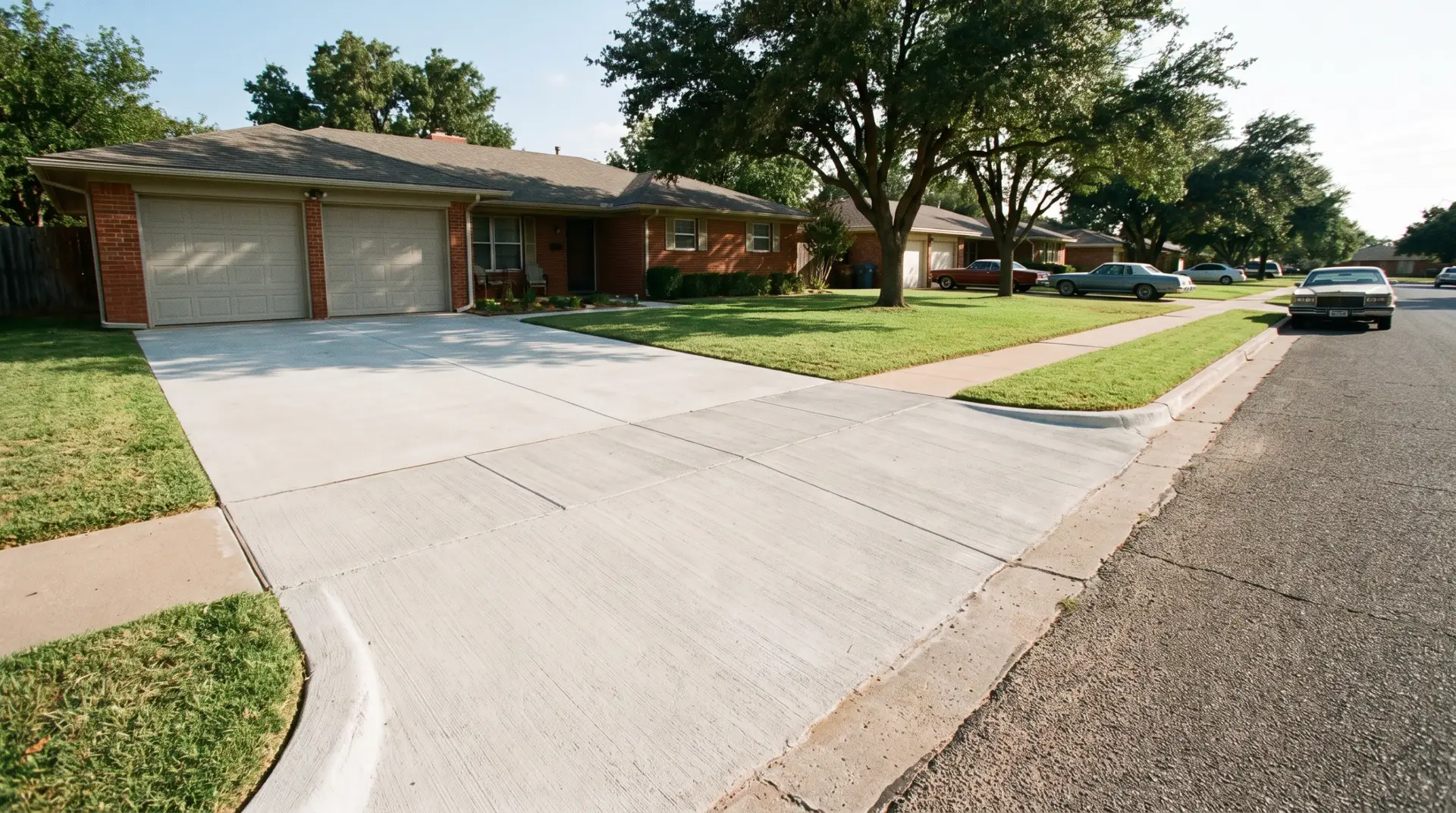
Concrete Resurfacing Versus Replacement
The financial comparison is straightforward once you know which is appropriate. Resurfacing a 600 square foot driveway runs roughly $2,400 to $5,400 against $4,000 to $8,000 to replace, and it is done in a day or two rather than a week with no demolition, no dumpster and no waiting for a new slab to cure before you can park on it.
Lifespan is the other side. A well-prepared overlay on a sound slab in this climate should give you 10 to 15 years, and longer if it is sealed and maintained. A new slab, properly thick and reinforced, should give 25 to 30. So resurfacing is not a permanent answer, it is a good-value extension of what you have.
The decision usually comes down to the condition of the base. If the original slab was poured thin, on poor base, with no reinforcement, then resurfacing is putting a good surface on a bad foundation and replacement is the better long-term spend. Our guide to concrete driveway repair covers how to judge that, and why concrete cracks in West Texas explains what the crack pattern is telling you.
There is also a middle route worth asking about. Replacing one or two failed panels and resurfacing the rest gives a uniform appearance without the cost of a full tear-out, and it is often the most sensible answer on a driveway where the damage is concentrated at one end.
Timing is worth planning as well. Fall is the best window for concrete resurfacing here, because moderate temperatures and lower wind give a thin overlay the slow, even cure it needs. Mid-summer work is possible but has to start early in the day and be protected as it cures, and that is a genuine reason a good crew may push your job back a few weeks.
Final Word: Getting Concrete Resurfacing Right
Diagnose before you price. Walk the slab, look for level differences, test whether cracks move, and note where water sits after rain. Those four observations decide whether resurfacing is appropriate, and no quote is meaningful before they are made.
Then judge contractors on preparation rather than on finish. Ask how the slab will be cleaned and profiled, how existing cracks and control joints will be handled, and what they will do about curing if the day turns hot and windy. Those answers predict the outcome far better than the sample board does.
Plan to seal the finished surface and to keep it sealed. A thin overlay has less material to lose than a full slab does, so the protection matters more. Our guide to concrete sealing in Lubbock covers timing and products.
One more practical note: decide on the finish before the crew arrives, not on the day. Stamped and stained overlays need different preparation and sometimes different products than a plain broom finish, and changing your mind once the primer is down is not an option.
If you want someone to tell you honestly whether your driveway is a resurfacing candidate or past it, we look at concrete across Lubbock and the South Plains and will say so either way. You can read more about our concrete work on our concrete services page.
Frequently Asked Questions About Concrete Resurfacing
What Lubbock homeowners ask before resurfacing a driveway or patio
A properly prepared overlay on a structurally sound slab should give you 10 to 15 years here, and longer if it is sealed on a regular cycle and kept free of de-icing salt. That is less than a new slab, which should reach 25 to 30 years, so resurfacing is best understood as a good-value life extension rather than a permanent replacement. The biggest single factor in reaching the upper end of that range is how well the original surface was cleaned and profiled before the overlay went down. Keeping downspout water off the slab edge also helps, since repeated soaking is what starts most spalling here in the first place.
It depends entirely on the crack. Fine, stable hairline cracks and surface crazing are fine and get covered permanently. Cracks wider than about a quarter inch, or any crack where the two sides move independently when you shift your weight across it, mean the slab is no longer acting as one piece. An overlay bonded to that slab will crack along the same line, usually within a year or two. Have someone check whether the cracks are active before committing. A straightedge laid across the crack makes level differences obvious, which is the other thing to check while you are down there.
Yes, typically by around a third. Resurfacing runs $4 to $9 per square foot against $6 to $12 for a plain replacement slab, so a 600 square foot driveway is roughly $2,400 to $5,400 instead of $4,000 to $8,000. You also avoid demolition, disposal and the wait while a new slab cures. The caveat is that it only saves money when the slab underneath is sound, because an overlay over a failing base has to be done again. Remember to compare like for like, since a decorative overlay costs more than a plain one and closes much of the gap with replacement.
Most polymer-modified overlays take foot traffic within 24 hours and vehicle traffic in about three to five days, though you should follow the specific product's guidance rather than a rule of thumb. Avoid turning the steering wheel while stationary for the first couple of weeks, since that scuffs a new surface. In our dry, windy conditions the curing period matters more than usual, so do not let anyone rush you back onto it early. Park on the street for the first week if you can, which is easier than remembering not to turn the wheel.
Static cracks that have been properly filled and bridged generally will not show. Active cracks almost certainly will, because the movement underneath continues and the thin overlay cannot resist it. The same applies to control joints, which are deliberately carried through the new surface rather than covered, since concrete will crack somewhere and it is far better to decide where. A contractor who promises to hide an active crack is overselling what the product does. Ask to see the crack treatment before the overlay goes down, since it is invisible afterwards.