Concrete driveway repair is worth doing when the slab is basically sound and the problem is limited to cracks, settling, or a worn surface. It stops being worth doing when the panels have broken into pieces, the base underneath has washed out, or you are patching the same spot every other spring. Telling those two situations apart is the whole decision.
Driveways in Lubbock take a specific kind of abuse. Caliche and expansive clay move under the slab with every wet and dry cycle, summer pours cure in hot dry wind, and winter runs the concrete through freeze and thaw more times than most people realize. This guide covers what each type of damage means, what the fixes cost, and where the line sits between saving a driveway and pouring a new one.
On this page, a complete guide to concrete driveway repair in Lubbock, TX:
- Quick Answer: Is Concrete Driveway Repair Worth It?
- Six Common Driveway Problems and What They Mean
- The Repair Methods and What Each One Does
- Why Lubbock Driveways Crack in the First Place
- When Concrete Driveway Repair Stops Making Sense
- Final Word: Fix Small Things Early
- Frequently Asked Questions About Concrete Driveway Repair
Quick Answer: Is Concrete Driveway Repair Worth It?
Repair if the driveway is structurally intact. That means hairline to moderate cracks, one or two settled panels, spalling on the surface, or a section lifted by a tree root. Those problems have targeted fixes that cost a fraction of replacement and hold for years. A typical Lubbock repair runs $400 to $3,000 depending on method and area.
Replace if you see multiple wide cracks that intersect, panels that rock under a car tire, chunks you can lift out by hand, or exposed and rusting rebar. Once the slab has lost continuity, patches ride on nothing and open again in a season. Full replacement in this market generally runs $8–$14 per square foot, so a two-car driveway of roughly 600 square feet lands somewhere near $5,000 to $8,500.
The rough rule crews use: if repair costs more than about half of replacement, or if the underlying base has failed, pour new. Concrete driveway repair buys time on a good slab. It cannot fix a slab that is sitting on soil that moved out from under it.
Concrete driveway repair makes sense on a sound slab with cracks, settling, or surface wear, and typically runs $400 to $3,000 in Lubbock. Replace instead when panels rock, cracks intersect and widen, or rebar is exposed. Full replacement runs roughly $8 to $14 per square foot here.
Six Common Driveway Problems and What They Mean
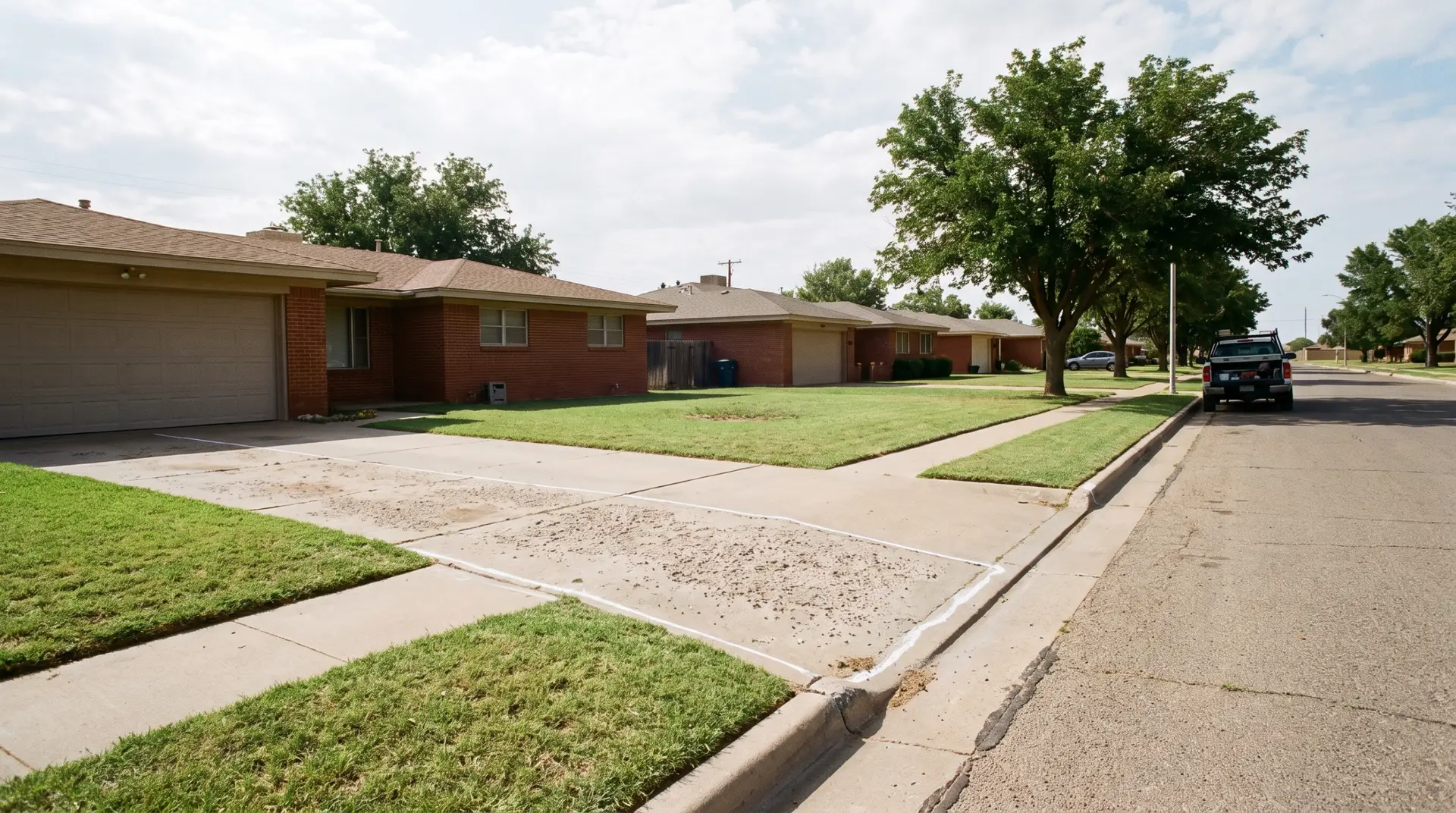
Not every crack is a problem, and some things that look cosmetic are actually the base telling you it failed. Before you get bids, walk the driveway slowly with a tape measure and a screwdriver. Width, whether the two sides of a crack sit level with each other, and whether the concrete sounds hollow when tapped tell you nearly everything.
Here are the six conditions that show up most often on Lubbock driveways, roughly in order from least to most serious, with the repair each one calls for.
- Hairline shrinkage cracks, under 1/8 inch: Almost universal and rarely structural. These form in the first days after the pour as water leaves the mix, and in West Texas they form fast because hot dry wind pulls moisture out of the surface before the slab has strength. Clean them out and fill with a self-leveling polyurethane sealant to keep water and grit from getting in. Budget $3 to $8 per linear foot.
- Working cracks, 1/8 to 1/2 inch, level on both sides: The slab has moved but the two sides are still at the same height, which means the base is holding. Rout the crack into a clean channel, fill with a flexible sealant that can stretch through the seasonal cycle, and reseal every few years. Rigid patching compound in a moving crack fails within a year.
- Settled or heaved panels with a lip: One side of a joint sits higher than the other, and you feel it in the car and stub a toe on it. This is base failure, not concrete failure. Slab lifting with injected polyurethane foam or traditional mudjacking raises the low panel back to grade for a fraction of replacement, and it also fills the void that caused the drop.
- Spalling and scaling on the surface: The top layer flakes away and leaves the aggregate exposed and rough. Usually caused by deicing salts, a finish that was overworked with bleed water still on it, or freeze-thaw damage on a poorly cured slab. If the sound concrete underneath is thick and solid, a bonded overlay or resurfacing coat gives a new wearing surface at $3 to $8 per square foot.
- Tree root lifting: Elm and mulberry roots run shallow in Lubbock soil and will pick up a panel over a decade. Cutting the root and lifting or replacing the single panel works, but only if the tree is far enough away that the roots will not come back into the same space in five years. Sometimes the honest answer involves the tree, not the driveway.
- Intersecting cracks and rocking panels: When cracks cross each other and pieces move independently under load, the slab has lost its continuity. Nothing you inject or patch restores that. This is the point where money spent on concrete driveway repair is better spent as a down payment on a replacement.
One thing to check before you call anybody: where does the water go? A driveway that holds standing water after a rain, or one that drains toward the garage, is a drainage problem wearing a concrete costume. Fixing the slab without fixing the grading gets you the same failure again on a shorter timeline, and it is a fast way to waste several thousand dollars.
The Repair Methods and What Each One Does
Crack sealing is the cheapest and the most commonly skipped. The point is not appearance. Water in a crack gets under the slab, softens the base, freezes in December, and widens the crack a little more every cycle. Sealing a quarter-inch crack for a few hundred dollars is what keeps it from becoming a two-inch trench in five years. Use a flexible polyurethane or polymer sealant, never a rigid cement patch, because the crack will keep moving with the seasons.
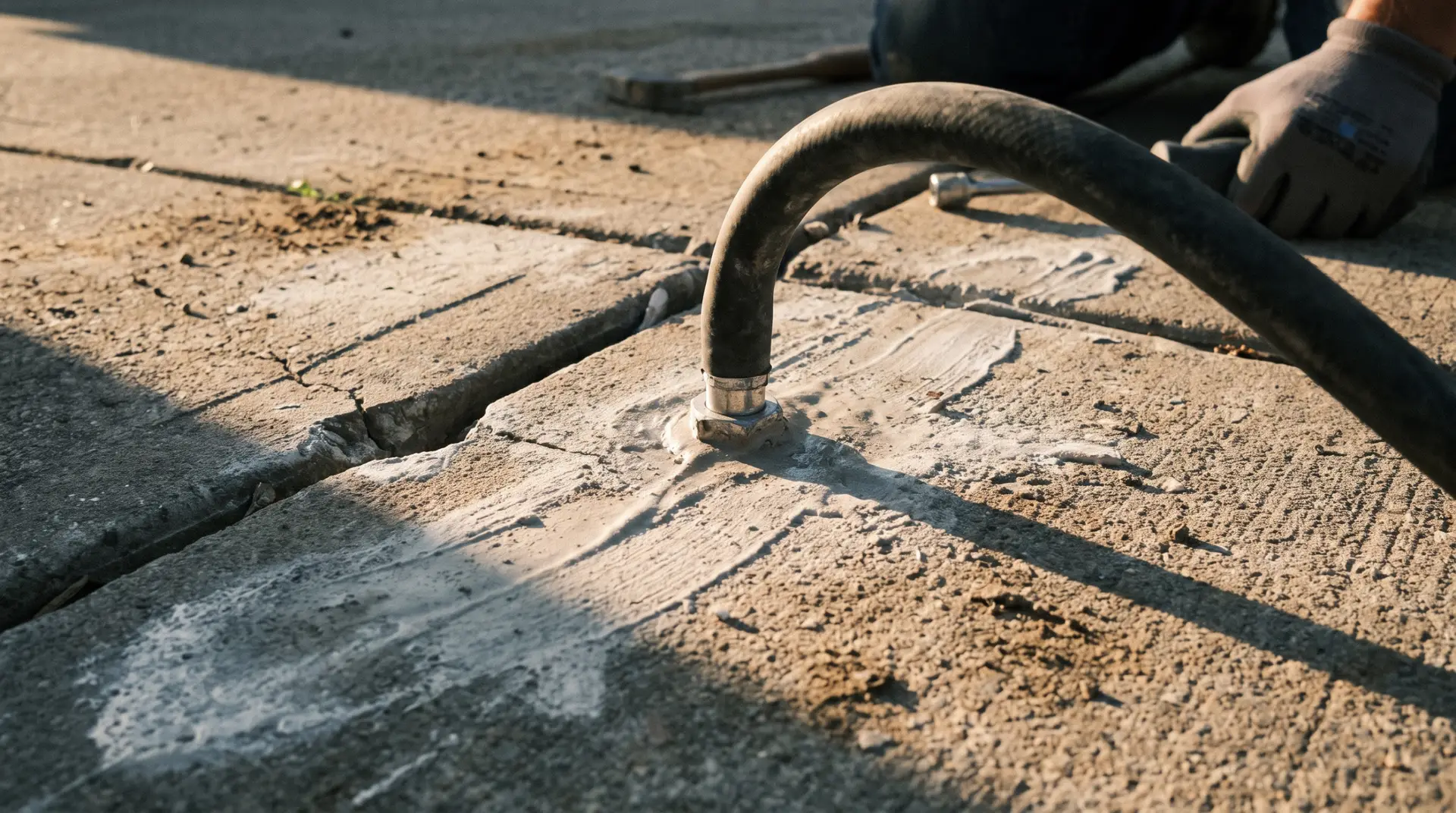
Slab lifting is the fix people underestimate. A crew drills penny-sized holes through the settled panel and injects either a cement slurry or an expanding polyurethane foam underneath. The material fills the void, then lifts the panel back to grade. It takes a few hours, you can drive on foam-lifted concrete almost immediately, and it costs far less than tearing out and repouring. On a driveway where one panel dropped an inch near the street, this is usually the right answer.
Resurfacing addresses appearance and wear rather than structure. A bonded overlay, roughly a quarter inch to an inch thick, goes over a prepared surface and gives you a fresh finish, sometimes with a broom texture or a stamped pattern. It requires a solid base slab with good bond potential, and it will telegraph any active crack straight through within a year or two unless that crack is properly treated first.
Partial replacement is the underrated middle ground. Concrete driveways are poured in panels separated by control joints, and a single bad panel can be saw-cut out and repoured without touching the rest. Expect the new panel to be a different color for a year or two as it cures and weathers. If you want the cost picture for a whole new driveway to compare against, our Lubbock concrete driveway cost guide has current numbers.
Why Lubbock Driveways Crack in the First Place
Concrete cracks everywhere. It cracks faster here, and for reasons specific to the South Plains. If you understand what is actually pushing on your slab, you can pick a repair that addresses the cause instead of covering the symptom, and you can build the replacement so it lasts longer than the one it replaced.
Caliche and Expansive Clay Underneath
Lubbock sits on soil that changes volume with moisture. Expansive clay swells when it gets wet and shrinks when it dries out, and our rainfall arrives in short heavy bursts separated by long dry stretches, which is the worst possible pattern. The slab above rides that movement. Caliche layers add another wrinkle, since caliche compacts beautifully when it is prepared right and behaves like loose rock when it is not. A properly compacted base with the right moisture content at the time of the pour is the single biggest predictor of how long a driveway lasts here.
Hot, Dry, Windy Pours
Concrete does not dry, it cures, and it needs water to do that. A July pour in Lubbock with 100 degree air, single-digit humidity, and a 20 mph wind pulls surface water out faster than the mix can bleed it, and the result is plastic shrinkage cracking on day one. Crews who work here plan around it with early morning pours, evaporation retarders, wet burlap or curing compound, and by not letting the finishers chase a surface that is setting under them. A driveway that was rushed through a hot afternoon will show it for its entire life.
Freeze-Thaw and Winter Chemicals
Lubbock winters swing above and below freezing repeatedly, sometimes several times in a week. Water sitting in a crack or in the pores of a poorly air-entrained slab expands as it freezes and pries the concrete apart a little each time. Add deicing salt tracked off the street or spread on the slab and you accelerate surface scaling badly. Sealing the concrete every few years and keeping salt off it are two cheap habits that measurably extend the life of a driveway in this climate.
When Concrete Driveway Repair Stops Making Sense
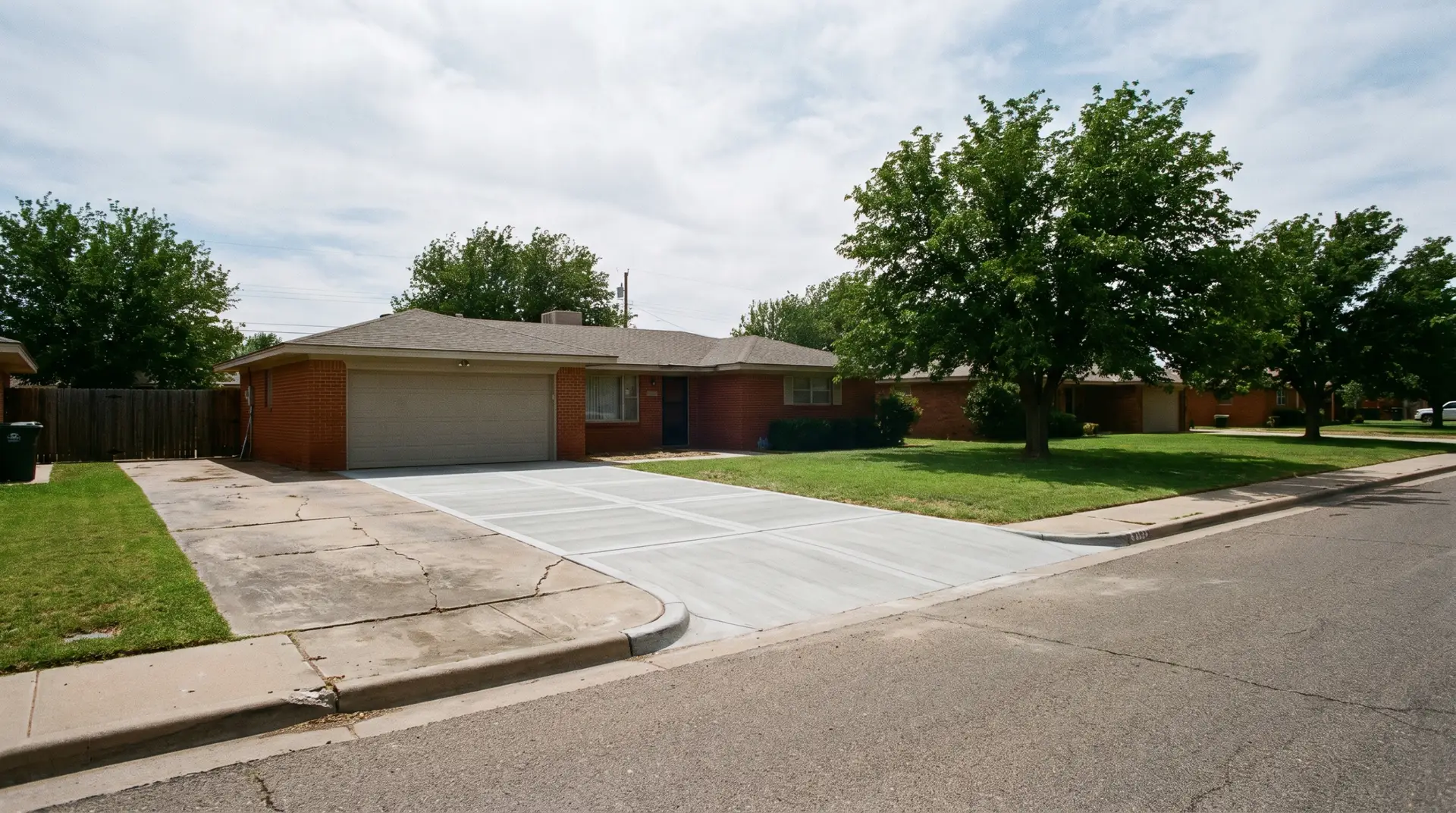
There is a point where every additional dollar of repair is a dollar borrowed against a replacement you are going to do anyway. The clearest signals are structural: panels that move under weight, cracks wider than about half an inch that have vertical displacement between the two sides, exposed rebar with rust staining, and any area where you can see the base has washed out beneath the edge. At that stage the concrete is no longer acting as a slab.
Age and slab thickness matter too. Many older Lubbock driveways were poured at three and a half to four inches with wire mesh that was never pulled up into the pour, which means it did nothing. Modern practice for a residential driveway that will see truck traffic is four to five inches over a compacted base with rebar on chairs and control joints cut at the right spacing. The Portland Cement Association keeps a public technical library on residential slab design and joint spacing at cement.org if you want to check what your contractor proposes.
Run the arithmetic before you decide. If a contractor quotes $3,800 to lift four panels, seal 60 feet of cracks, and resurface the apron on a driveway that would cost $7,000 to replace, you are spending more than half of replacement on a slab that is already twenty-five years old. Spend the extra and get thirty years instead of five. On a ten-year-old driveway with one settled panel, the same math points the other direction and repair is clearly correct.
Final Word: Fix Small Things Early
The cheapest driveway work is the work you do before anything is really wrong. Seal the cracks while they are hairline. Keep the sprinkler heads from soaking the edge of the slab every morning, because saturated soil under a driveway edge is how settling starts. Get the grading right so water leaves the surface instead of ponding on it. None of that is expensive and all of it buys years.
If your driveway is already past that stage, get two or three bids and make sure each one specifies base preparation, slab thickness, reinforcement, and joint spacing rather than just a square foot price. A cheap bid on concrete is almost always cheap in the base and the thickness, and both of those are invisible the day the job finishes and obvious four winters later. Sealing the finished slab is worth doing as well, and our concrete sealing guide covers timing.
Elite Roofing and Exterior pours and repairs concrete across Lubbock, Wolfforth, Shallowater, and the surrounding area, and we will tell you plainly when a slab is worth saving and when it is not. If you want someone to look at yours, start with our concrete services page.
Frequently Asked Questions About Concrete Driveway Repair
What Lubbock homeowners ask before repairing or replacing a driveway
Crack sealing typically runs $3 to $8 per linear foot, so a driveway with 60 feet of cracking lands in the $200 to $500 range. Slab lifting to raise a settled panel usually costs several hundred dollars per panel depending on the size of the void and the method. Resurfacing a worn surface runs roughly $3 to $8 per square foot. Most whole-driveway repair projects here fall between $400 and $3,000, well under the cost of a full replacement.
Usually yes, as long as the two sides of each crack are still level with each other and the panels do not move under a car. Level cracks mean the base is still supporting the slab, and a flexible sealant will keep water out and stop the crack from growing. Once cracks intersect, widen past half an inch, or show one side sitting higher than the other, the slab has lost its structural continuity and repair becomes a temporary measure.
A properly sealed crack on a sound slab holds five to ten years before the sealant needs refreshing. A panel raised by polyurethane foam injection can last as long as the surrounding concrete, since the foam does not absorb water or wash out the way some older materials did. Resurfacing gives you roughly eight to fifteen years of new wearing surface. The variable in all three is drainage, because water under the slab shortens every one of those numbers.
Something underneath is moving, and patching the top will not stop it. The usual culprits in Lubbock are a void from washed-out base material, expansive clay that swells and shrinks with moisture cycles, a sprinkler head soaking one area daily, or a tree root growing into the space. Find the cause first. A crack that reopens twice after proper repair is telling you the problem is in the soil, and that needs base work rather than another bead of sealant.
At that age, look at slab thickness and overall condition before spending anything. Many driveways from that era were poured thin with mesh that never got positioned correctly, so they have less structure to save. If repairs would run more than about half the cost of replacement, put the money toward a new slab poured at four to five inches over a properly compacted base. A correctly built driveway in this climate should give you twenty-five to forty years.