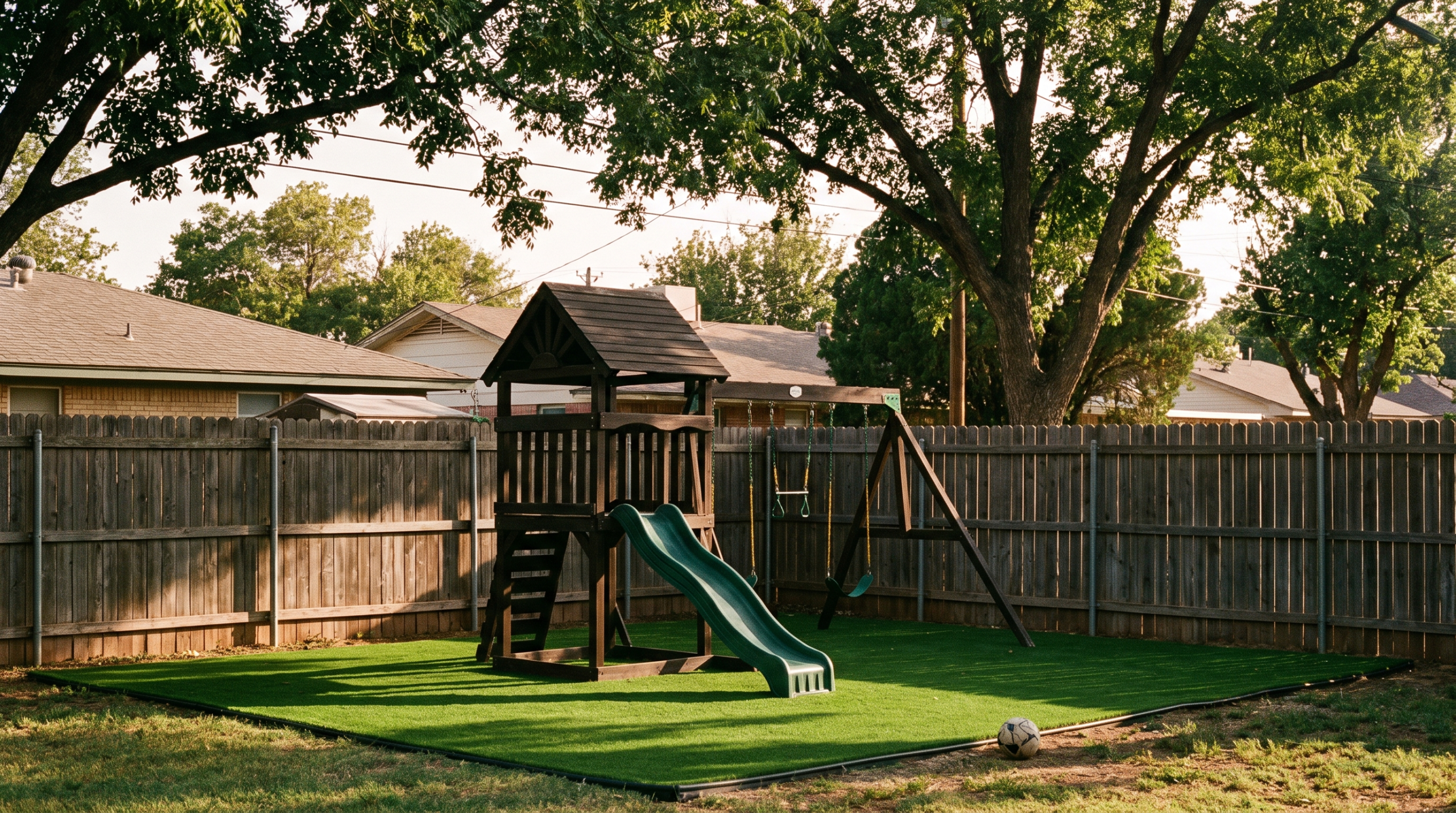
Artificial turf for playgrounds is a different product and a different installation than the synthetic lawn in a Lubbock backyard, and treating them as the same thing is how play areas end up too hard, too hot and too short-lived. The grass on top may look similar. Everything underneath it is not.
A play surface has to absorb a fall, drain after a hard storm, stay cool enough to use in August, and survive being run on in the same three spots every day for years. A decorative lawn has to do none of those things.
Schools, churches, daycares and a growing number of Lubbock homeowners are putting turf under play equipment because our natural grass will not survive the traffic and our dirt turns to caliche dust or mud. This guide covers what makes a play installation different, what it costs here, and the safety specification that actually matters.
On this page, a complete guide to turf for playgrounds in Lubbock, TX:
- Quick Answer: What Turf for Playgrounds Costs in Lubbock
- How Turf for Playgrounds Differs From Lawn Turf
- Safety Standards and Fall Height
- What West Texas Does to a Play Surface
- Planning a Turf Play Area in Lubbock
- Final Word: Getting Turf for Playgrounds Right
- Frequently Asked Questions About Turf for Playgrounds
Quick Answer: What Turf for Playgrounds Costs in Lubbock
Installed turf for playgrounds in Lubbock typically runs $12 to $22 per square foot, noticeably more than the $8 to $15 a standard synthetic lawn costs. The difference is the shock pad underneath and the heavier-duty turf on top.
A small residential play area of 300 to 500 square feet generally lands between $3,600 and $11,000. A commercial or school installation is priced per project because the fall height of the equipment drives the pad thickness.
The safety specification is the part that matters most. Play surfaces are rated by critical fall height, which is the height from which a fall onto that surface is unlikely to cause a serious head injury. Taller equipment needs a thicker shock pad, and that pad is a large share of the cost.
Skipping the pad to save money produces a surface with roughly the impact absorption of a carpet over dirt, which defeats the point of the installation entirely.
Turf for playgrounds costs $12 to $22 per square foot installed in Lubbock, above a standard synthetic lawn, because of the shock pad underneath. The pad thickness is set by the fall height of your equipment, and it is the component that makes the surface safe.
How Turf for Playgrounds Differs From Lawn Turf
From above they can look almost identical, which is exactly why homeowners get sold the wrong product. The differences are in the backing, the pile, the infill and above all in what sits between the turf and the ground.
Play turf uses a shorter, denser pile that recovers from traffic rather than matting flat, and a more permeable backing because a play area concentrates both rainfall and use in a small footprint.
The infill choice differs too. Play installations frequently use antimicrobial or organic infills rather than crumb rubber, partly for heat and partly because small children are in direct, prolonged contact with the surface.
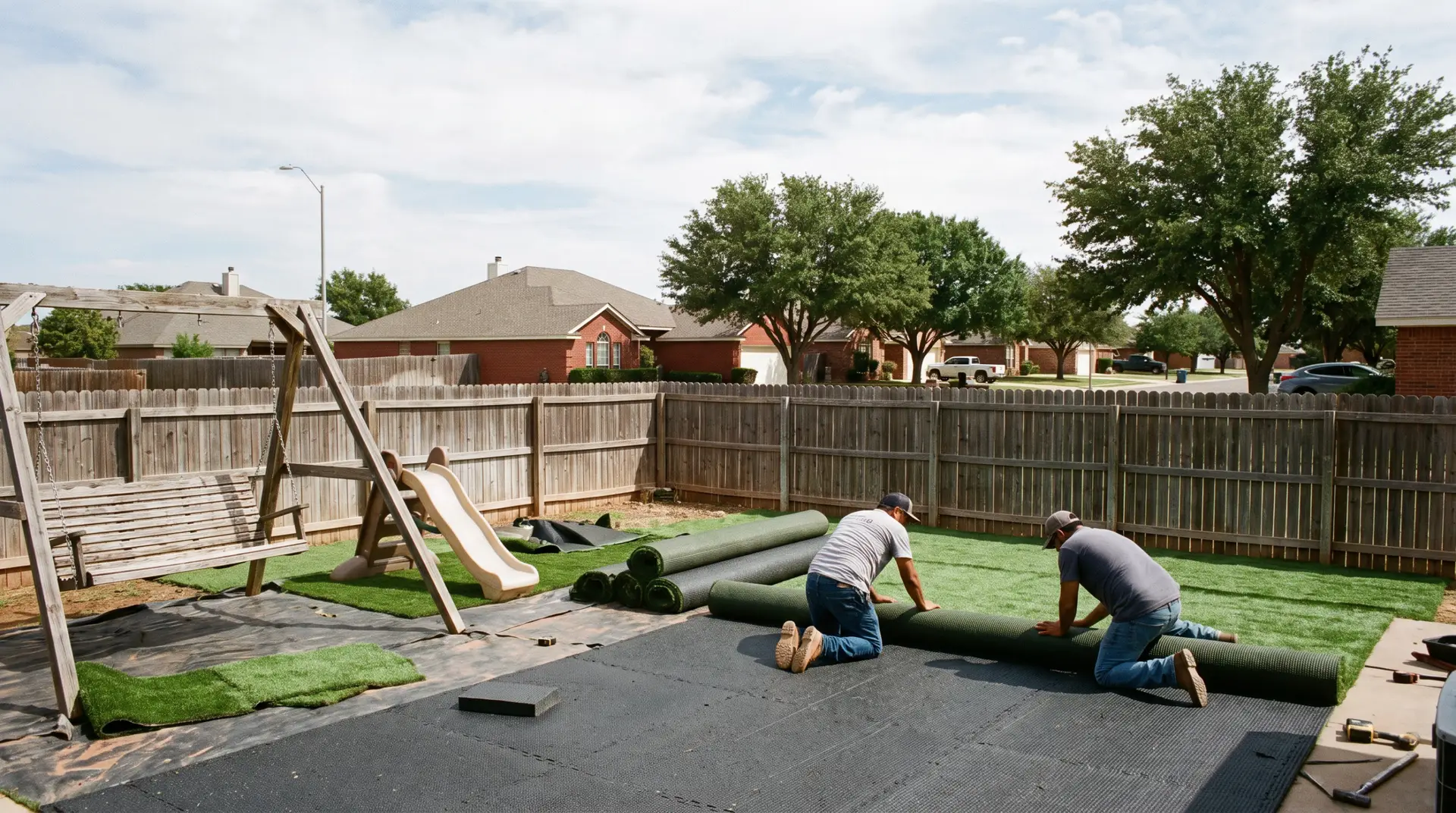
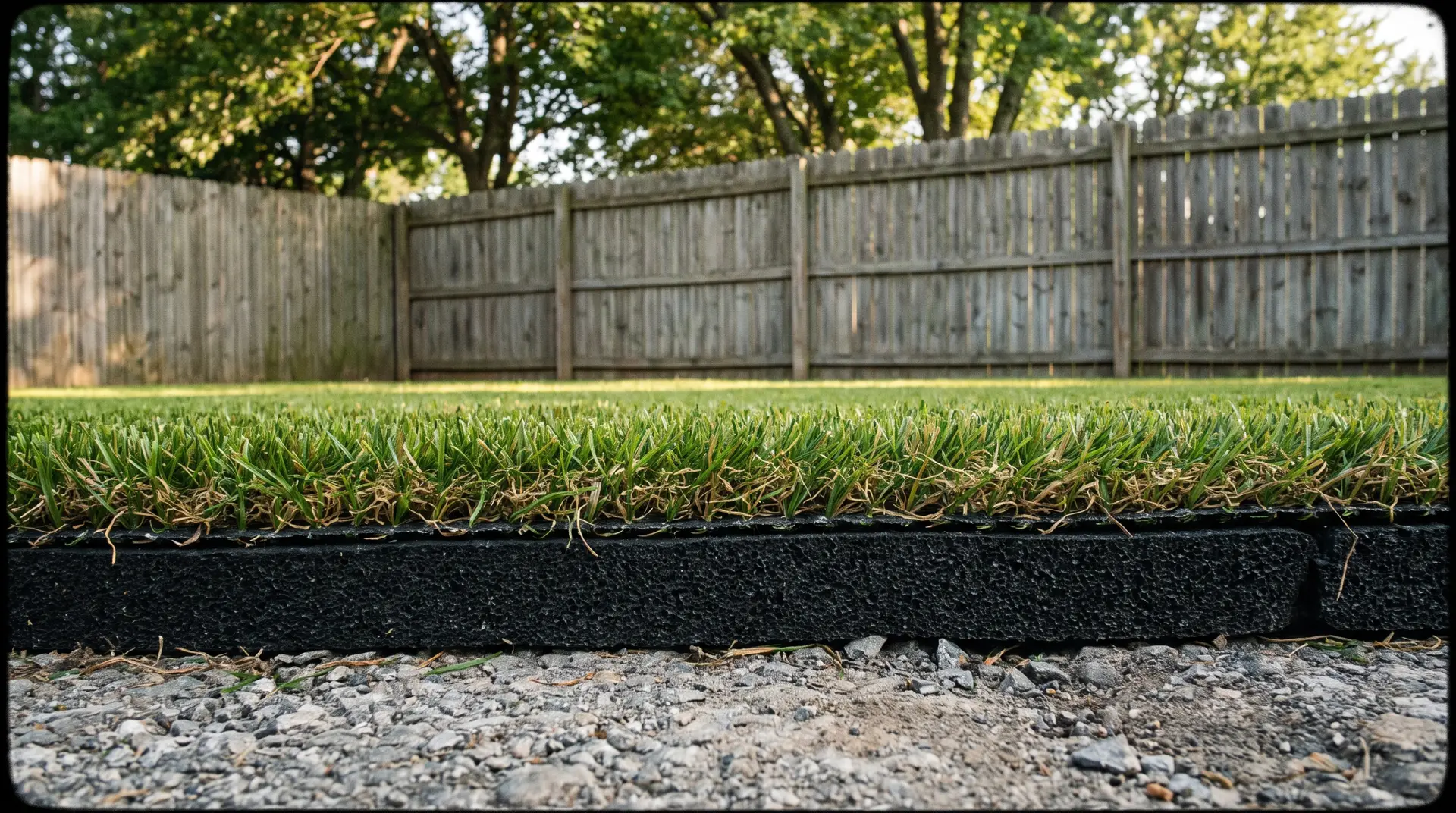
The shock pad is the real distinction. It is a closed-cell foam layer, typically between half an inch and two and a half inches thick, laid over the compacted base and under the turf. Its thickness is chosen from the fall height of the equipment it sits beneath.
Everything below that is the same base work any good turf installation needs here, and it is just as unforgiving of shortcuts.
Warranties differ as well. A lawn turf warranty generally covers fading and fiber loss. A play system warranty should also cover the pad and its impact performance over time, since a pad that compresses permanently stops doing its job while still looking perfectly fine from above.
- Shock pad sized to fall height: The single most important element. Measure the highest standing or sitting surface on the equipment and specify the pad from that. Taller slides and climbers need thicker pads, and there is no way to substitute infill depth for it.
- Short, dense pile: Play turf uses a shorter blade and higher stitch density than lawn turf so it recovers underfoot instead of matting into permanent tracks at the slide exit and swing landing.
- Highly permeable backing: A play area takes concentrated rain runoff from the equipment above it. Fully perforated backing over a properly graded base is what keeps it from holding water after our short, heavy storms.
- Non-rubber infill options: Silica sand with an antimicrobial coating, or organic infills, are common on play areas. They run cooler than crumb rubber and address the contact concerns parents raise about recycled tyre material.
- Secure perimeter anchoring: Edges are what fail first on a play surface, because children pick at them and pull on them. Anchoring into a buried border board or concrete edge is worth the extra cost.
- Deep compacted base: Four to six inches of properly compacted crushed base under the pad. Skimping here means settling and low spots within a year, and on a play surface a low spot becomes a puddle every storm.
Be careful with any quote that lists turf and base but no shock pad, or that describes the pad as optional. On a play area the pad is the safety component, and a surface without one does not meet any meaningful impact standard regardless of how good the turf above it is. If the price seems close to a standard lawn, that is usually why.
Safety Standards and Fall Height
Critical fall height is the number that governs this whole category. It describes the maximum height from which a fall onto a given surface is unlikely to cause a life-threatening head injury, and every play surface product is tested and rated for it.
The practical consequence is that the equipment sets the specification, not the budget. A toddler climber with a two-foot deck needs far less pad than a four-foot slide, and a six-foot play structure needs more again. Measure the highest accessible surface before anyone quotes.
The U.S. Consumer Product Safety Commission publishes public playground safety guidance covering surfacing, use zones and fall height, and it is the reference that commercial installations are held to. It is equally useful for homeowners, because the physics do not change in a backyard.
Use zone matters as much as pad thickness and gets overlooked constantly. The protective surface has to extend a meaningful distance beyond the equipment in every direction a child could fall or be thrown from a swing. A perfectly specified pad that stops at the edge of the frame leaves the most likely landing spots uncovered.
For a residential installation none of this is legally required, and that is exactly why it gets skipped. Whether you are bound by a standard or not, a two-inch pad under a tall climber is the difference between a fall that produces a cry and one that produces a trip to the emergency room.
Worth knowing: impact performance is not permanent. Shock pads compress under years of repeated loading in the same spots, particularly at slide exits and swing landings, and the surface can quietly fall below its original rating. On commercial installations that is tested periodically. At home, the practical version is to check whether the high-traffic areas feel noticeably firmer than the rest and have them looked at if they do.
What West Texas Does to a Play Surface
Our climate puts specific demands on a play area that milder regions do not. Three conditions decide whether an installation stays usable and safe, and each one has a design answer that costs money at installation and saves it afterwards. Get these three right and a play area here will outlast the equipment standing on it.
Summer surface heat
Synthetic turf gets hot. On a 100 degree Lubbock afternoon a synthetic surface in full sun can read between 140 and 170 degrees at the fiber tips, which is genuinely too hot for bare feet and hands. This is the single biggest practical complaint about play turf here. The answers are shade over the play area, lighter-coloured infill that reflects rather than absorbs, and cooling infill technologies that hold moisture. Siting a play area where it gets afternoon shade from the house or a tree does more than any product choice, and it is free if you plan for it.
Hard, fast rainfall
We get under twenty inches of rain a year and much of it arrives as an inch in an hour. A play area collects concentrated runoff from the equipment above it, so drainage has to handle a short, intense load rather than a steady one. Perforated backing over four to six inches of compacted crushed base, graded to fall away from the structure, is what prevents the surface from holding water. A shock pad laid on poorly drained base holds moisture against the turf and shortens its life considerably.
Wind, grit and UV
Spring wind drives caliche dust into the pile, where it settles between blades and gradually stiffens the surface. Regular rinsing and brushing clears it and keeps the fibers standing. Our UV load at 3,200 feet also fades and embrittles lower-grade turf faster than manufacturers assume, so buying a product with a genuine UV-stabilised yarn matters more here than in most markets. Perimeter edges take the worst of the wind and need proper anchoring.
Planning a Turf Play Area in Lubbock
Start with the equipment and the shade, not the turf. Measure your tallest fall height so the pad can be specified correctly, and look at where afternoon shade falls in July rather than in March. Those two decisions shape the whole installation, and both are far cheaper to get right before anything is built.
Size the area to include the use zone rather than just the footprint of the frame. Swings in particular need generous clearance front and back, and that surface has to be protective too. Most homeowners underestimate this and end up with turf under the structure and hard ground exactly where children actually land.
Budget honestly for base and pad. On a play installation those two components are most of the cost and all of the safety, and turf is the visible part that people wrongly assume they are buying. A cheap quote is nearly always cheap because of what is missing underneath. Our guide to the turf installation process covers what proper base work involves.
Think about infill deliberately. It affects heat, feel, drainage and how often the surface needs topping up, and on a play area it is also what parents ask about most. Our overview of turf infill options covers the trade-offs between sand, coated sand and the alternatives.
Plan the maintenance from the start. A play surface needs brushing to keep fibers upright in the high-traffic spots, rinsing to clear dust and keep it cooler, and infill topped up where it migrates. None of that is difficult, but a surface that never gets it will mat and stiffen within a couple of seasons.
Finally, think about what the area becomes later. Children outgrow play equipment, and a well-built turf area with a shock pad converts easily into a general backyard space once the swing set goes. Siting it somewhere that will still make sense in ten years is worth a few minutes of thought at the planning stage.
Final Word: Getting Turf for Playgrounds Right
The turf is the part you see and the least important part of the decision. Fall height, pad thickness, use zone and base preparation are what make a play area safe and durable, and all four are invisible once the job is finished.
Ask any installer what critical fall height their proposed build achieves and how they arrived at it. An installer who can answer that specifically, with reference to your equipment, is working to a standard. One who talks only about the turf product is selling you a lawn with a swing set on it.
Plan for heat honestly. Even the best play turf gets hot in a Lubbock August, and shade is the only thing that genuinely solves it. Our guide to how hot artificial turf gets here covers the real numbers and what reduces them.
If you want a straight assessment of what your play area needs, whether it is a backyard swing set or a church playground, we install turf across Lubbock and the South Plains and will specify it to the equipment rather than to a price. You can read more on our turf installation page, and our turf cost guide covers standard lawn pricing for comparison.
Frequently Asked Questions About Turf for Playgrounds
What Lubbock parents and facility managers ask about synthetic play surfaces
Expect $12 to $22 per square foot installed, compared with $8 to $15 for a standard synthetic lawn. The difference is the shock pad beneath the turf and the heavier-duty product above it. A residential play area of 300 to 500 square feet typically lands between $3,600 and $11,000. Commercial and school installations are priced per project, because the fall height of the equipment determines pad thickness and that is the largest single cost variable.
Yes, when it is installed with a shock pad matched to the fall height of the equipment. The turf itself provides very little impact absorption; the closed-cell foam pad underneath is what does the work. Without that pad the surface performs roughly like carpet over compacted dirt. Ask any installer what critical fall height their build achieves and how they determined it, and make sure the protective surface extends across the full use zone around the equipment.
It can. On a 100 degree afternoon a synthetic surface in full sun may read 140 to 170 degrees at the fiber tips, which is too hot for bare skin. The most effective remedy is shade, whether from the house, a tree or a purpose-built structure, and siting the play area accordingly costs nothing if you plan ahead. Lighter-coloured and cooling infills help, as does rinsing the surface before use, which drops the temperature substantially for a while.
Antimicrobial-coated silica sand is the most common choice for play areas here, and organic infills such as cork blends are also used. Both run cooler than recycled crumb rubber and avoid the contact concerns parents commonly raise about tyre material. Whatever you choose, it will migrate out of the high-traffic spots around slide exits and swing landings over time, so plan on topping it up periodically as part of normal maintenance.
A properly installed play surface with a good UV-stabilised yarn should give 12 to 18 years here, though high-traffic zones under swings and at slide exits will show wear well before the rest. Our UV load at elevation is the limiting factor, and cheaper turf with poorly stabilised fiber fades and embrittles considerably faster. Regular brushing to keep the fibers upright and rinsing to clear caliche dust both extend that life meaningfully.