Christmas light bulb types are the first real decision in any display, and the choice matters more than most Lubbock homeowners expect. The bulb you pick sets the spacing on the wire, the load on your circuit, how far the light carries down the street, and whether the run still looks straight after a 45 mph December front comes through. Get it wrong and you spend six weeks looking at a roofline that reads as a faint gray smudge from the curb.
This guide covers the christmas light bulb types a professional crew actually hangs on West Texas homes: C9, C7, 5mm wide-angle minis, T5 minis, icicles, and patio globes. Size, socket spacing, wattage, LED versus incandescent draw, and where each one belongs on the kind of houses we work on here.
On this page, a complete guide to christmas light bulb types in Lubbock, TX:
- Quick Answer: Which Christmas Light Bulb Types Suit Your House
- The Six Christmas Light Bulb Types Worth Your Money
- LED vs Incandescent: Wattage, Amp Draw, and Strands Per Circuit
- What West Texas Weather Does to Each Bulb
- Where the Different Christmas Light Bulb Types Belong on a Lubbock House
- Final Word: Match the Bulb to the House, Not to the Price Tag
- Frequently Asked Questions About Christmas Light Bulb Types
Quick Answer: Which Christmas Light Bulb Types Suit Your House
For most Lubbock rooflines, C9 LED bulbs on 12-inch spacing are the right call. A C9 stands about 2.5 inches tall with a 1-inch face on an E17 intermediate base, so it throws a defined point of light that still reads clearly from a hundred feet out. On a two-story in Lakeridge or a long ranch roofline out in Wolfforth, nothing smaller holds up.
C7 bulbs are the same shape at roughly two-thirds the size, using an E12 candelabra base and a bulb about 1.5 inches tall. They fit single-story homes, porch columns, and window outlines where people view them from 20 or 30 feet. 5mm wide-angle minis on 4-inch spacing give a continuous ribbon of light for wrapping trunks and railings, and T5 minis do the same job with a softer, rounder glow. Icicles belong only on a clean, straight eave with a gutter to hide the wire.
C9 bulbs read best from the street on two-story and long rooflines. C7 suits single-story homes and close-up trim work. Mini strands wrap trunks and rails. Icicles need one unbroken eave line. LED versions of all four cut power draw by roughly 90 percent.
The Six Christmas Light Bulb Types Worth Your Money
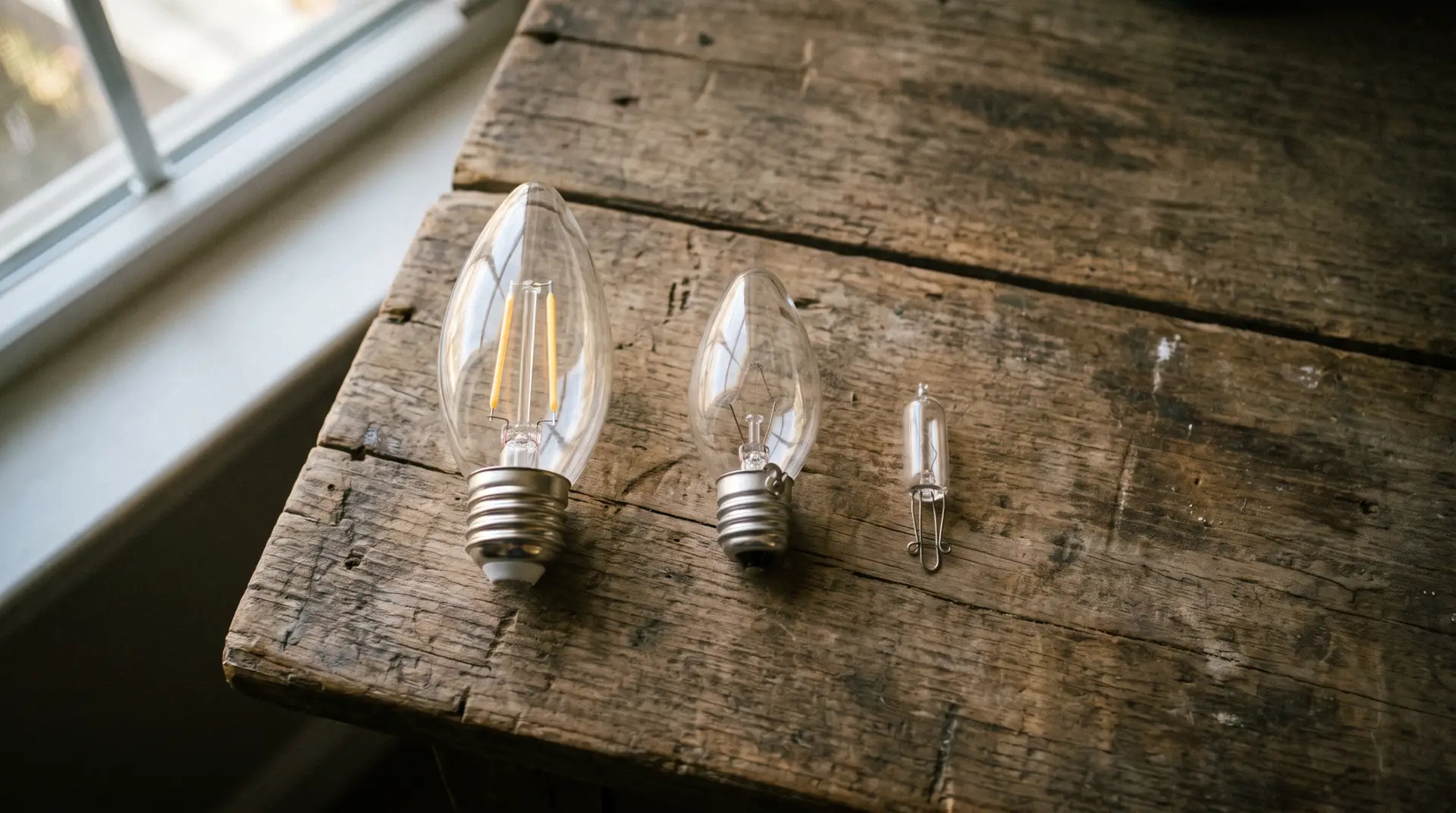
Walk into any big-box store in October and you will find two dozen boxes promising the same thing. Strip off the packaging and there are really six shapes doing the work on a residential display. What separates them is bulb diameter, socket spacing on the wire, and lens style.
Spacing changes the look as much as bulb size does. A C9 on 12-inch centers gives you a rhythm of distinct points; the same bulb on 8-inch centers reads almost as a solid line and runs about 50 percent more in bulb cost per foot. Lens style shifts the character too. Smooth transparent bulbs sparkle and show the filament, faceted bulbs scatter light in every direction, and opaque ceramic bulbs glow like the painted glass sets your grandparents hung.
- C9, large, E17 intermediate base: About 2.5 inches tall with a 1-inch face. The classic roofline bulb. Standard socket wire runs 12-inch spacing, though 8-inch and 15-inch spools exist. Incandescent versions pull 7 watts each; LED retrofits pull roughly 0.5–1 watt. If your house sits back from the street or carries a second story, this is the bulb that still reads from the curb at dusk.
- C7, medium, E12 candelabra base: Roughly 1.5 inches tall and about two-thirds the visual weight of a C9. Incandescent C7 draws 5 watts; LED versions draw close to 0.5 watt. C7 looks right on single-story ranch homes, porch ceilings, window frames, and fence caps, anywhere the viewer stands 20 or 30 feet away instead of a hundred.
- 5mm wide-angle mini LED: A small conical lens, usually on 4-inch or 6-inch spacing with 70 or 100 bulbs per strand. The lens spreads light sideways, so a wrapped trunk looks genuinely lit rather than dotted. These are the workhorse for pear and oak trunks, columns, and handrails, and they take abuse far better than glass.
- T5 and M5 mini LED: Same small footprint as the 5mm but with a rounded, torpedo-shaped lens that glows more softly and reads closer to old incandescent minis. Good for bushes, wreaths, garland, and anywhere you want warm light instead of sharp points. Usually 4-inch spacing, 70 or 100 bulbs per strand, and easy to hide in foliage.
- Icicle strands: A horizontal wire with staggered drops hanging 9–18 inches, typically 150 to 300 bulbs per set. They only look right along a straight, unbroken eave or gutter line. On a cut-up roofline with dormers, gables, and returns, the drops finish at mismatched heights and the whole run reads as clutter instead of design.
- G40 and G50 globe strings: Round bulbs 1.5 to 2 inches across on 12-inch or 18-inch spacing, usually built on heavy patio-style cord. These are cafe lights that happen to work at Christmas. Strung over a covered porch or a back patio in Tech Terrace they look great. Run along a roofline they read as too casual for the season.
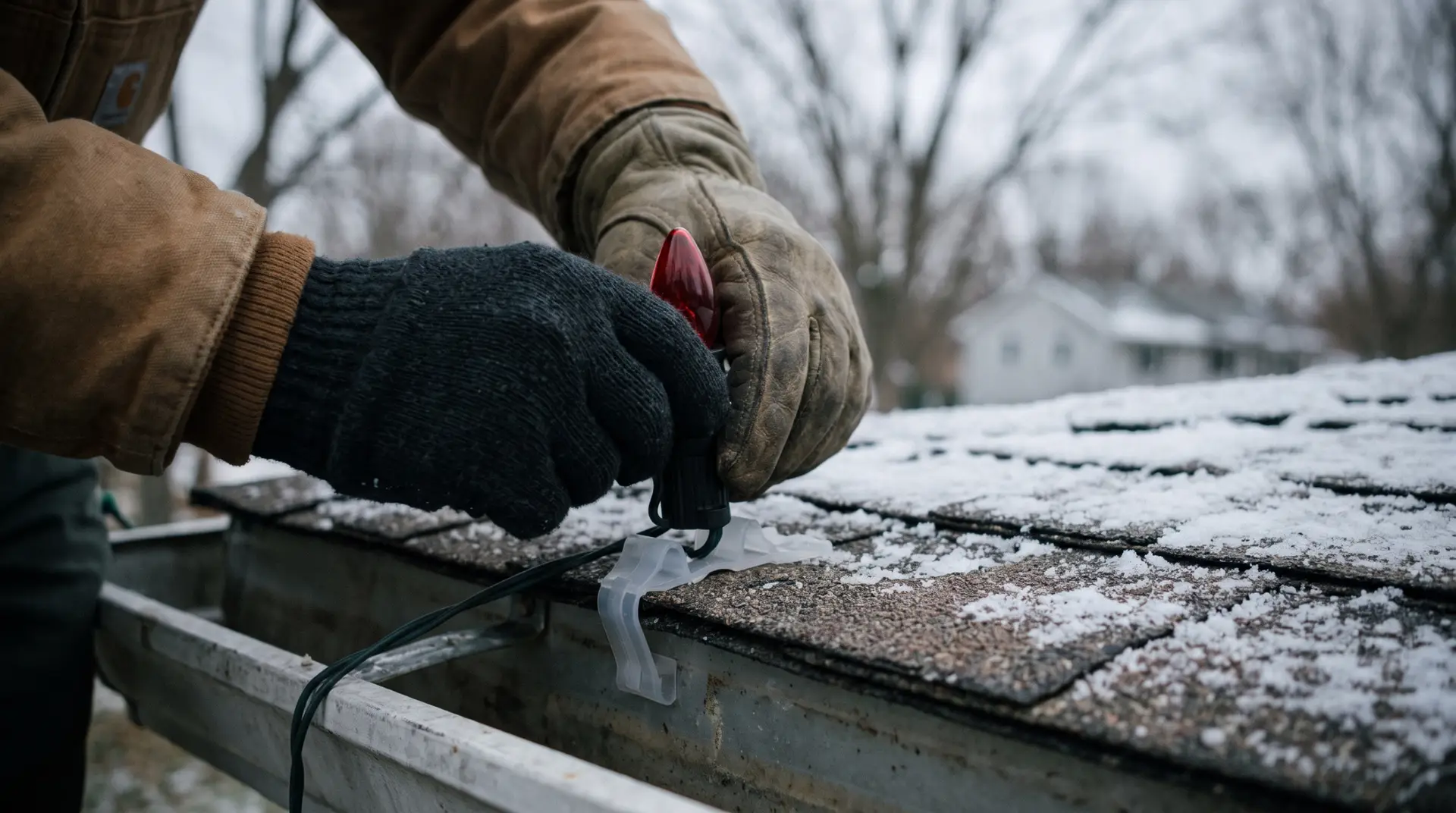
One thing the box will not tell you: retail strands and commercial socket wire are different products. Retail strings use thin sealed wire and fail as a unit when a section quits. Professional crews build runs from SPT-1 or SPT-2 spool wire and press sockets on at measured spacing, so a dead bulb becomes a 30-second swap on a ladder instead of a whole strand replacement in the middle of December.
LED vs Incandescent: Wattage, Amp Draw, and Strands Per Circuit
Wattage is where this gets practical. An incandescent C9 pulls 7 watts, so a 25-bulb string draws 175 watts. A standard 15-amp household circuit handles 1,800 watts, and good practice loads a continuous circuit to no more than 80 percent, or about 1,440 watts. That works out to roughly 8 strings, or 200 bulbs, on one exterior outlet. Most Lubbock homes have exactly one weatherproof receptacle out front.
Switch to LED C9 and the same bulb pulls about 0.5 to 1 watt. Two hundred LED C9 bulbs draw somewhere near 140 watts total, less than a tenth of the incandescent load. The real ceiling stops being the breaker and becomes the manufacturer’s end-to-end connection limit, which typically runs 3 to 5 strings for incandescent and 40 or more for LED. That is the difference between snaking extension cords around the house and plugging an entire roofline into one outlet.
Operating cost follows the same math. Two hundred incandescent C9 bulbs burning six hours a night for 45 nights use roughly 378 kWh, which lands near $49 at typical South Plains electric rates. The LED equivalent uses about 38 kWh, or five dollars for the season. Factor in rated bulb life near 25,000 hours for LED against 1,500 to 3,000 for incandescent, and the incandescent bulbs you buy this year are the bulbs you replace next year.
The one place LED gives ground is color consistency. Warm white LED bulbs land anywhere from 2400K to 3000K depending on the production run, and two boxes bought a year apart can read noticeably different on the same fascia. Buy your bulbs in a single order, keep a dozen spares from that lot, and you will not end up with a patchwork line in year three.
What West Texas Weather Does to Each Bulb
Bulb choice on the High Plains is a different conversation than it is in Dallas. Lubbock sits at 3,200 feet with almost nothing upwind to slow the air down, and a December cold front can drop the temperature 40 degrees in an afternoon. Add blowing dust off the cotton fields and some of the hardest water in the state, and several differences between christmas light bulb types stop being cosmetic and start being about whether the display survives to New Year’s.
Wind: What 40 mph Gusts Do to a Display
Gusts over 40 mph are routine here from November through March, and they punish anything hanging loose. Icicle strands are the first casualty. The drops whip, tangle around each other, and by New Year’s half of them are twisted into ropes. C9 and C7 bulbs sitting tight against a shingle line on all-in-one clips barely move, because the socket wire gets pinned every 12 inches and no slack is left to catch air. If you want icicles in Shallowater or out toward Idalou where there is no windbreak, plan on somebody going back up to comb them out mid-season. We also zip-tie the transition points where a run leaves the roof for a downspout, since that free span is exactly where wind gets a grip.
Temperature Swings and UV on Wire and Lens
A 68-degree afternoon followed by a 24-degree night is an ordinary December here, and PVC wire jacket does not enjoy that cycle. Cheap retail strands go brittle inside two seasons, then split at the socket where the copper enters. Commercial SPT-1 and SPT-2 wire uses a UV-stabilized jacket rated for outdoor exposure, and it will run five to seven seasons on the South Plains before the insulation chalks. Bulb material matters too. Smooth polycarbonate LED bulbs hold their color under our UV load better than older painted glass C7 and C9 bulbs, which fade to washed-out pastel after two or three Decembers of full afternoon sun on a south-facing run.
Blowing Dust and Hard Water on the Lens
Blowing dust puts a film on everything within a week of going up. On smooth transparent bulbs that film cuts output and dulls the sparkle you paid for, which is one reason faceted and opaque ceramic bulbs hold their look better through a dusty season. Anything mounted low takes the worst of it. Bushes and tree wraps within reach of a sprinkler head pick up hard-water spotting from our high-calcium groundwater, and that mineral haze will not rinse off with a garden hose. If you plan to run mini strands in planting beds, shut off that irrigation zone or move the heads before the lights go up in November.
Where the Different Christmas Light Bulb Types Belong on a Lubbock House
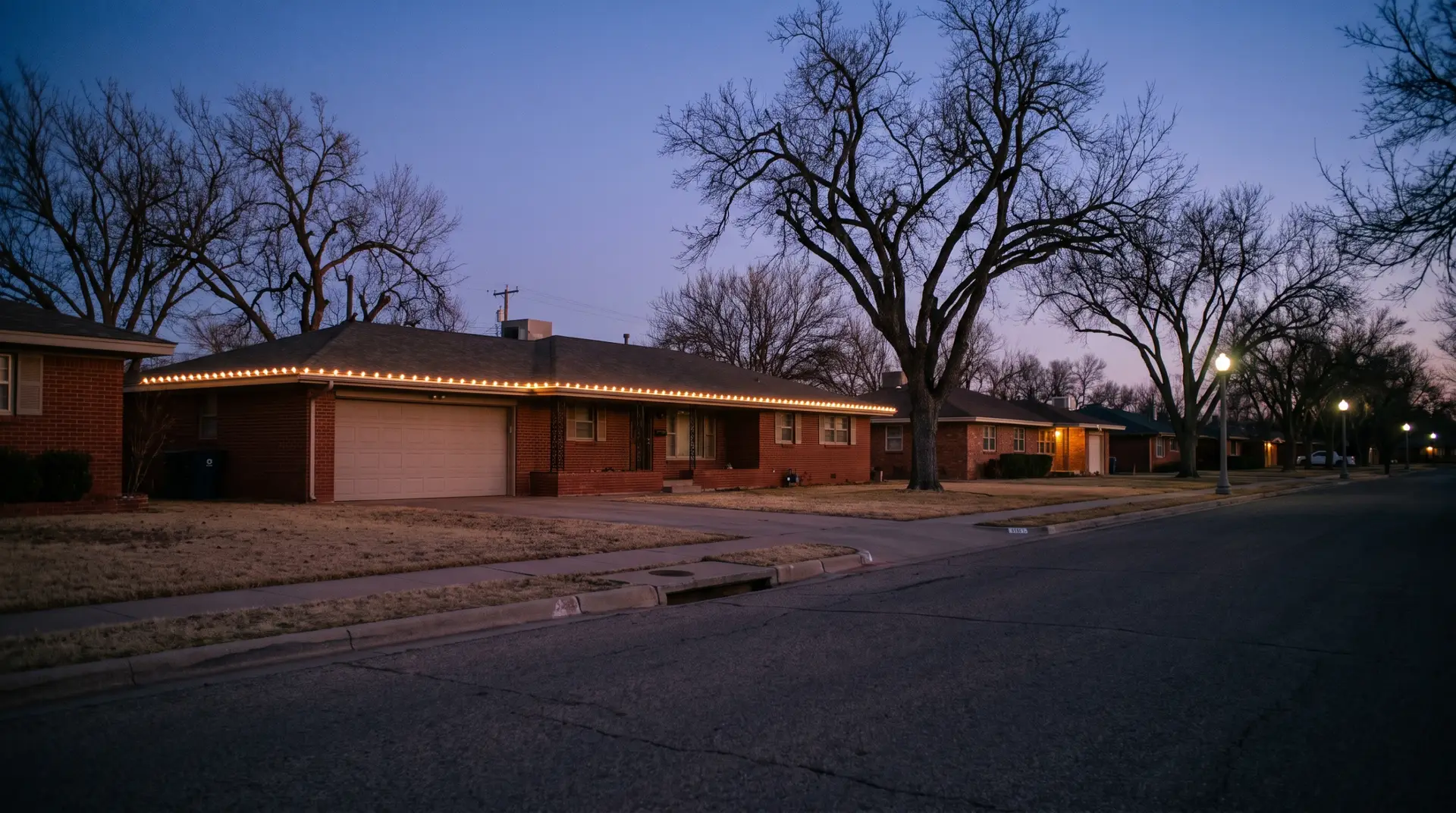
Start from the street. Walk out to the curb, or across it, and look at your house the way a driver at 25 mph sees it. Two-story homes and anything set back more than 60 feet from the road want C9. On a single-story ranch with a shallow setback, C7 gives you the same clean roofline without bulbs looking oversized on a low fascia. That one judgment call settles most of the debate about christmas light bulb types before you price a single bulb.
Then work down the house. The roofline and any strong horizontal gets the large bulb. Columns, porch rails, and trunk wraps get 5mm wide-angle minis, because a small bulb on 4-inch spacing reads as a line of light rather than a string of dots when you are standing 10 feet away. Bushes and wreaths get T5 minis. Windows can go either way, though C7 outlining a big front window in Tech Terrace looks deliberate in a way mini lights never do. If you want to see how these pieces assemble into a full design, our guide to Christmas light ideas and design trends for Lubbock homes walks through complete looks room by room and elevation by elevation.
Whatever you hang, keep the electrical side honest. Use strands and cords rated for outdoor use, plug into a GFCI-protected exterior receptacle, and never chain more strands end to end than the manufacturer allows. The Electrical Safety Foundation International holiday safety guidance covers the outdoor-rating and connection rules people skip most often. Do not staple through wire, and do not drive a nail into a shingle to hold a clip.
Final Word: Match the Bulb to the House, Not to the Price Tag
The cheapest box on the shelf in October is almost always 100-count retail mini lights, and that is exactly why so many Lubbock rooflines look thin from the street. Minis were never designed to outline a roof. They were designed to wrap something you stand close to. Getting christmas light bulb types right comes down to matching bulb size to viewing distance, then matching wire and clips to our wind.
If you are buying your own, buy commercial grade: LED C9 or C7 bulbs, SPT-1 socket wire cut to your measured roofline, all-in-one shingle and gutter clips at 12-inch spacing, and enough spare bulbs from the same lot to carry you three seasons. Expect to spend more the first year and almost nothing after that. If you would rather skip a Saturday on a ladder in a 35-degree north wind, we handle measurement, bulbs, install, mid-season service, takedown, and storage. Compare that against a do-it-yourself build in our breakdown of professional Christmas light installation cost in Lubbock, or see what is included on our Christmas light installation service page. Either way, book before Halloween. Every good crew in town fills up by the second week of November.
Frequently Asked Questions About Christmas Light Bulb Types
Sizing, spacing, and power questions we field every November across Lubbock and the South Plains
Size and base. A C9 stands about 2.5 inches tall with a 1-inch face and screws into an E17 intermediate socket. A C7 is roughly 1.5 inches tall on a smaller E12 candelabra base. Both use the same strawberry shape, so a C7 reads like a scaled-down C9. Choose C9 when the viewer is far away or the house is tall, and C7 when the run sits close to eye level, such as porch trim or window outlines.
LED, in almost every case. An LED C9 pulls about 0.5 to 1 watt against 7 watts for incandescent, so you can run 40 or more strands end to end instead of three to five, and a full roofline costs a few dollars to operate for the season. LED bulbs are also polycarbonate rather than glass, which matters when a 50 mph gust drives a bulb into a gutter edge. The tradeoff is color consistency between production runs.
Twelve inches is the standard and the right answer for most homes. It gives a clear rhythm of individual points that still reads as a continuous line from the street. Eight-inch spacing produces a denser, almost solid line and looks strong on large two-story elevations, but it raises bulb count and cost by about half. Fifteen-inch spacing saves money and works on very long, simple runs, though it can look sparse on a short front elevation.
Anything pinned tight to a surface. C9 and C7 bulbs on socket wire clipped every 12 inches have no slack to catch air, so they ride out 40 to 50 mph gusts without moving. Mini strands wrapped snug around a trunk or rail do fine as well. Icicle strands are the weak point, since the hanging drops tangle and knot in sustained wind. If you want icicles here, plan on a mid-season service visit.
Yes, and the best displays do. The rule is one bulb size per element, not one per house. Put C9 or C7 on the roofline, wide-angle 5mm minis on columns and trunks, and T5 minis in bushes and wreaths. Trouble starts when two different bulb sizes share the same continuous line, or when warm white and pure white bulbs land on the same elevation. Keep the color temperature identical across everything the eye takes in at once.