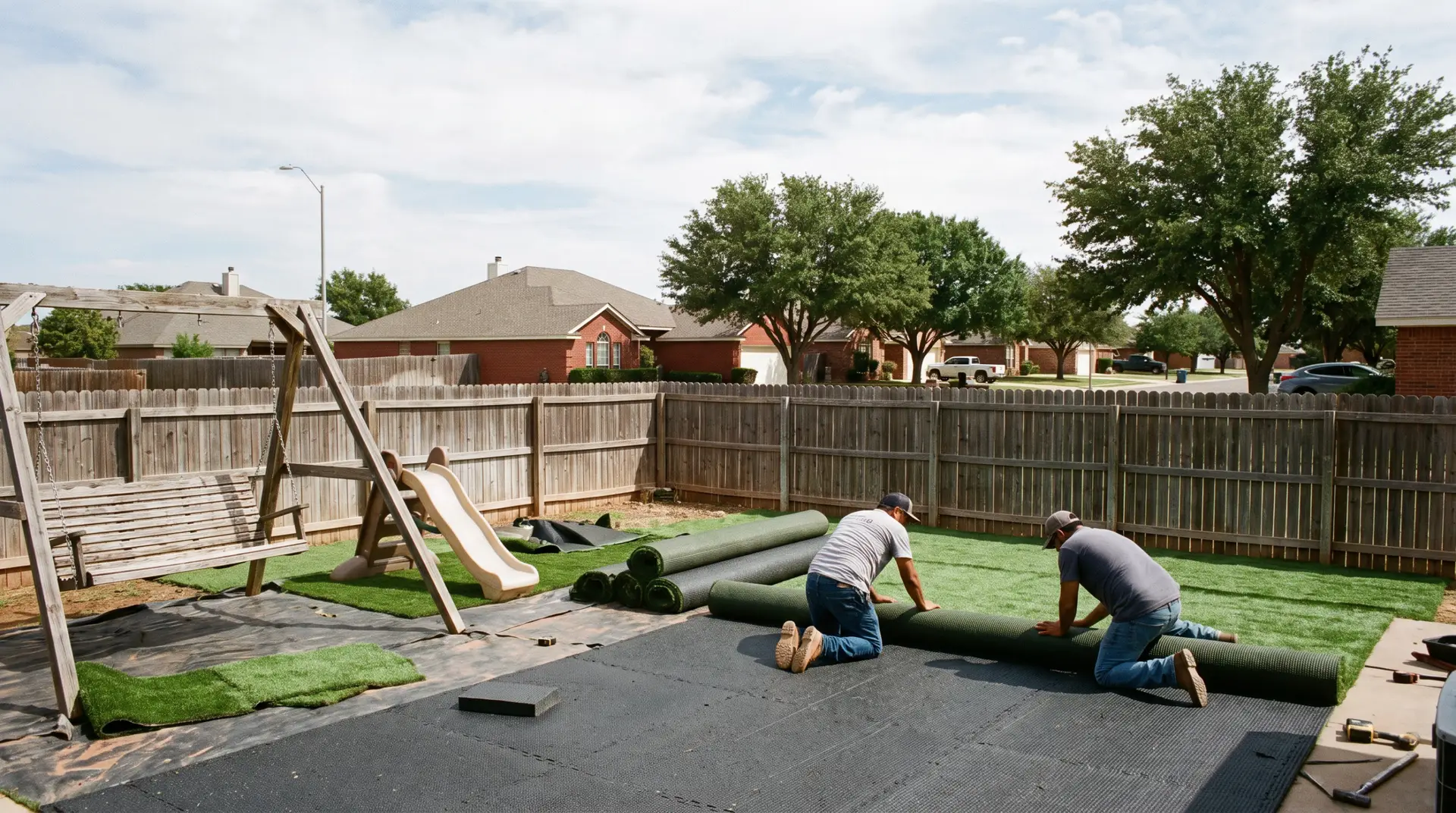
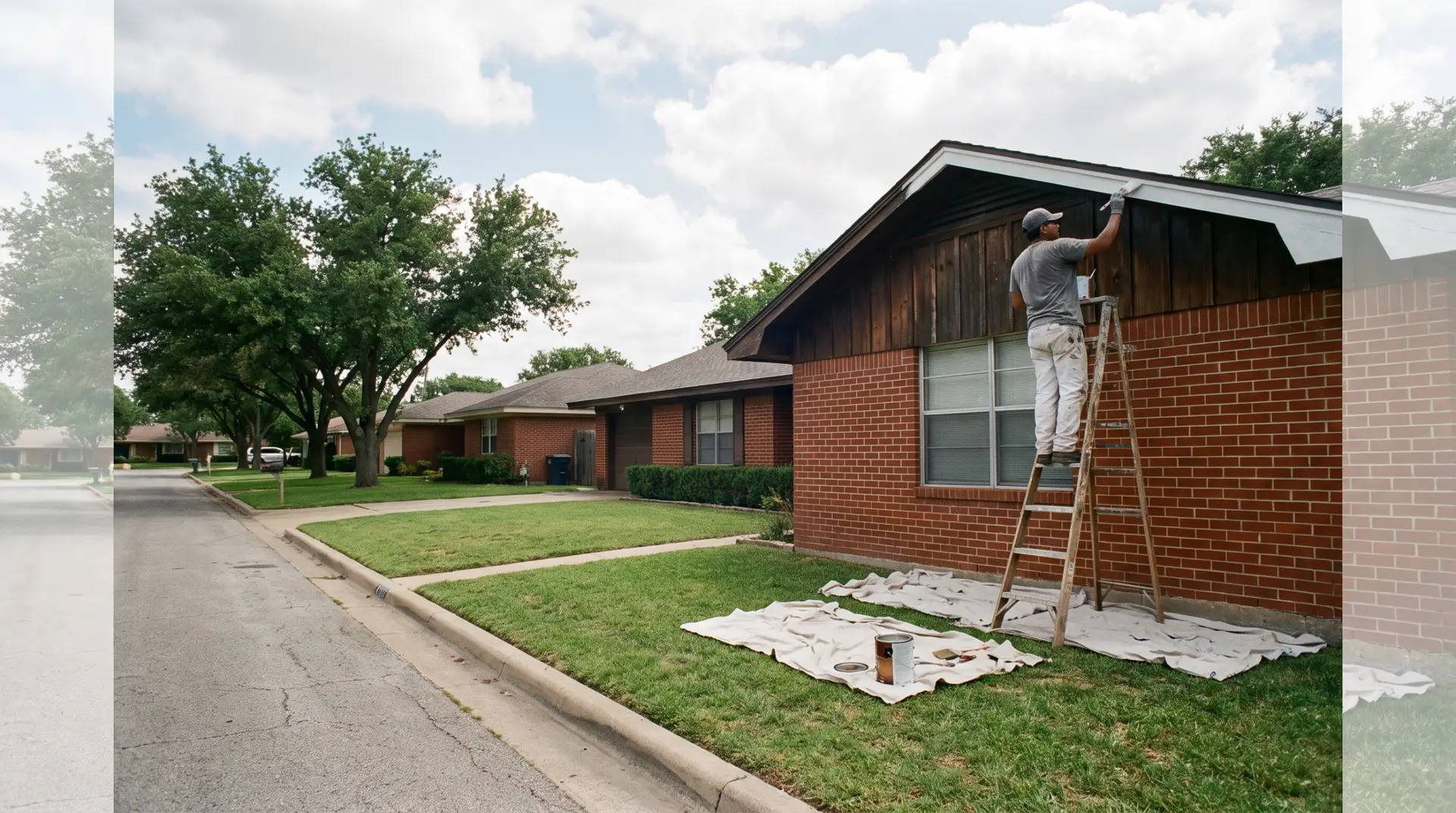
Christmas light removal is the half of the job most Lubbock homeowners never think about until the second week of January, when the wind is running 30 mph out of the southwest and the display that looked sharp on Christmas Eve is still clipped to a frozen roofline. Taking a display down is not simply installation run backward. Clips turn brittle in the cold, cords stiffen up, and the same grit and sun that age a roof out here go to work on your bulbs the minute the season ends.
This guide covers when takedown should happen on the South Plains, how a crew labels and rolls strands so next November takes half the time, where to store lights so they survive a Lubbock attic in July, and what actually kills a set of C9s. If you are still working out a design, our Lubbock Christmas light design ideas guide covers the front end of the season. This one covers the back end.
On this page, a complete guide to christmas light removal in Lubbock, TX:
- Quick Answer: When Should Christmas Light Removal Happen in Lubbock?
- What a Professional Christmas Light Removal Visit Actually Includes
- How to Store Christmas Lights So They Survive a Lubbock Attic
- What West Texas Weather Does to Lights You Leave Up Too Long
- Safety: Why Christmas Light Removal Is the Riskier Half of the Job
- Final Word: Christmas Light Removal Should Be Part of the Service
- Frequently Asked Questions About Christmas Light Removal
Quick Answer: When Should Christmas Light Removal Happen in Lubbock?
Schedule Christmas light removal for the first three weeks of January. Most Lubbock crews start takedown routes on January 2 and work through roughly January 25, weather permitting. That window exists for a reason: the strands have only seen about six weeks of weather, the clips still release cleanly, and the roof has not yet been through the freeze-thaw cycling that loosens fasteners.
Wait until February and you are into the front edge of West Texas wind season, when sustained gusts over 40 mph shut down ladder work for days at a time. Wait until March and you are asking a crew to pull sun-baked clips off shingles at the same time hail season starts. Every week a display stays up past January adds UV exposure, adds dust in the sockets, and adds the odds that a strand comes down in pieces instead of in one roll. A booked takedown date, set at the same time you book the install, is the single easiest way to avoid all of it.
Book takedown for January 2 through January 25. At that point strands have seen only six weeks of weather, clips release without cracking, and crews still have calm-morning windows before West Texas wind season closes the roof to ladder work in February.
What a Professional Christmas Light Removal Visit Actually Includes
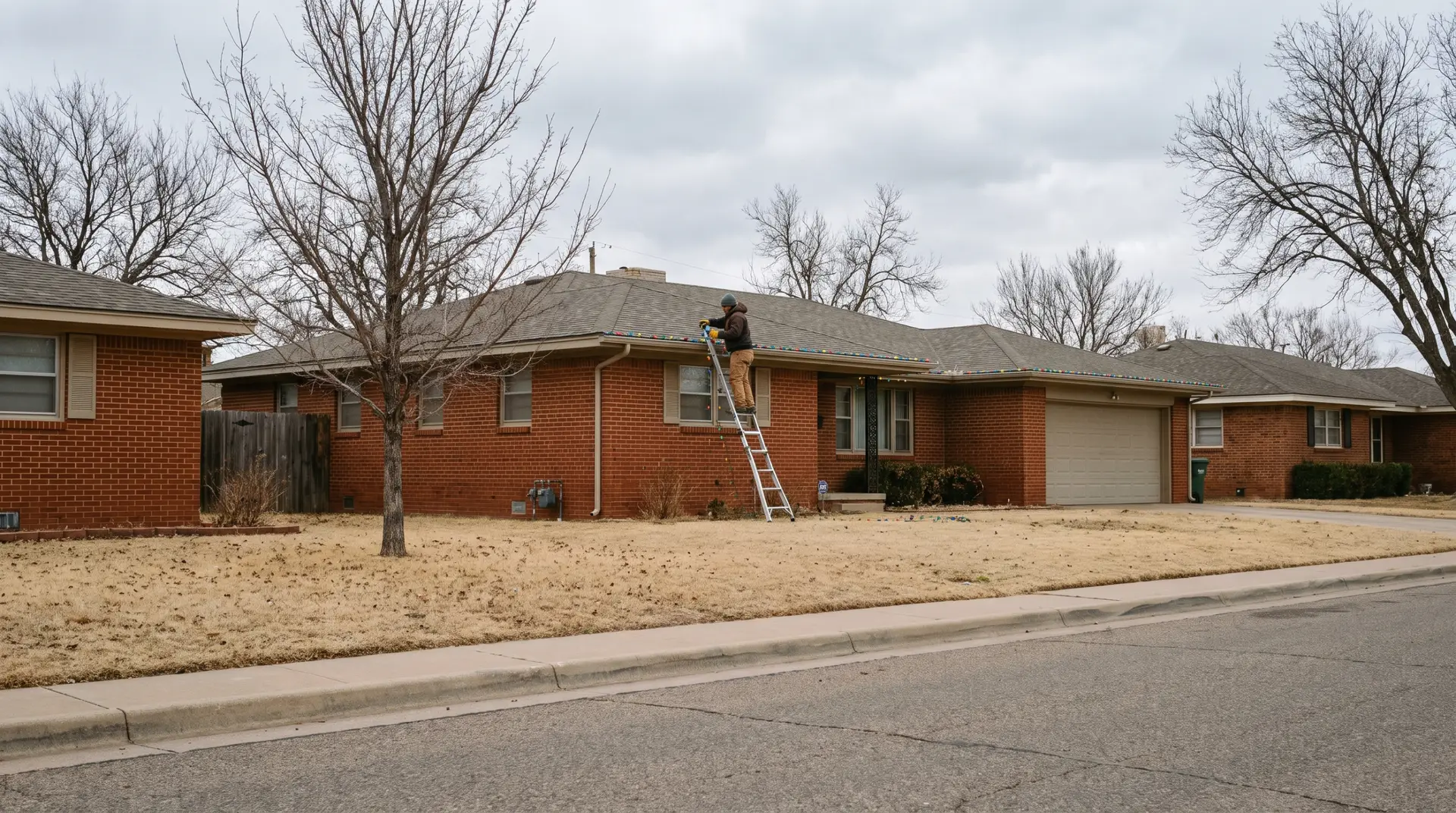
Homeowners often assume takedown is one guy yanking strands into a garbage bag. A crew that plans to hang the same display next year works very differently, because everything they do in January decides how long the November install takes. The strands come off in the same order they went on, roofline first, then trees and columns, then ground stakes and timers.
Here is what a real takedown visit covers on a typical Lubbock home, whether that is a single-story ranch off 34th Street or a two-story in Lakeridge with three gable runs.
- Clip and fastener recovery: Every shingle tab clip, gutter clip, and column strap comes off the house. Left behind, plastic clips bake in 100-degree summer sun, go chalky, and snap into pieces you then have to pick out of gutters and flower beds in the fall.
- Section labeling: Each run gets tagged by location, not by length. “Front eave, left of chimney” is useful in November. “Strand 4” is not. On a house with eight or nine runs, labeling is the difference between a three-hour reinstall and a six-hour one.
- Bulb and socket inspection: Burned-out bulbs, cracked lenses, and corroded sockets get pulled and noted while the strand is in hand. Finding a dead section in January costs nothing. Finding it on a ladder the week of Thanksgiving costs a return trip.
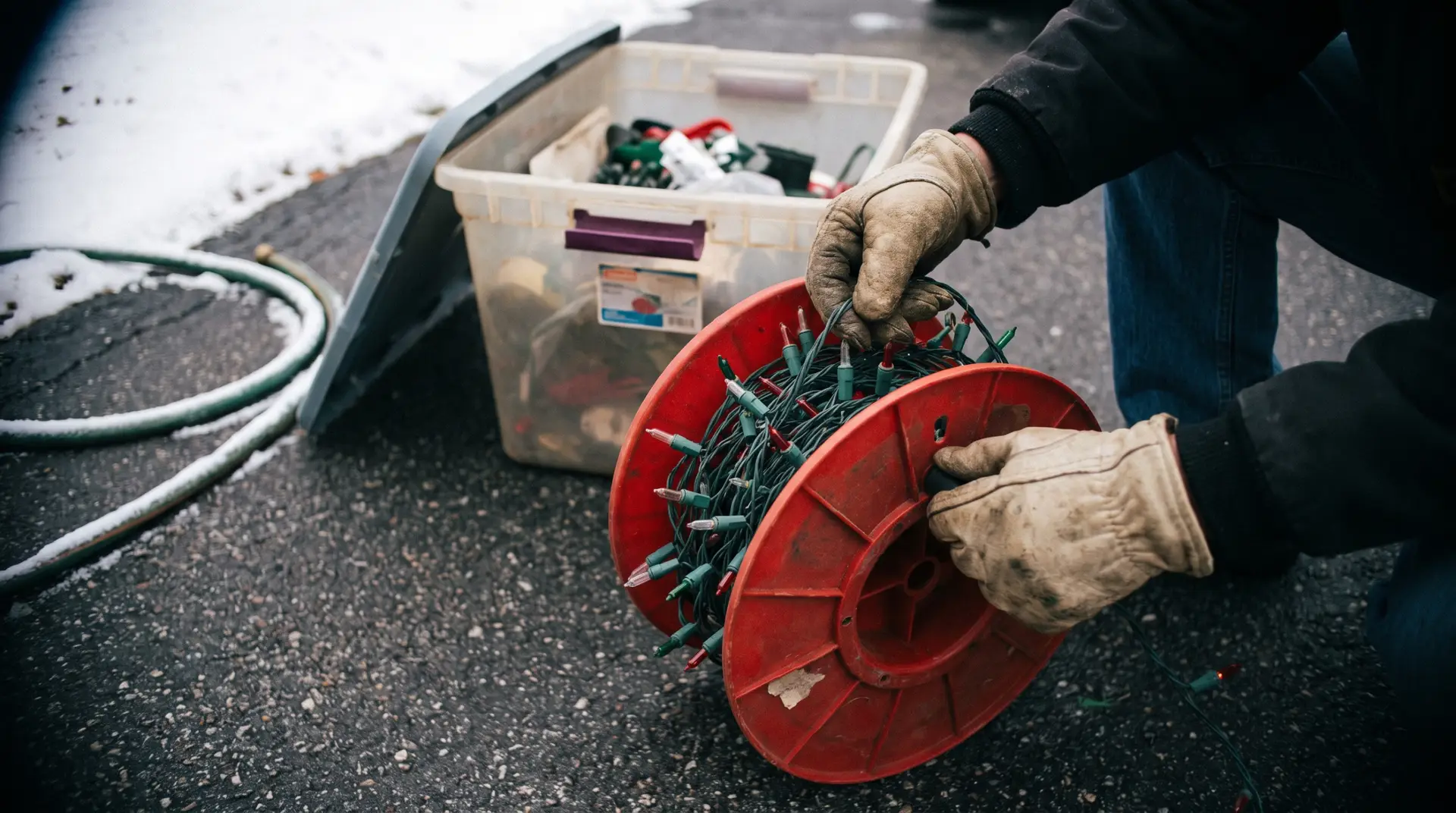
- Reel or spool winding: Strands go onto reels or figure-eight coils rather than into a tangle. A coiled C9 line lays flat next season instead of holding a corkscrew memory that fights you the whole way down the eave.
- Timer, cord, and clip hardware: Extension cords, stake timers, and photocells come down with the lights and get tested. Outdoor timers are the most common single-point failure in a display, and they fail quietly in storage.
- Roof and gutter walk: A quick look at shingles, gutter seams, and flashing while the crew is already up there. January is when a lifted shingle or a separated gutter joint is cheap to catch, well before spring storms find it first.
One caveat on labeling: it only pays off if the labels survive storage. Paper tags and masking tape turn to dust in an attic that hits 140 degrees in August. Use plastic tags, cable markers, or a paint pen on the plug end. That small habit is what makes stored sets genuinely reusable rather than technically reusable.
How to Store Christmas Lights So They Survive a Lubbock Attic
Storage is where most displays actually die, not the roof. A Lubbock attic swings from roughly 20 degrees on a January night to somewhere north of 130 degrees on an August afternoon, and it does that every year. PVC insulation on light strands softens at the top of that range, then hardens and cracks on the way back down. Do that four or five summers in a row and the jacket splits at every bend point.
If you have a conditioned option, use it. A garage cabinet, an interior closet, or a shelf in a utility room beats an attic every time, even if the attic is more convenient. When the attic is the only choice, get the boxes off the decking and onto a raised shelf near the access hatch, where temperatures run cooler than the ridge, and keep them away from can lights and flue pipes.
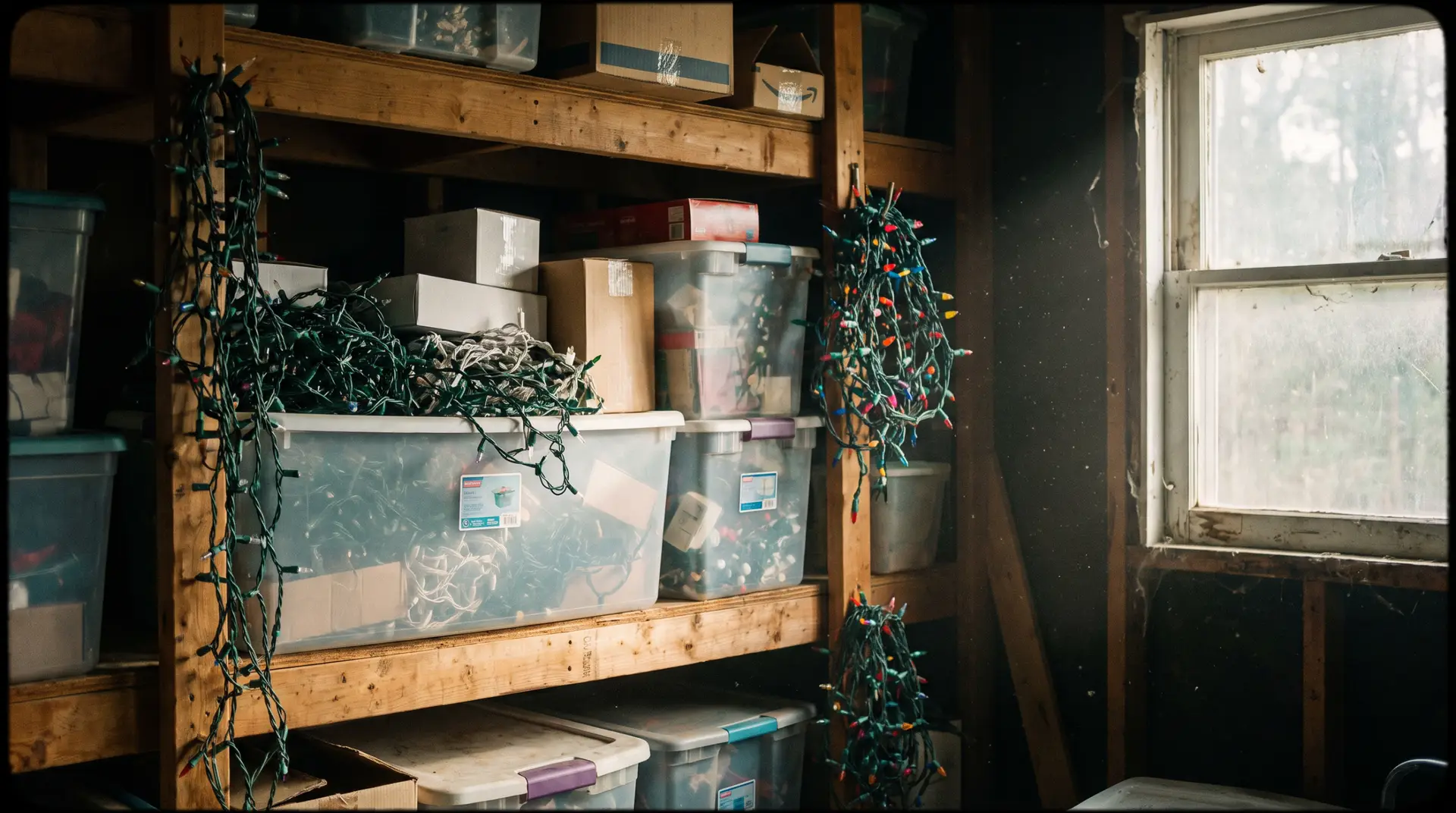
Containers matter more than people expect. Cardboard is the wrong answer here because it holds humidity after a spring storm, collapses under stacking, and gives mice a reason to move in. Rigid plastic totes with latching lids, sized so a single person can carry one down a pull-down ladder, work best. Label the outside of the tote with the section names inside so nobody opens four bins looking for the porch columns.
How you coil matters as much as where you store. A strand wound tight around a rectangular reel holds a sharp bend at every corner, and after a summer in the heat those bends set permanently. Use a round reel or a loose figure-eight coil about the width of your forearm, and secure it with hook and loop straps rather than zip ties, which pinch the jacket. Keep each roof section on its own reel. Mixing two runs on one reel saves a little space and costs you twenty minutes of sorting on the ladder in November.
Rodents deserve their own line. Attic mice chew wire jackets for nesting material, and a chewed strand is a fire risk you cannot see from the ground the next December. Latching totes solve most of it. If you have had mice before, that is worth mentioning to whoever handles your takedown so the strands get an inspection before they go back up.
What West Texas Weather Does to Lights You Leave Up Too Long
Every year a few displays stay up into spring, usually because the homeowner ran out of weekends or the ladder work looked unappealing in January. The lights almost always come down in worse shape than they went up, and the reasons are specific to this part of Texas rather than general wear. Lubbock sits above 3,200 feet with thin, dry air, heavy spring wind, and enough airborne dust to sand a finish. Each of those does a different kind of damage.
Ultraviolet Exposure at 3,200 Feet
Altitude and clear skies mean the UV load on the South Plains runs noticeably higher than it does at sea level, and it does not take summer to matter. A red C9 lens left on a south-facing eave from December through April will visibly shift toward orange, and the color loss is permanent. Cord jackets go the same way, chalking on the sun side while the shaded side still looks new. Once a jacket chalks, it has lost plasticizer, and the next time you coil that strand around a reel it cracks at the tightest bend. Six weeks of December sun is fine. Five months of it is what ends a set of commercial-grade lights years earlier than it should.
Blowing Dust and Grit in the Sockets
Spring on the caliche plains means blowing dust, and that dust is fine enough to work past a bulb base and into the socket. It packs around the contacts, holds moisture after a rain, and starts low-grade corrosion on the brass. The symptom shows up the following winter as a section that flickers or refuses to light even after you have swapped every bulb in it. Cleaning corroded sockets on a 100-foot run is not realistic, so the strand gets replaced. Pulling the display in January keeps the sockets out of March and April entirely, which is the single biggest reason takedown timing matters more here than in Dallas or Houston.
Freeze-Thaw Cycling and Brittle Clips
Lubbock runs a lot of freeze-thaw swings, often a hard freeze overnight and 60 degrees by afternoon in the same 24 hours. Plastic shingle clips contract and expand through every one of those cycles while gripping an asphalt tab that is doing the same thing. By March, a clip that released cleanly in January snaps at the hook instead, and the broken half stays wedged under the shingle. Pulling it out is when granule loss and lifted tabs happen. The damage is minor on any one clip and adds up fast across two hundred of them.
Safety: Why Christmas Light Removal Is the Riskier Half of the Job
Installation happens in November on dry shingles in 60-degree weather. Takedown happens in January, often on a roof that had frost on it two hours earlier, with cold hands and a north wind. That is a meaningfully different job, and the injury numbers for holiday decorating reflect it. The Electrical Safety Foundation International publishes seasonal guidance on decorating, cords, and ladder work that is worth reading before anyone goes up, available through their holiday safety resource center.
The specific West Texas problem is wind. A 24-foot extension ladder is a sail, and a 25 mph gust against a homeowner reaching sideways for one last clip is how people come off roofs. Crews here plan takedown around morning windows for that reason, because the South Plains typically runs calmer before about 11 a.m. and builds through the afternoon. If you are doing this yourself, that is the pattern to copy: start early, quit when it picks up, and never work a windward eave.
Cords are the third piece. By January, outdoor extension cords have sat through six weeks of sun, cold, and moisture, and the failure point is almost always the connection where two cords meet at a downspout or a shrub. Water gets in, the connection corrodes, and the breaker either trips or, worse, does not. Pull cords with the lights, dry them, coil them loosely, and store them in the same tote as the run they served rather than in a pile with everything else.
Frost is the other one. Composition shingles that read dry from the driveway can hold a thin film of frost in shade until mid-morning, and shaded north slopes stay slick the longest. Roof pitch matters too. Anything over a 6:12 on a two-story is a job for someone with fall protection and roof experience, not a homeowner with a borrowed ladder. That is a real part of the value in having Christmas light removal handled by the same crew that installed the display: they already know the pitch, the access points, and where the soft decking is.
Final Word: Christmas Light Removal Should Be Part of the Service
The best test of a Lubbock light company is what happens in January, not December. Anyone can hang a display when the weather is nice and the customer is excited. Coming back on a cold morning to pull two hundred clips, label eight runs, coil the strands onto reels, and haul labeled totes into your garage is the part that decides whether next season is easy or a rebuild. Takedown, labeling, and storage handling belong in the quote from the start, not as a January upcharge.
If you want the numbers side of that, our breakdown of professional Christmas light installation cost in Lubbock shows how removal factors into a full-season price. And since a crew is already on your roof in January, it is a good moment to pair takedown with the items on our winter roof maintenance checklist for Lubbock homeowners.
Elite Roofing & Exterior handles design, install, takedown, and storage as one package for homes across Lubbock, Wolfforth, Shallowater, and Frenship. If you would rather spend the second week of January doing anything other than roof work, see our Lubbock Christmas light installation service and get a takedown date on the calendar with your install.
Frequently Asked Questions About Christmas Light Removal
Timing, storage, cost, and what happens to a display left up through a West Texas spring
There is no city ordinance setting a date, so the real deadline is weather. Aim to have everything down by the end of January. February is when West Texas wind season starts closing safe ladder windows, and by March you are competing with the front edge of hail season for a crew's calendar. Displays left past March pick up UV fading, dust in the sockets, and brittle clips that break shingle tabs on the way off. Late January is the practical cutoff for getting strands down in reusable condition.
Most Lubbock companies build takedown into the seasonal price rather than billing it separately, so a full-service quote already covers install, mid-season service calls, removal, and storage handling. When removal is priced on its own for a display someone else installed, expect it to run roughly a third to half of what the install cost, since the labor is similar but the setup is less. Ask specifically whether takedown, clip recovery, and labeled storage are included before you compare two bids side by side.
You can, and some Lubbock homeowners do, but you will replace them far sooner. Commercial-grade C9 sets are built for seasonal outdoor use, not for twelve months of West Texas UV, blowing dust, and freeze-thaw cycling. Year-round exposure fades colored lenses, chalks cord jackets, and corrodes sockets from the inside. The clips are the bigger problem: sun-baked plastic snaps under a shingle tab instead of releasing, and prying out the broken half scuffs granules off the shingle surface.
If you have any conditioned space at all, use it instead. A garage cabinet or interior closet spares the strands the 130-plus degree August attic swing that softens and then cracks PVC insulation. When the attic is the only option, use rigid latching totes rather than cardboard, keep them on a raised shelf near the hatch where it runs cooler, coil strands on reels instead of folding them, and label the outside of each tote by roof section so nobody opens four bins looking for the porch run.
Not if it is done in the right window with the right clips. Shingle tab clips and gutter clips are designed to release without fasteners, and in January they still do. Damage shows up when strands are stapled or nailed, when clips are pried off after months of sun have made them brittle, or when someone walks a steep roof in the wrong shoes on a cold morning. A crew that installed the display already knows the pitch, the access points, and which sections of decking to stay off.