Gutter installation is an easy line item to cut from a Lubbock roofing budget, and it is one of the worst ones to skip. We only average about 19 inches of rain a year here, which convinces a lot of homeowners that gutters are a wet-climate problem. The trouble is not the annual total. It is that most of our rain arrives in short, hard thunderstorms that dump an inch or more in under an hour, straight onto expansive clay sitting against a slab foundation.
A proper gutter installation moves that water out and away before it can soak the soil at the perimeter. On the South Plains, where the ground swells and shrinks with every wet-dry cycle, that is a foundation issue more than a yard drainage one. Here is what it costs, what sizes actually work, and how the job should be done.
On this page, a complete guide to gutter installation in Lubbock, TX:
- Quick Answer: What Gutter Installation Costs in Lubbock
- Gutter Sizes, Profiles, and Materials to Choose From
- What Drives a Gutter Installation Quote Up or Down
- Why Gutters Matter More on the South Plains Than the Rain Total Suggests
- How Much Water a Lubbock Roof Sheds, and How a Proper Install Handles It
- Final Word: The Job Is Not Finished at the Downspout
- Frequently Asked Questions About Gutter Installation in Lubbock
Quick Answer: What Gutter Installation Costs in Lubbock
Expect $6–$10 per linear foot for one-piece 5-inch K-style aluminum formed on site, $9–$14 per linear foot for 6-inch aluminum, and $10–$16 per linear foot for painted steel. A typical Lubbock home has 150 to 200 linear feet of gutter, which puts a straightforward 5-inch aluminum job around $1,200–$2,000 installed, downspouts included.
For most West Texas homes we recommend 6-inch K-style with 3×4 downspouts rather than the builder-standard 5-inch with 2×3. A 6-inch trough carries roughly 40 percent more water, and a 3×4 downspout moves close to twice what a 2×3 does. That difference is what handles a cloudburst instead of overshooting the gutter entirely. The upgrade usually adds $400–$700 on an average house, and it is the single best money in the whole gutter installation.
Aluminum gutters roll-formed on site run $6 to $10 per linear foot in Lubbock, or roughly $1,200 to $2,000 for an average home. Upgrading to 6-inch trough with 3×4 downspouts adds $400 to $700 and handles our hard, fast thunderstorms far better.
Gutter Sizes, Profiles, and Materials to Choose From
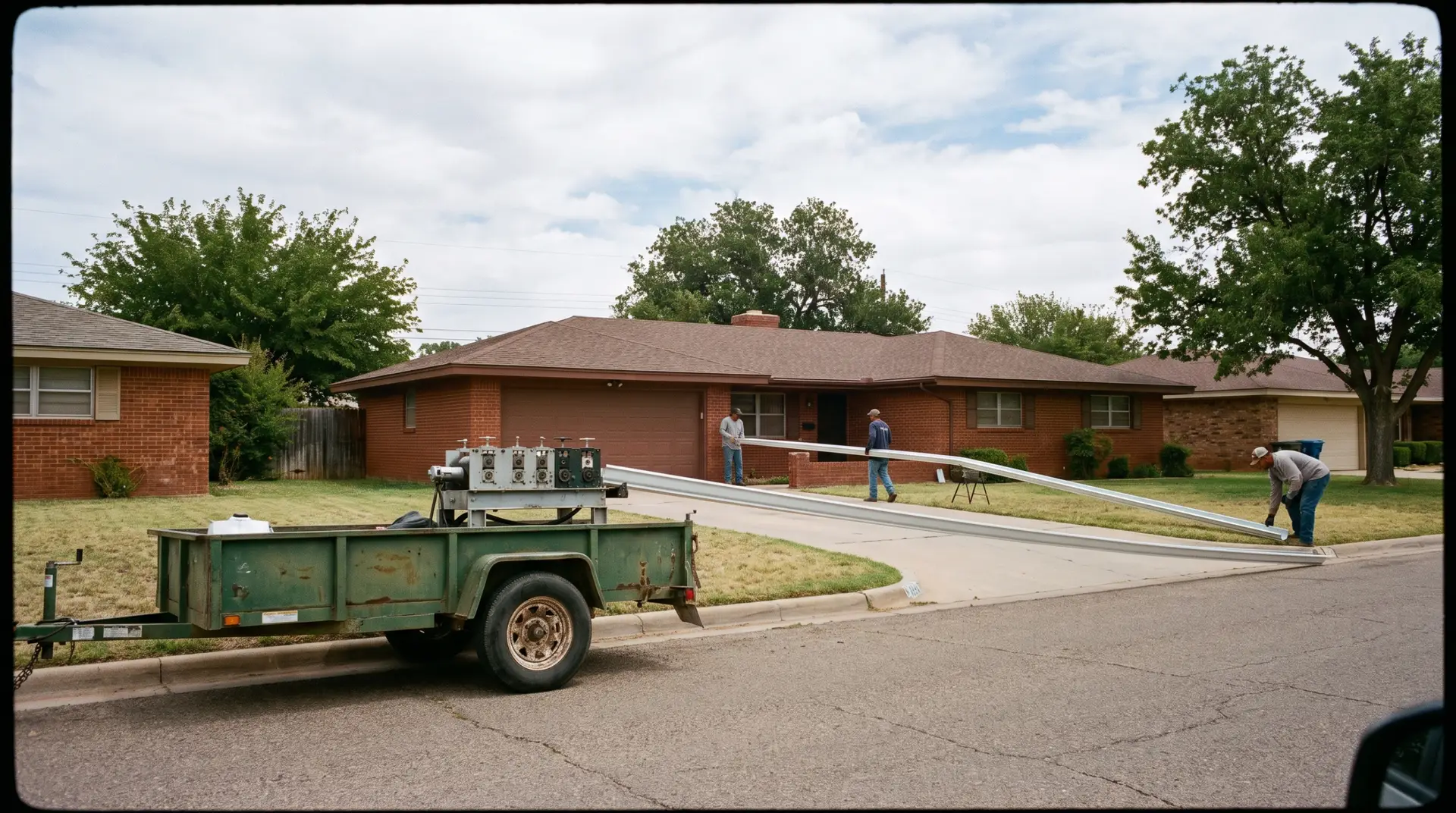
Almost every residential gutter in Lubbock is K-style aluminum, formed on site from a coil by a roll-forming machine on a trailer. That one-piece construction matters because joints are where gutters leak first, and a single continuous run down a 40-foot fascia has no seam except at the corners and outlets.
Where you have real choices is trough size, downspout size, metal thickness, and profile. Those four decide capacity, wind resistance, and how the gutter looks against your fascia. Sectional gutters sold in ten-foot sticks at home centers cost less up front and are not worth it on a house here, because every joint becomes a future leak under our temperature swings.
Profile is mostly an appearance decision. K-style, the shape with the ogee front face that looks a little like crown molding, is on the overwhelming majority of Lubbock homes and carries more water than a half-round of the same nominal size. Half-round reads correct on older architecture and sheds debris better. Fascia gutters, a boxy profile that doubles as trim, show up on some newer builds with no separate fascia board.
- 5-inch K-style, the builder standard: Handles most simple rooflines with moderate pitch and reasonable downspout spacing. It is what came on the majority of Lubbock homes built before 2015. Fine on a single-story ranch with short roof runs, undersized on a two-story with large drainage areas feeding one corner. Least expensive option at $6–$10 per linear foot installed.
- 6-inch K-style, the West Texas upgrade: Roughly 40 percent more capacity than 5-inch and the profile most steep or complex roofs should carry. Pairs with 3×4 downspouts. Costs $9–$14 per linear foot. If you have a valley dumping onto one section of gutter, or a two-story roof draining onto a lower roof, this is the size that keeps water in the trough.
- Half-round gutters: A rounded trough usually seen on older or architecturally specific homes, including some of the 1930s and 1940s houses around Tech Terrace. It sheds debris better than K-style because there are no inside corners for sludge to collect. It carries less water than K-style of the same nominal width and runs $12–$25 per linear foot depending on material.
- Aluminum thickness, .027 versus .032: The gauge nobody quotes unless you ask. Standard .027 aluminum is adequate; .032 is noticeably stiffer, dents less from ladders and hail, and holds its shape better on long runs. The upcharge is small, often under a dollar per foot, and in a hail market like ours it is worth specifying in writing.
- Steel and galvalume: 26-gauge or 24-gauge painted steel resists hail dents and ladder damage better than aluminum and suits metal roof jobs where the trim already matches. It costs more at $10–$16 per linear foot, is heavier to hang, and will rust at cut edges and scratches if the coating gets compromised. Copper is available, beautiful, and rarely justified here at $25–$45 per foot.
- Downspouts, 2×3 versus 3×4: The most undersized component on most Lubbock houses. A 3×4 downspout moves close to twice the volume of a 2×3, clogs far less often with elm seeds and cottonwood fluff, and costs only a few dollars more per drop. Plan one downspout for every 30 to 40 linear feet of gutter run.
Gutter guards are a separate decision and a separate line item, usually $5–$12 per linear foot on top of the gutter. Micro-mesh performs best against our blowing dust and seed debris, while cheap foam inserts and plastic screens tend to trap fine silt and make things worse. Guards reduce cleaning frequency here. They do not eliminate it. Whatever you choose, get the guard warranty in writing and confirm it does not void the gutter or roof warranty, since some clip-under-shingle designs lift the first course and give a roofing manufacturer a reason to argue.
What Drives a Gutter Installation Quote Up or Down
Linear footage is the base, but four other things move the number. Height comes first: a two-story fascia takes taller ladders, more staging time, and often a second crew member, which typically adds 20 to 35 percent over the same footage at single-story height. Steep pitch does the same thing.
The second is corners and outlets. Every inside and outside miter is a hand-cut, sealed joint, and a cut-up roofline with six or eight corners costs meaningfully more than a simple rectangle with four. The third is fascia condition. If the existing fascia board is soft from an old leak, it has to be replaced before hangers go in, and that is carpentry billed separately, usually $8–$15 per linear foot for replaced fascia.
The fourth is where the water ends up. Splash blocks are included on most jobs. Buried drain lines running water 10 or 15 feet out to daylight or to a dry well are excavation work and run $15–$30 per linear foot of trench. On a house with foundation concerns, that trench is often the most valuable part of the whole project.
One more variable that catches people: color and material availability. Standard aluminum coil colors are in stock locally, but a specialty color match or a heavier gauge may be a special order with a two to three week lead time. Ask before you schedule around it.
Why Gutters Matter More on the South Plains Than the Rain Total Suggests
People move here from Houston or Dallas, look at our rainfall numbers, and reasonably conclude gutters are optional. That conclusion misses how our water arrives and what it lands on. Nineteen inches spread evenly through the year would barely matter. Nineteen inches delivered in a couple dozen intense thunderstorms, onto clay soil that has been bone dry for weeks, is a different problem entirely, and it is the reason gutter installation belongs on the list here.
Expansive Clay and the Wet-Dry Cycle
Much of Lubbock County sits on clay-rich soil that swells when it takes on water and shrinks as it dries. A slab foundation resting on that soil rides up and down with it. The damage does not come from moisture itself; it comes from uneven moisture, where one corner of the house stays wet from roof runoff while the opposite side bakes dry. Without gutters, every roof edge becomes a linear sprinkler dumping water in a narrow band right at the foundation. Getting that water 5 or 6 feet out, through downspout extensions or buried lines, keeps the soil moisture around the perimeter far more uniform.
Wind, Hail, and Hanger Spacing
Sustained spring winds over 40 mph and gusts past 60 are normal here, and a gutter is essentially a long airfoil bolted to your fascia. Hidden hangers screwed into solid wood every 24 inches is the common standard; on exposed elevations and long runs we tighten that to 18 inches. Spikes and ferrules, the old nail-through method, work loose in our wind and temperature cycling and should not be used on a new job. Hail is the other factor. A .027 aluminum gutter dents from moderate hail, while .032 aluminum or 26-gauge steel takes considerably more before it shows.
Dust, Seeds, and What Actually Clogs Gutters Here
Lubbock gutters do not fill with maple leaves. They fill with blowing dust, elm and cottonwood seed, cottonseed hull fragments during harvest, and asphalt granules washed off aging shingles. That mix packs into a dense sludge in the trough and at the downspout elbow, and it does not float out the way wet leaves do. Plan on cleaning twice a year, once after the spring seed drop in May and once in late fall. Roof granules in the gutter are also a useful signal about shingle age, which our guide on how long a roof lasts in Lubbock gets into.
How Much Water a Lubbock Roof Sheds, and How a Proper Install Handles It
Start with the volume. One inch of rain falling on a 2,000 square foot roof footprint produces roughly 1,250 gallons of water. A thunderstorm dropping two inches in ninety minutes sends about 2,500 gallons off the roof, and it does not arrive evenly. Valleys concentrate flow, so one section of gutter below a valley can be handling several times what a straight eave sees. That concentration, not the annual rainfall total, is what a system has to be sized for. Climate records and local storm history for the South Plains are published by the National Weather Service office in Lubbock, and they show how much of our yearly precipitation comes from a handful of heavy events between May and September.
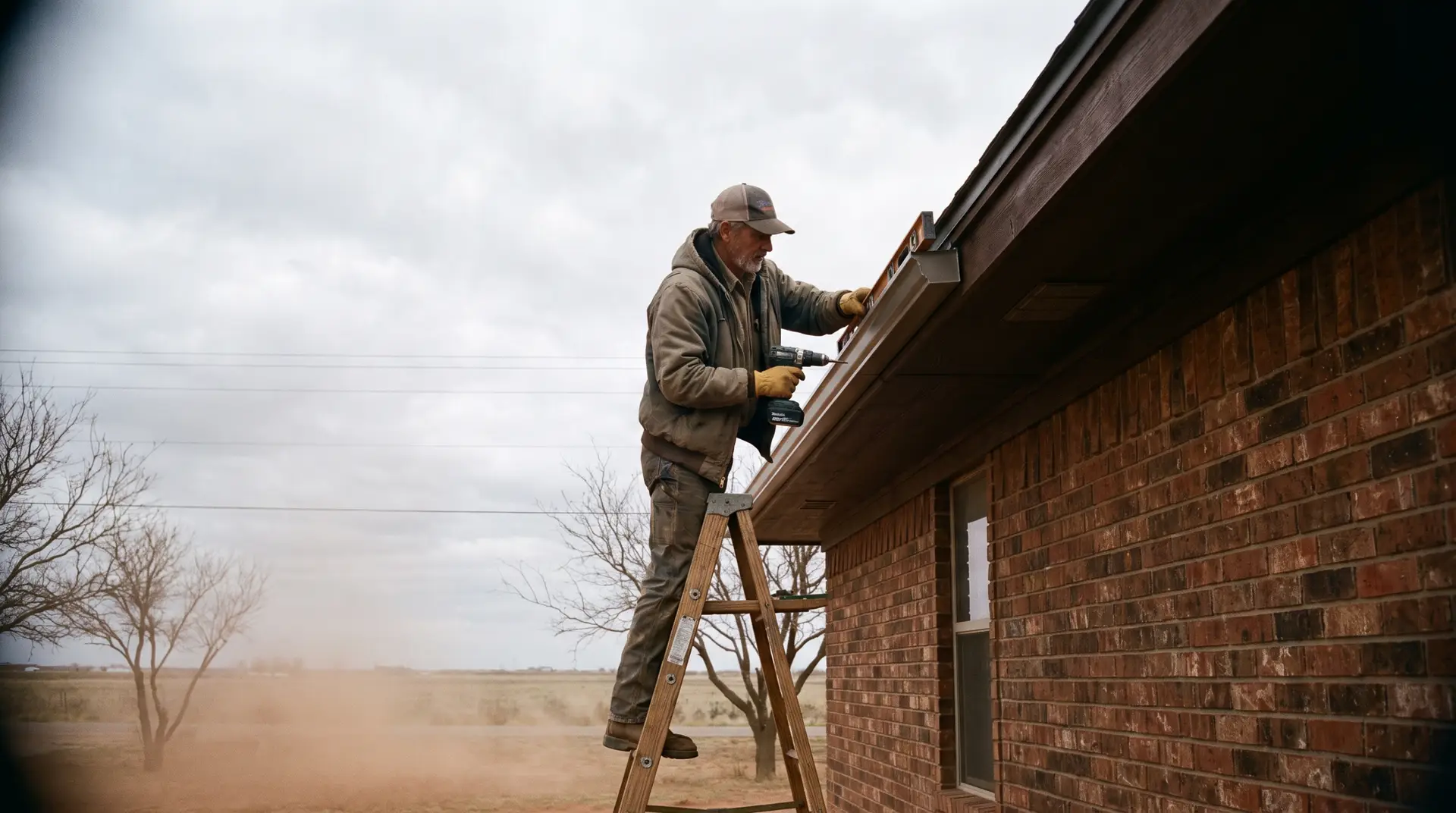
A correct install answers that with slope, spacing, and outlet size. Gutters should pitch about a quarter inch per 10 feet toward the outlet, enough to drain fully without being visible against a level fascia line. Long runs get pitched from a high point in the middle toward downspouts at both ends. Downspouts go in every 30 to 40 feet, with an extra drop wherever a valley concentrates flow.
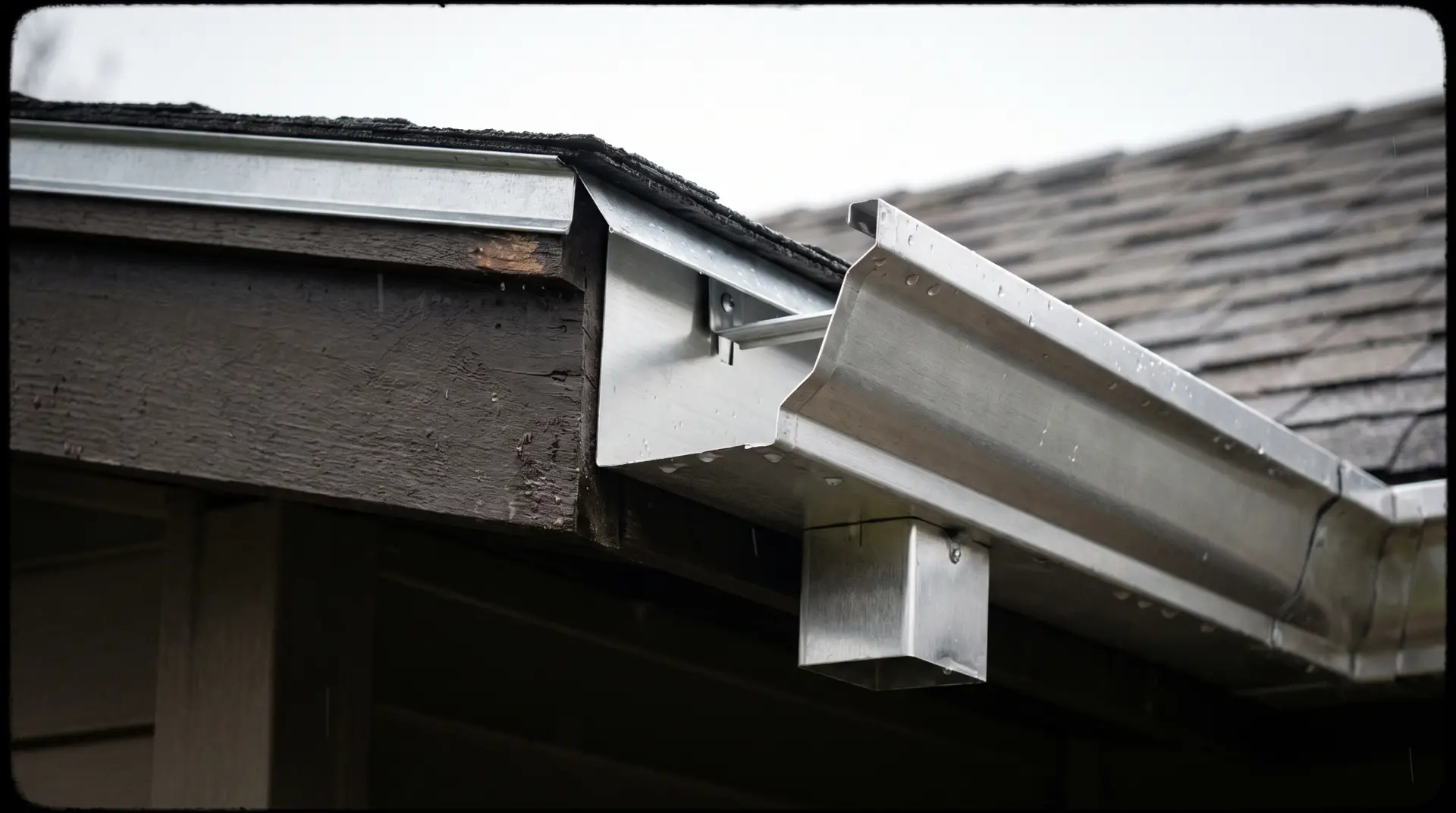
The details that separate good work: hidden hangers screwed into solid fascia rather than nailed, sealed miters at every corner instead of a bead of caulk over a gap, outlets cut cleanly and sized to the downspout, and drip edge tucked into the back of the gutter so water cannot run behind the trough and rot the fascia. Extensions should carry water at least 4 to 6 feet from the foundation, farther on clay.
Final Word: The Job Is Not Finished at the Downspout
Most gutter problems we get called about in Lubbock are not gutter problems. They are termination problems. Somebody installed a clean system, ran a 12-inch elbow at the bottom of each downspout, and called it done, and now the water is landing 14 inches from a slab foundation instead of 14 feet. The trough and the fascia work perfectly while the soil at the perimeter goes through the same swelling cycle it always did.
When you get quotes, ask three questions: what size trough and downspout, how far apart are the hangers, and where does the water go once it leaves the downspout. A contractor who has a specific answer to the third one is thinking about your foundation and not just your fascia. It is also worth timing gutter work with roof work, since drip edge, fascia repair, and gutter hanging all touch the same few inches of the roof edge, and doing them together avoids paying twice for the same setup.
We handle gutter installation alongside roofing across Lubbock, Wolfforth, Shallowater, Idalou, and the rest of the South Plains. Our roofing services page covers how we scope the work, and if a recent storm is what brought you here, our guide to storm and wind damage roof repair in Lubbock is the right next read. Before the first hard freeze, run through our winter roof maintenance checklist and clear the troughs.
Frequently Asked Questions About Gutter Installation in Lubbock
Cost, sizing, timing, and maintenance questions we hear from South Plains homeowners
Yes, and the reason is soil rather than rainfall. Our clay-rich soil swells and shrinks with moisture changes, and a slab foundation moves with it. Roof runoff concentrated in a narrow band along the drip line creates exactly the uneven moisture that causes differential movement. Gutters also stop the splash-back staining on brick and siding and keep water off doorways and walkways. On the South Plains, a gutter system is foundation protection first and rain management second.
One day for most single-story homes with 150 to 200 linear feet of straightforward runs. The crew rolls the gutter on site in one continuous length, hangs it, cuts and seals miters, sets downspouts, and cleans up. Two-story homes, complex rooflines with many corners, or jobs that include fascia replacement can run two days. Buried drain lines to carry water away from the foundation add another day of excavation work depending on trench length and soil conditions.
Six-inch, in most West Texas cases. The 6-inch trough carries roughly 40 percent more water and pairs with larger 3x4 downspouts that clog less with our seed and dust debris. Five-inch is adequate on a simple single-story roof with short runs and good downspout spacing. If your roof has valleys concentrating flow, steep pitch, or a second story draining onto a lower section, the larger size prevents the overshoot that soaks your foundation.
Twice a year for most Lubbock homes: once in late spring after elm and cottonwood seed drops, and once in late fall. Houses under mature trees or near open farm ground may need a third pass. What accumulates here is dense sludge from dust, seed, and shingle granules rather than loose leaves, so it packs into elbows and does not wash through. Micro-mesh guards stretch the interval but do not remove the need entirely.
They can go on an existing roof any time, as long as the fascia is solid and there is proper drip edge at the eave. That said, if the roof is within a couple of years of replacement, wait and do both together. Drip edge, fascia repair, and gutter hangers all occupy the same few inches of roof edge, and combining the work saves a second mobilization and avoids removing new gutters during a tear-off.