Picking shingle colors is the part of a roof replacement homeowners enjoy and contractors rush, which is backwards. It is the one decision on the whole job you will look at every single day for the next twenty five years, and out here it has real consequences for attic temperature and how the roof ages.
In West Texas the colour conversation is not purely cosmetic. We sit at 3,200 feet with a UV load most of the country does not deal with, summer attic temperatures that routinely pass 130 degrees, and a constant film of caliche dust that changes how every colour actually reads from the street.
This guide covers which shingle colors hold up here, what the heat difference genuinely amounts to, and how to choose one against the brick you already have rather than against a brochure.
On this page, a complete guide to shingle colors in Lubbock, TX:
- Quick Answer: The Best Shingle Colors for West Texas
- How Shingle Colors Behave on a Lubbock Roof
- Do Shingle Colors Really Affect Cooling Costs?
- Choosing Shingle Colors Against West Texas Brick
- Practical Advice Before You Pick Shingle Colors
- Final Word: Shingle Colors You Will Still Like in 2050
- Frequently Asked Questions About Shingle Colors
Quick Answer: The Best Shingle Colors for West Texas
For most Lubbock homes, weathered wood, driftwood, light and medium greys, and warm tans are the shingle colors that perform best. They sit light enough to keep attic heat down, they hide our dust well, and they work against the red and brown brick that dominates the local housing stock.
The heat difference is real but smaller than salespeople suggest. A light shingle can run 20 to 40 degrees cooler at the surface than a near-black one on a summer afternoon. In a vented attic with adequate insulation, that translates to a modest cooling saving rather than a dramatic one.
Very dark colours, particularly black and deep charcoal, look sharp on the right architecture and are the hardest working choice here. They absorb the most heat and they show caliche dust and the chalky residue of our hard water most obviously.
The practical rule: go a shade lighter than you think you want, and judge the sample outdoors against your own brick rather than under showroom lighting.
Weathered wood, driftwood, grey and warm tan are the best-performing shingle colors for Lubbock homes. Light shingles run 20 to 40 degrees cooler at the surface than black, hide our caliche dust better, and sit naturally against West Texas brick.
How Shingle Colors Behave on a Lubbock Roof
Colour affects three things on a roof here: how hot the surface gets, how obvious dust and weathering become, and how the house reads from the curb. Those three pull in slightly different directions, which is why the decision is less obvious than it looks.
Surface temperature is the one people ask about. Roof surface and attic temperature are related but not the same thing, and ventilation and insulation matter more than colour does. A light roof over a badly vented attic will still cook.
The dust question is specific to us. Blowing caliche settles on everything and reads as a pale film. On a dark roof that film is visible within weeks. On a mid-tone weathered wood it is effectively invisible.
Then there is how a colour ages. Asphalt shingles lose granules slowly over their life, and the underlying mat is dark. On a dark roof that process is nearly invisible. On a very light roof it can show as mottling after fifteen years. Mid-tone blends split the difference, which is part of why they dominate this market.
None of these three factors outranks the others outright. A homeowner who parks under the roof every day and hates seeing dust will weigh appearance heavily; one with a west-facing upstairs bedroom will care more about heat.
- Weathered wood and driftwood: The most popular choice in Lubbock for good reason. The mixed brown and grey granules disguise dust, sit comfortably against red brick, and hide the granule variation that shows up as a roof ages.
- Light and medium grey: Cooler than the browns, modern looking, and particularly good against the grey and white brick on newer south Lubbock and Wolfforth builds. Shows less dust than any dark colour.
- Warm tan and desert sand: The coolest-running common option and a natural fit for stucco or lighter brick. The trade-off is that it can look washed out against a pale wall, so it wants some contrast in the trim.
- Charcoal and dark grey: Sharp on contemporary and two-story homes, and the most popular dark choice. Runs noticeably hotter and shows dust, but it hides algae streaking and granule loss well as the roof ages.
- Black and near-black: The hottest option and the highest maintenance in appearance terms. It suits certain architecture genuinely well, but expect to see every bit of dust and hard-water residue on it.
- Red, green and blue tones: Uncommon here and worth thinking hard about. They date faster than neutrals, they are harder to match if you need a repair in ten years, and they limit what you can do with paint and trim later.
One practical warning: never choose from a brochure or a small sample board. Granule blends read completely differently at scale and in direct sun. Ask for a full shingle, or better a sample of several, and lay them on the driveway against the house in the middle of the afternoon before you commit.
Take a photo of the samples against the wall too. Looking at that picture the next morning, away from the sales conversation, is often when the right answer becomes obvious.
Do Shingle Colors Really Affect Cooling Costs?
Yes, but the size of the effect gets exaggerated in both directions. Dark roof surfaces genuinely do run hotter. On a 100 degree Lubbock afternoon a black shingle surface can reach 160 to 180 degrees while a light one sits closer to 130 to 140. That is a real physical difference and it is easy to demonstrate with an infrared thermometer.
What happens next is where it gets complicated. That heat has to travel through the roof deck, across the attic, through the insulation and into the living space. Each of those layers dampens the effect. In a house with a properly vented attic and adequate insulation, the difference between a light and dark roof typically shows up as a small percentage of the cooling bill rather than a transformative saving.
The Environmental Protection Agency publishes research on reflective roofing and how surface colour and solar reflectance affect building temperature, which is a useful reality check against marketing claims in either direction.
If lowering cooling cost is your actual goal, the order of effectiveness here is attic insulation first, ventilation second, and shingle colour third. Getting the first two right does far more than choosing a lighter shingle on top of a hot, badly vented attic. Our guide to roofing materials for West Texas covers how the whole assembly works together.
Colour also affects the shingle itself. Higher surface temperatures accelerate the ageing of asphalt and can soften the sealant strips in extreme heat. It is one more small reason to lean lighter in a climate like ours, independent of any energy argument.
Choosing Shingle Colors Against West Texas Brick
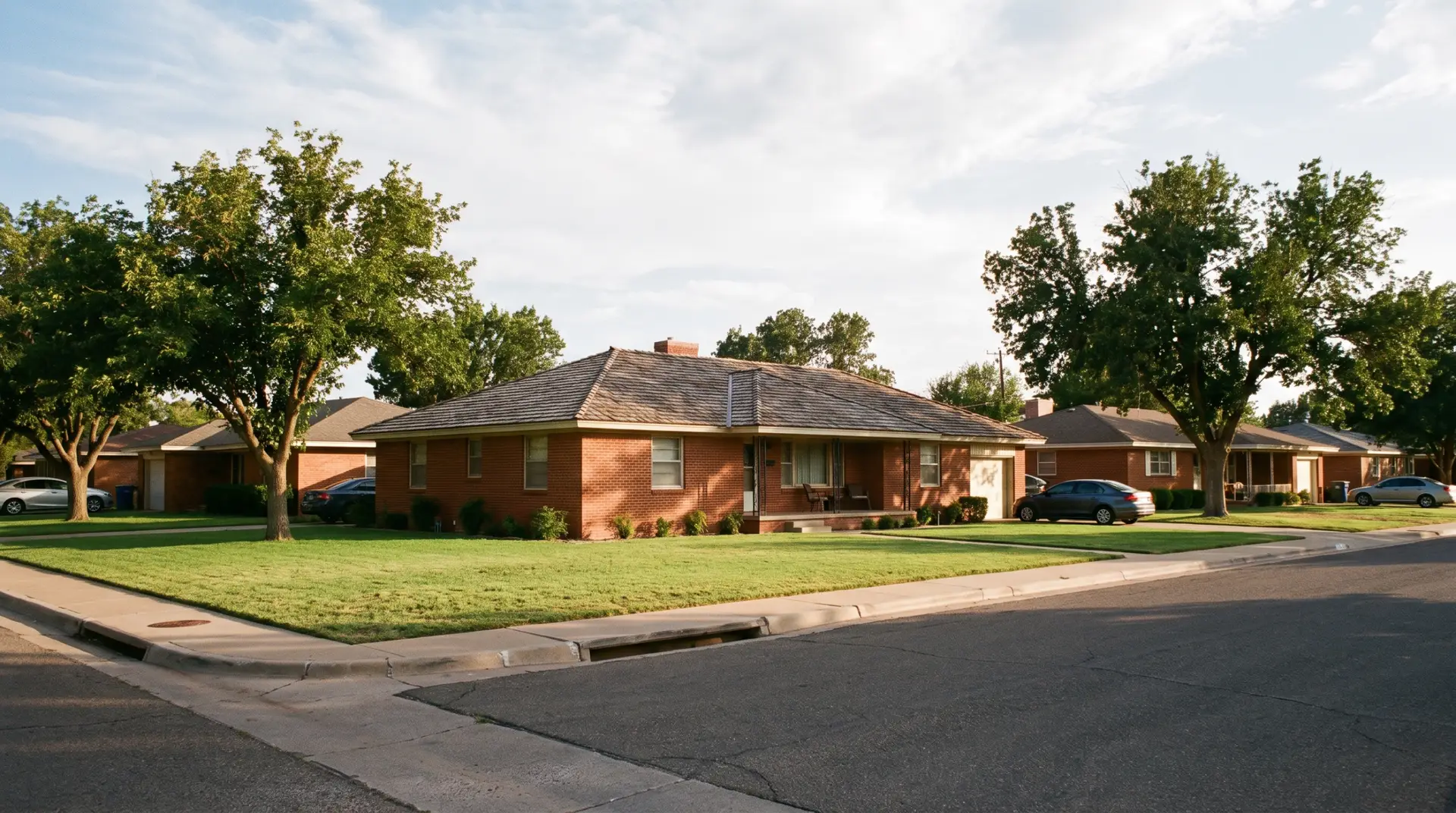
The single biggest constraint on your colour choice is already sitting there: the brick. Most Lubbock housing stock is red, brown or buff brick, and a roof that fights it will look wrong no matter how good the shingle is. Three considerations decide whether a combination works, and none of them are about the shingle in isolation. They are about the relationship between the roof and everything already on the house.
Undertone matters more than shade
Red brick carries a warm undertone, and it wants a roof that either matches that warmth or sits neutral against it. Weathered wood and warm greys work. A cool blue-grey next to orange-red brick reads as a clash even when both are attractive on their own. Buff and tan brick is more forgiving and takes both warm browns and true greys. If you are unsure, hold the sample directly against the wall in afternoon light and step back thirty feet, because the relationship only becomes obvious at the distance people actually see your house from.
Contrast sets the character
A roof close in tone to the brick makes a house read as one solid mass, which suits long low ranch homes and plays down an awkward roof line. Strong contrast, like a charcoal roof on light brick, emphasises the shape of the roof and suits steeper pitches and two-story homes. Neither is better. The question is whether your roof is a feature worth drawing attention to or a surface you would rather have recede. On most Lubbock ranch houses, lower contrast is the safer choice.
Everything else has to live with it
The roof will outlast your paint, your gutters, probably your front door and possibly your fence. Choose the shingle first and let the changeable elements work around it rather than matching a shingle to a paint colour you may get bored of. Neutral shingle colors leave you the most freedom later, which is the practical argument against picking something distinctive that you will be locked into for twenty five years.
Practical Advice Before You Pick Shingle Colors
Look at real roofs, not samples. Drive the newer parts of Wolfforth, Frenship and south Lubbock and find houses with brick close to yours. Seeing a full roof in your own light, at normal viewing distance, tells you more in twenty minutes than an hour with a sample board. Note the manufacturer and colour name if you can, and ask your contractor to price that.
Look at the samples at different times of day. A blend that looks warm at noon can read grey at six in the evening, and the low afternoon sun here is intense enough to change a colour noticeably. If you can only look once, look in the afternoon, since that is when most people see the front of your house.
Check what your neighbourhood expects. Some newer subdivisions and HOAs around Lubbock maintain approved colour lists, and finding that out after the material is ordered is an expensive way to learn. A quick call before you sign avoids the problem entirely.
Finally, separate the colour decision from the performance decision. Impact rating, wind rating and warranty are chosen from the product line; colour is chosen within it. Most manufacturers offer the same colour range across several performance grades, so you rarely have to trade one for the other. Our guide to impact-resistant shingles covers the performance side of that choice.
Order a sample of the second-choice colour too. Homeowners who look at only one option tend to talk themselves into it, and having two full shingles side by side on the driveway makes the better fit obvious in about a minute. It costs nothing and it prevents the most common regret we hear about, which is going one shade too dark.
Final Word: Shingle Colors You Will Still Like in 2050
The homeowners who are happiest with their roof years later almost always chose something neutral, mid-toned and slightly lighter than their first instinct. Weathered wood remains the most popular colour in this market because it is genuinely hard to get wrong on a Lubbock house.
Give the decision an afternoon rather than five minutes at the end of a sales appointment. Get full shingle samples, put them on the roof slope or against the brick, and look at them in the light you will actually see them in.
Remember the order of operations for heat: insulate the attic, ventilate it properly, then pick a lighter colour as the finishing touch. Doing it the other way round buys disappointment.
If you are planning a replacement and want to see samples against your own house, we bring them out and leave them with you. You can read more about how we handle full replacements on our roof replacement page, and our roof replacement cost guide covers the numbers.
Frequently Asked Questions About Shingle Colors
What Lubbock homeowners ask before choosing a roof colour
They help, but less dramatically than marketing suggests. A light shingle surface can run 20 to 40 degrees cooler than a black one on a hot afternoon, which is a genuine physical difference. How much of that reaches your living space depends far more on attic ventilation and insulation than on the shingle itself. In a well-vented, well-insulated attic the saving is modest. In a hot, poorly vented attic, fixing the ventilation will do more than changing the colour. If you want the cooling benefit and the darker look, spend the money on attic insulation and take the charcoal shingle; you will come out ahead on both counts.
Weathered wood and driftwood blends are consistently the most common choice here, followed by medium greys. They suit the red and brown brick that dominates local housing stock, they sit at a mid tone that does not absorb as much heat as charcoal, and their mixed granule blend hides the caliche dust that settles on every roof in West Texas. They also age well, since granule variation over time reads as part of the blend rather than as wear. Manufacturers use different names for very similar blends, so compare actual samples rather than colour names across brands.
Indirectly, yes. Darker shingles reach higher surface temperatures, and sustained heat accelerates the ageing of the asphalt and can soften sealant strips. In a climate like ours, with intense sun at elevation and long hot summers, that is a real if gradual effect. It is not large enough on its own to override a colour you strongly prefer, but it is one more reason to lean a shade lighter when you are genuinely torn between two options. Adequate ventilation reduces this effect considerably, which is another reason the two decisions belong together.
Either works, and the right answer depends on your roof line. Low contrast, where the roof sits close in tone to the brick, makes the house read as one mass and suits long single-story ranch homes, which is most of Lubbock. Strong contrast emphasises the roof shape and works better on steeper pitches and two-story houses. The more important rule is undertone: warm red brick generally clashes with cool blue-greys regardless of how light or dark you go. Trim, gutters and front door colour can bridge a near-miss between roof and brick, so consider them part of the same decision.
Not really, and this is worth thinking about before you choose something unusual. Repairs need matching shingles, and manufacturers discontinue colours regularly. Even with the same product, a new shingle will not match one that has been in the Lubbock sun for a decade. Common neutral colours stay available far longer than distinctive ones, which is a practical argument for choosing something mainstream if you expect to own the house a long time. Keeping a few spare bundles from the original job in the garage solves the matching problem entirely for minor repairs.