Fence installation cost in Lubbock is one of those numbers that sounds simple until you get three bids and they land a thousand dollars apart for what looks like the same fence. The lumber is not what separates them. What separates them is how deep the posts go, what they are set in, and whether the crew has built for our wind before.
A backyard fence here is a solid wall standing in the open against 60 mph spring gusts. It is the most heavily wind-loaded structure on most properties, and it is sitting in expansive clay over a caliche layer that shows up at a different depth in every yard on the block.
That combination is why fences fail early in Lubbock and why the cheapest bid is so often the one you pay for twice. This guide covers real local pricing, what drives it, and which upgrades are worth the money out here.
On this page, a complete guide to fence installation cost in Lubbock, TX:
- Quick Answer: Fence Installation Cost in Lubbock, TX
- What Drives Fence Installation Cost Up or Down
- Fence Installation Cost by Material in Lubbock
- Why Lubbock Is Hard on Fences
- Getting a Fence Installation Cost You Can Trust
- Final Word: Budgeting a Fence That Lasts Here
- Frequently Asked Questions About Fence Installation Cost
Quick Answer: Fence Installation Cost in Lubbock, TX
For most Lubbock backyards, fence installation cost runs $28 to $55 per linear foot installed for a standard six-foot wood privacy fence. A typical residential perimeter of 150 to 200 linear feet puts the whole job between $4,500 and $10,000.
By material, treated pine sits at roughly $28 to $38 per foot, cedar at $38 to $55, and ornamental metal or steel at $45 to $75. Chain link remains the budget option at $18 to $30 per foot. Gates are priced separately, usually $300 to $900 each depending on width and hardware.
Removing and hauling off an existing fence adds $3 to $8 per linear foot. That line item catches people out, because a replacement job carries demolition costs that a new-build on bare ground does not.
The single biggest variable is not visible in the finished fence at all. Post depth, post spacing and whether the posts are set in concrete decide both the price and how long the fence stands. That is where bids diverge, and it is the one thing worth asking about directly.
A six-foot wood privacy fence in Lubbock costs $28 to $55 per linear foot installed, putting a typical 150 to 200 foot backyard between $4,500 and $10,000. Post depth, spacing and concrete footings drive both the price and whether the fence survives our spring wind.
What Drives Fence Installation Cost Up or Down
Two fences of identical length on the same street can be quoted thousands apart, and the difference is almost never the pickets. It is the parts of the job that disappear underground or that nobody thinks to ask about until the crew is already on site.
Walk your property line before you call anyone. Measure the actual run, count the gates you need, note where the ground slopes, and look for anything a crew will have to work around. Handing a contractor accurate information gets you a more accurate number and fewer change orders.
Also find out where your utilities run. Locates are free in Texas and required before digging, and a line in the wrong place can change the layout of the whole fence.
One more thing to settle early: where exactly the line runs. A survey pin is worth finding before anybody digs, because moving a finished fence is far more expensive than setting it right.
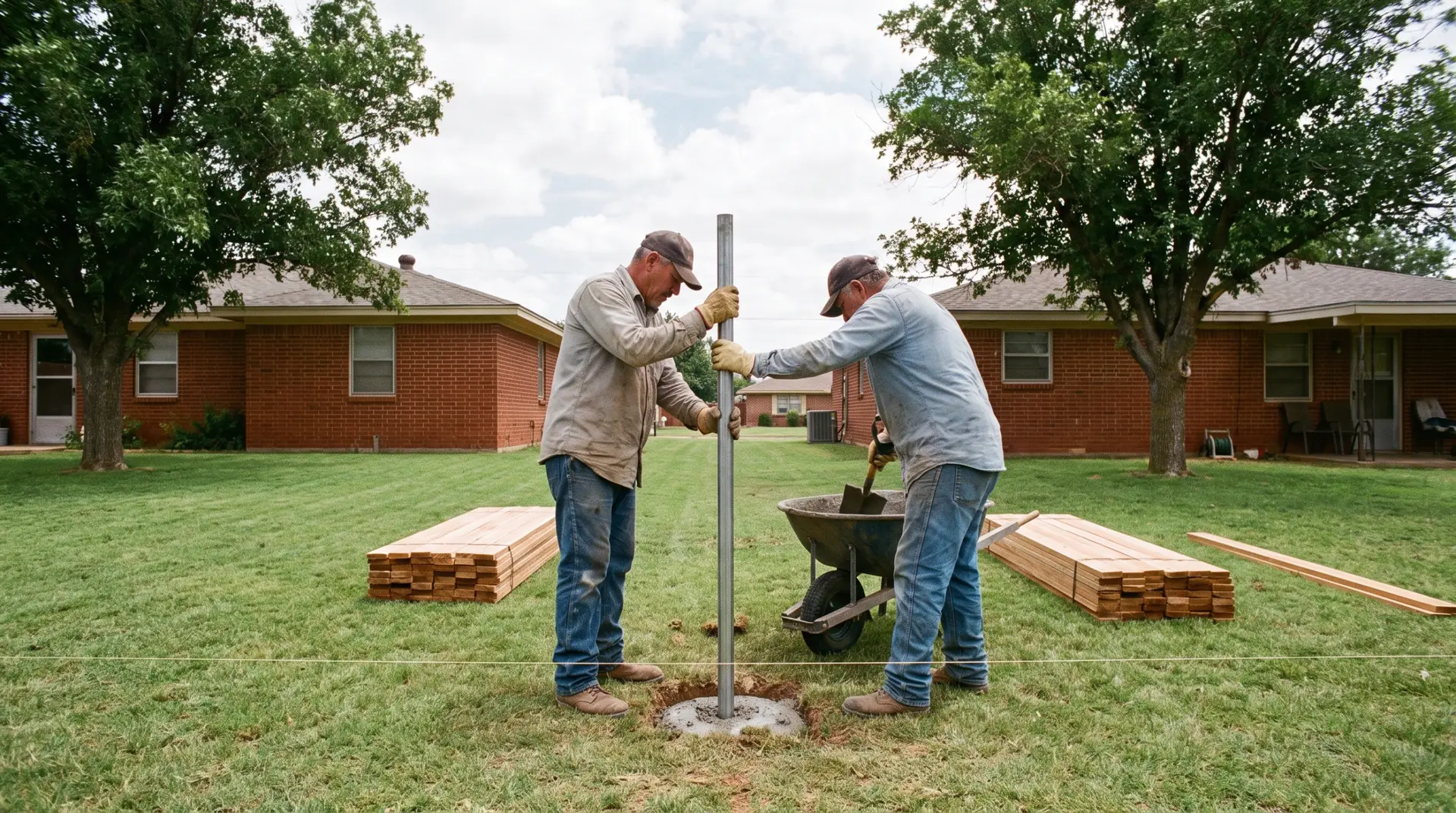
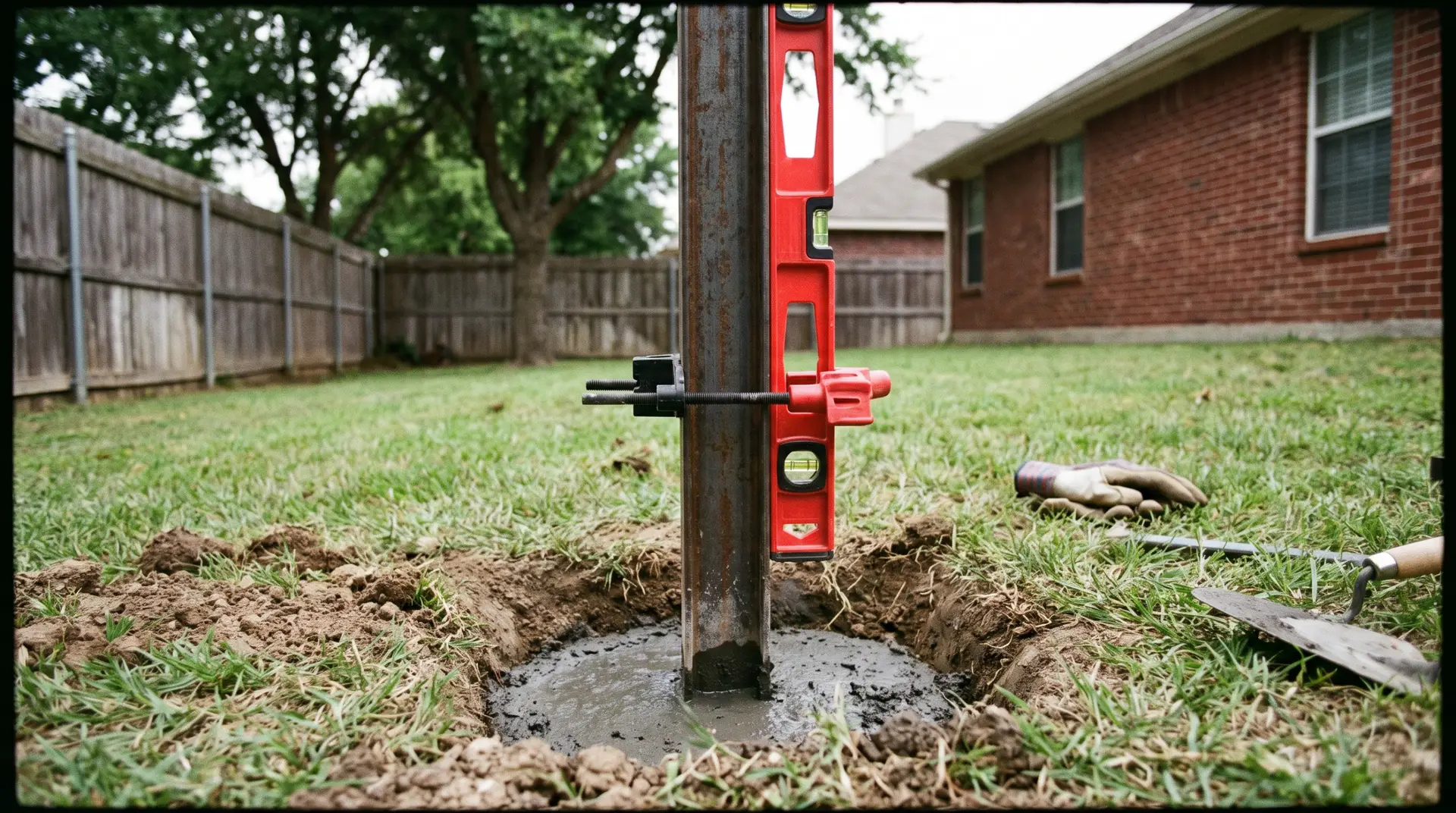
- Post depth and footings: The item that matters most here. Posts should go at least a third of their above-ground height into the ground, set in concrete. Shallow posts in dirt are cheaper on paper and are why so many Lubbock fences lean after one windy spring.
- Post spacing: Six-foot spacing costs less than eight. In a high-wind area the tighter spacing is worth the extra posts, because wind load on a solid six-foot panel is considerable and every post shares it.
- Caliche depth: The genuine local wildcard. Caliche sits at a different depth in every yard, and hitting a hard layer at eighteen inches turns quick auger work into jackhammer work. Good contractors price this as a possibility rather than a surprise.
- Terrain and slope: A fence on a slope has to be either stepped or racked, and both take more layout time than a flat run. Tight access, a narrow gate, or a backyard a trailer cannot reach all add labor hours.
- Gates and hardware: Gates are the moving part and the first thing to sag. A properly braced gate with heavy hinges costs more and lasts years longer than a light one hung on builder hardware.
- Demolition and disposal: Removing an old fence, digging out the previous concrete footings and hauling everything away typically adds $3 to $8 per linear foot. Old footings are the slow part, not the panels.
Be careful comparing a bid that quotes per panel against one that quotes per linear foot. Panel pricing can quietly assume eight-foot spacing and a shallower post, which is a different fence than the one next to it in your pile of quotes. Ask every contractor for post depth, post spacing and footing detail in writing.
It is also worth asking whether the price includes the gate hardware you actually want, since light builder hinges on a heavy cedar gate are a predictable early failure.
Fence Installation Cost by Material in Lubbock
Treated pine is the default here and the value leader at roughly $28 to $38 per foot installed. It handles the sun acceptably once it is sealed and it is readily available. The trade-off is movement: pine warps, cups and twists in our dry heat more than cedar does, and boards that were straight in April can be wavy by August if the wood was not dry when it went up.
Cedar runs $38 to $55 per foot and is the material most Lubbock homeowners actually want. It stays straighter, resists insects naturally, and takes stain beautifully. It also weathers to grey within a season or two if you leave it alone, which surprises people who paid the premium expecting it to stay warm-toned. Our comparison of cedar versus pine fencing covers how each behaves here over time.
Ornamental steel and aluminum sit at $45 to $75 per foot. They do not block wind, which sounds like a disadvantage and is actually why they survive it so well, and they need essentially no maintenance. They provide no privacy, so they tend to be a front-yard or pool-surround choice rather than a backyard one.
Chain link is $18 to $30 per foot and remains the honest answer for a dog run, a side yard or a property line where appearance is not the point. Vinyl fencing is uncommon here for good reason: it goes brittle under our UV load and it is expensive to repair when hail cracks a panel.
Whatever the material, the posts matter more than the pickets. Steel posts set in concrete under a wood fence cost more up front and are the single most effective upgrade available in this market, because the post is almost always what fails first, not the boards.
Why Lubbock Is Hard on Fences
A fence in West Texas is doing a job that fences in most of the country never have to do. Three local conditions decide whether it stands for five years or twenty five, and all three are working on the parts you cannot see once the job is finished. None of them show up in a brochure, and all three are the reason a fence built to a generic national spec underperforms here. Understanding them is what lets you read a bid properly rather than sorting quotes by price.
Wind load on a solid wall
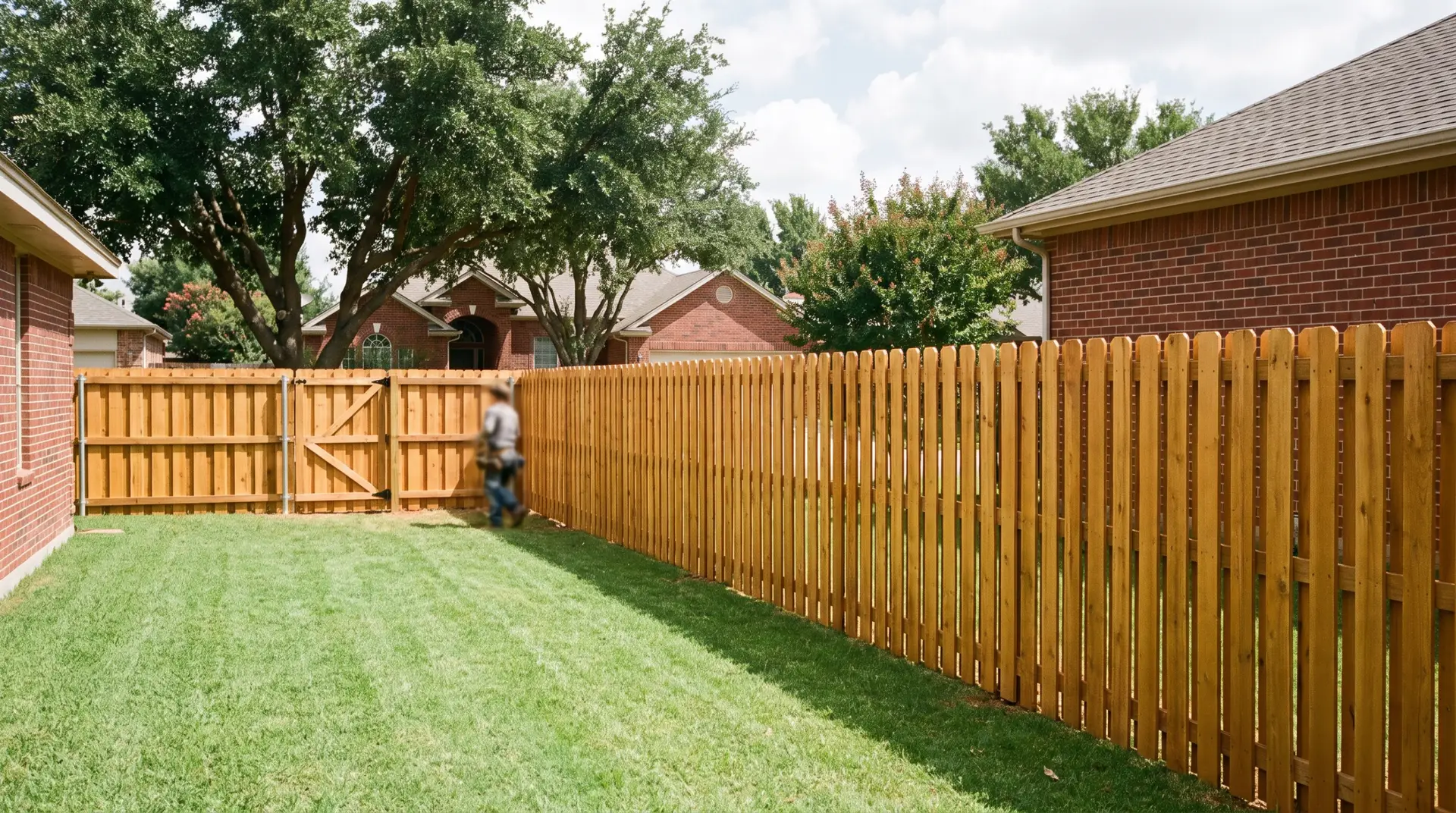
A six-foot privacy fence is a sail. Wind does not flow through it, it pushes on it, and a spring gust front here regularly runs 50 to 60 mph. All of that force transfers to the posts, and specifically to the top few inches of the footing where the post meets the ground. That is why leaning fences almost always fail at the same place, and why post depth and concrete matter more than the grade of the lumber. Leaving a small gap between pickets, or using a shadowbox pattern, reduces the load meaningfully without giving up much privacy.
Leaving that gap also reduces the load on the footings themselves, which is where the real cost of a failure sits.Expansive clay and caliche
Our soil swells when it takes on water and shrinks hard when it dries. That cycle works a post loose over time, opening a gap around the footing that lets in more water, which accelerates the whole process. Underneath the clay, caliche sits at wildly variable depth. A crew that hits it at sixteen inches in one corner and four feet away in the next has a genuinely harder job, and how they handle that is a fair question to ask before signing. Watering along a fence line during a long dry spell sounds odd and genuinely helps, because it keeps the clay from shrinking away from the footings and opening the gap that starts the cycle.
Sun and dryness
Wood here does not rot the way it does in a humid climate. It checks, cups and greys under UV at 3,200 feet, and it does it fast. Untreated cedar goes silver within two seasons. The Forest Products Laboratory at the USDA Forest Service publishes research on how exterior wood weathers and why surface finishes slow it down. Sealing a new fence within its first year is the cheapest life extension available. Let new wood dry for a few weeks first so the finish can actually penetrate, then keep to a cycle rather than waiting until the fence looks bad, because by then the surface has already checked.
Getting a Fence Installation Cost You Can Trust
Ask every bidder the same four questions: how deep do the posts go, how far apart are they, are they set in concrete, and what happens if you hit caliche. If a contractor cannot answer those quickly and specifically, the number on the page does not mean much. Those four answers explain nearly every price difference you will see.
Get the scope in writing, including who is responsible for utility locates, whether the old fence removal is included, how debris is handled, and who talks to the neighbour about a shared line. Shared fences are a frequent source of friction in older Lubbock neighbourhoods, and it is far easier to settle before the posts come out than after.
Watch for a bid that is dramatically below the others. In this trade the usual explanations are shallow posts, no concrete, wider spacing, or wet lumber bought cheap. None of those show up on the day the fence goes in. All of them show up within a couple of springs, and by then the cheap fence has cost more than the good one would have.
Think about the finish at the quoting stage rather than later. A new fence should be allowed to dry out and then sealed, and knowing that is coming lets you budget for it rather than being surprised. Our fence staining cost guide covers what that runs locally and when to do it.
Finally, ask about lumber moisture. A fence built from boards straight off a wet pallet will shrink as it dries in our air, opening gaps between pickets and pulling fasteners. Reputable suppliers here sell material that has had a chance to acclimate, and a contractor who mentions it unprompted is usually worth listening to on everything else.
Final Word: Budgeting a Fence That Lasts Here
Fence installation cost in Lubbock is genuinely a case where the middle of the market is the right place to buy. The cheapest bids are cheap because of what is underground, and the most expensive are usually paying for a material upgrade that matters less than the footing detail does.
Put the money into posts, depth and concrete first. Pick the wood you like second. Plan to seal it in the first year. A fence built that way in this climate will still be standing straight when your neighbour is on their second one.
If your existing fence is leaning rather than failed, replacement may not be the right call at all. Resetting posts is frequently cheaper and entirely effective, and our guides to fixing a leaning fence and choosing between repair and replacement walk through how to tell.
If you want a straight number for your own property line, we build and finish fences across Lubbock and the South Plains. You can read more about our fence work on our fence staining and restoration page, and estimates are free.
Frequently Asked Questions About Fence Installation Cost
What Lubbock homeowners ask before putting up a new backyard fence
A six-foot wood privacy fence generally runs $28 to $55 per linear foot installed in Lubbock. Treated pine sits at the lower end, around $28 to $38, and cedar at $38 to $55. For a typical backyard perimeter of 150 to 200 feet that works out to roughly $4,500 to $10,000. Gates are extra, usually $300 to $900 each, and removing an old fence adds another $3 to $8 per foot for demolition and haul-off. Ornamental metal and chain link price differently, so compare like with like when you collect quotes.
A good rule is at least a third of the post's above-ground height, so a six-foot fence wants posts set two feet deep or more, and deeper is better here. They should be set in concrete rather than tamped dirt. Our combination of high wind and expansive clay works shallow posts loose quickly. The complication is caliche, which sits at different depths across a single yard and sometimes has to be broken through rather than augered. Ask the contractor what they do when caliche turns up shallow, because the answer tells you how the bid was built.
In this climate, usually yes, though not for the reason people expect. Cedar's advantage here is dimensional stability: it stays straighter and cups less than pine in our dry heat, so the fence still looks square in five years. Its natural insect resistance is a secondary benefit. What cedar will not do is stay warm-toned without help. It weathers to grey within a couple of seasons unless you seal it, so budget for finishing either way. If you plan to stain rather than let it grey, cedar also takes finish more evenly than pine does.
Requirements vary by jurisdiction and by height, and rules differ inside Lubbock city limits versus in the county or in Wolfforth and Shallowater. Height limits, corner-lot visibility triangles and setback rules are the usual points that catch homeowners out. Check with the local building office before you order material, and if the fence sits on a shared property line, talk to your neighbour first. A reputable contractor will know the local requirements and handle permitting where it is needed. Getting this wrong can mean taking a finished fence down, so it is worth the phone call.
A properly built cedar fence with posts set deep in concrete should give you 15 to 25 years here. Treated pine built the same way runs 10 to 20. A fence with shallow posts set in dirt may start leaning within three to five years regardless of what the pickets are made of. Sealing the wood in its first year and re-sealing every few years after that is the cheapest thing you can do to reach the upper end of those ranges. Gates usually need attention before the fence itself does, so budget for hinge adjustment along the way.