How many Christmas lights do I need is the question we get every October, usually from somebody standing in a driveway in Wolfforth holding a tape measure and a shopping list. It is a good question, and it has an actual answer. You measure the house, pick a bulb spacing, divide, then add a little for corners and mistakes.
Buying by feel is what leads to the two classic December problems: a roof line that stops eleven feet short of the corner, or four unopened boxes in the garage. Neither is fun on a 30 degree Saturday. Twenty minutes with a tape and a notepad in the fall gets you a real number, and the same notepad saves you the whole exercise next year.
On this page, a complete guide to how many christmas lights do i need in Lubbock, TX:
- Quick Answer: How Many Christmas Lights Do I Need?
- Measure First: The Six Numbers That Set Your Count
- Spacing, Strand Length, and How Many Strands You Can Connect
- How Many Christmas Lights Do I Need for a Two-Story Lubbock House?
- Watts, Amps, and Keeping the Breaker Happy
- Final Word: Measure Once, Buy Once, Write It Down
- Frequently Asked Questions: How Many Christmas Lights Do I Need?
Quick Answer: How Many Christmas Lights Do I Need?
Measure the roof line you plan to light in linear feet, then divide by the bulb spacing. At the standard 12 inch spacing for C9 bulbs, a 25-bulb strand covers 25 feet. Most single-story Lubbock houses have 60 to 100 linear feet across the front, which works out to 3 or 4 strands. A two-story with gables usually runs 120 to 200 feet, or 5 to 8 strands.
Mini lights are a different math because they sit closer together. At 4 to 6 inch spacing, a 100-count strand covers roughly 33 to 50 feet. For wrapping tree trunks and branches, budget around 100 mini lights per vertical foot of dense coverage, or half that for a lighter look. Add 10 to 15 percent to whatever total you calculate, because corners, dormers, and one miscounted gable always show up.
To answer how many Christmas lights do I need, measure your roof line in linear feet and divide by bulb spacing. C9 bulbs at 12 inches means one 25-bulb strand per 25 feet. Single-story Lubbock homes usually need 3 to 4 strands, two-story homes 5 to 8, plus extra for trees and columns.
Measure First: The Six Numbers That Set Your Count
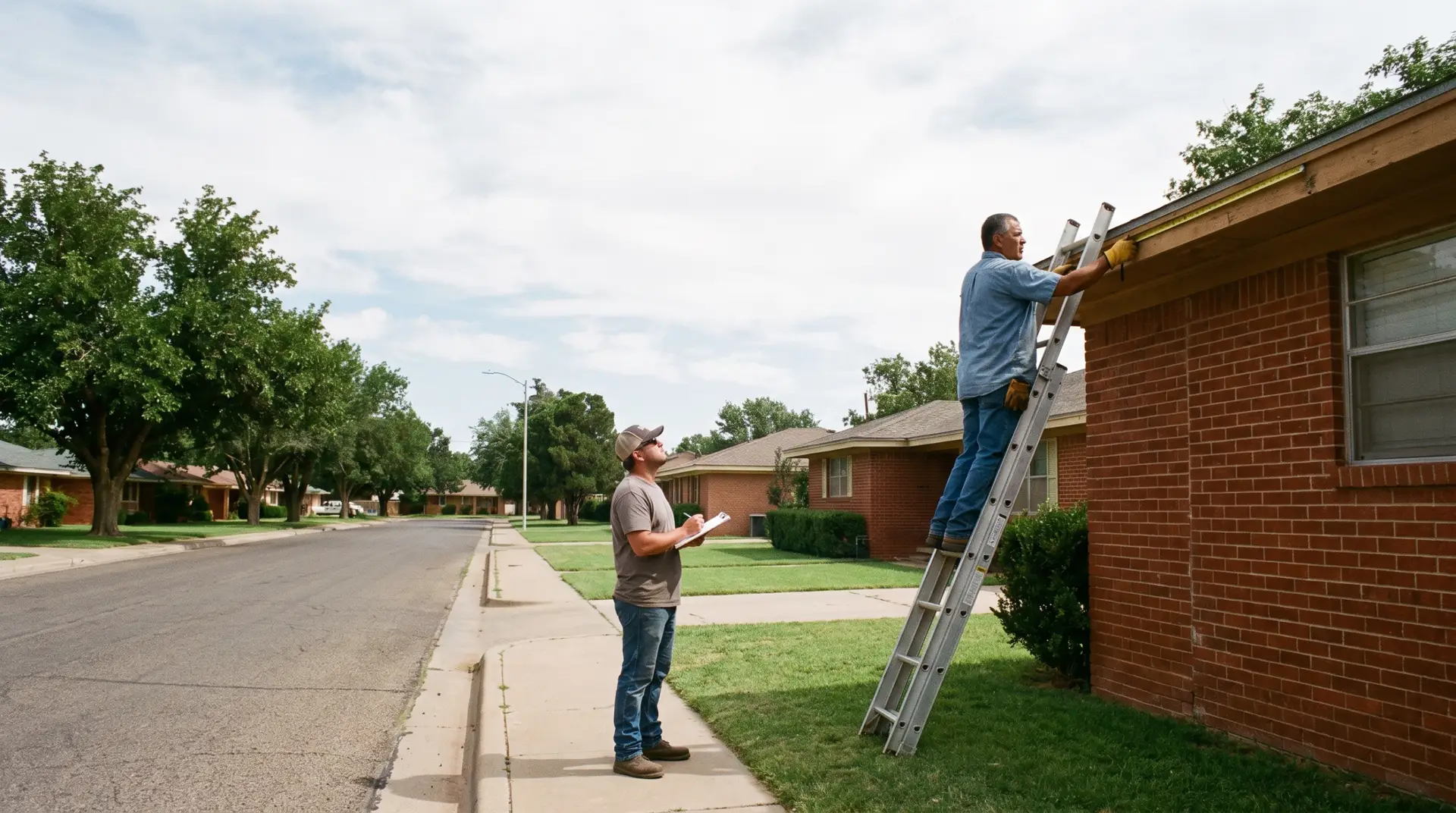
Everything downstream depends on the measurement, so do that part carefully. You do not need a ladder. A 100 foot tape, a helper, and the house footprint get you within a few feet, and a few feet is close enough when you are buying in 25 foot increments.
Walk the front of the house and write down each of the six items below as its own line. Keep them separate rather than totaling as you go, because different sections often use different bulbs, and you will want the breakdown next year when somebody asks how many Christmas lights do I need for just the porch.
If a section is hard to reach with a tape, pace it. A normal adult stride is close to three feet, and pacing a straight eave gets you within a few feet, which is plenty. Satellite imagery works too for footprint dimensions, though it will not show you a porch overhang or a bay window bump-out, so walk the front either way before you order.
- Horizontal eave runs: Measure along the ground under each straight section of gutter or fascia you intend to light. Ground distance equals roof line distance on a horizontal eave, so no correction is needed. This is usually the largest single number on the page.
- Gable rakes and peaks: Angled runs are longer than they look from below. Measure the horizontal width of the gable, then multiply by the pitch factor: about 1.05 for a 4:12 roof, 1.12 for 6:12, and 1.20 for 8:12. Double it, since a gable has two sides.
- Columns, posts, and porch rails: Measure the height of each post and decide on wrap spacing. A tight 3 inch spiral on an 8 foot column eats roughly 30 feet of mini strand. Rails get measured end to end like any other run.
- Windows and door frames: Add up the perimeter of anything you plan to outline. A standard double window frame is around 16 feet, a front door with sidelights closer to 20. These add up quickly on a house with a lot of front glass.
- Trees and shrubs: For a wrapped trunk, budget about 100 mini lights per vertical foot of dense coverage. For shrubs, net-style lights sized to the shrub are easier than free-wrapping. A mature live oak in Tech Terrace can absorb more lights than the entire house.
- Waste and corners: Add 10 to 15 percent to the total. Corners, chimney offsets, dormers, and the strand you cut short on the first attempt all come out of that margin. Leftovers become next year’s spares.
Buy the whole display at once, in one trip, from one lot if you can. Bulb color varies between production runs, and warm white from two different boxes can read noticeably different on the same roof line at night. That difference is invisible in a store and obvious from the curb. While you are at it, buy one extra strand of each type and set it aside unopened. A dead strand three days before Christmas is a lot cheaper to fix from the garage shelf than from a picked-over shelf at the store.
Count clips while you are at it. Shingle-tab or gutter clips go on every 12 inches along a roof line, so a 90 foot front needs about 90 of them plus extras. Buying clips short is the most common reason a display ends up taped, stapled, or sagging by the second week of December, and in our wind a sagging run does not stay up long.
Spacing, Strand Length, and How Many Strands You Can Connect
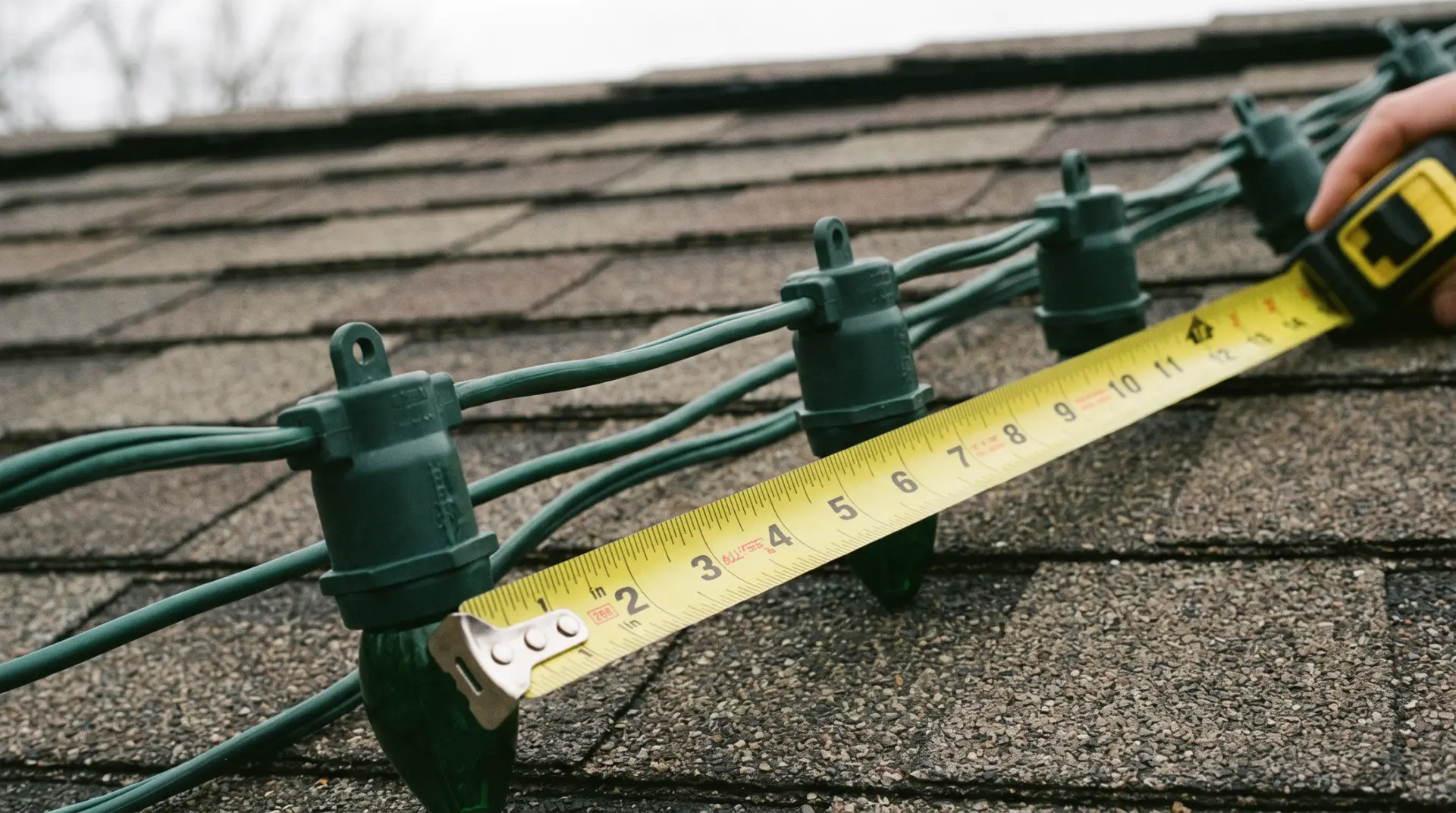
Bulb spacing is the number that changes everything, and it is printed on the box. C9 and C7 strands most often come with 12 inch spacing, so a 25-bulb strand covers 25 feet of roof line. Some commercial C9 spools come at 15 inch or 18 inch spacing for a more spread-out look on long runs, which stretches coverage and thins the effect. Mini strands are usually 4 to 6 inches apart, and a 100-count strand covers about 33 to 50 feet depending on which.
The look changes with spacing more than people expect. Twelve inch spacing on C9 bulbs gives the classic defined outline that reads clearly from the street, which is what most Lubbock homeowners are picturing. Wider spacing looks sparse on a short single-story eave and fine on a long two-story run. Tighter mini spacing gives a continuous line of light rather than distinct bulbs, better on columns and trees than on a roof line.
Now the limit that catches people. You cannot chain strands forever. Incandescent C9 sets typically allow only about three strands connected end to end before you exceed the wire rating, and old mini incandescent sets are similar. LED sets are the opposite story, with many manufacturers allowing dozens of strands in series because each one draws so little. The maximum is on the tag attached to the plug end. Read it, because exceeding it is how the fuse in the plug blows or worse.
Plan your runs around that limit before you buy. A 90 foot front eave lit with incandescent C9 bulbs needs four strands, which means two separate power drops rather than one long chain. The same run in LED C9 goes on a single feed with room to spare. That one difference is why most of the displays we install now are LED, before we even get to the electric bill.
How Many Christmas Lights Do I Need for a Two-Story Lubbock House?
Real houses beat formulas, so here are three common Lubbock elevations with the numbers we would order for each. Adjust for your own measurements, but these get you in the right neighborhood for budgeting and for knowing whether a quote you received makes sense.
Single-Story Ranch, 1,500 to 1,900 Square Feet
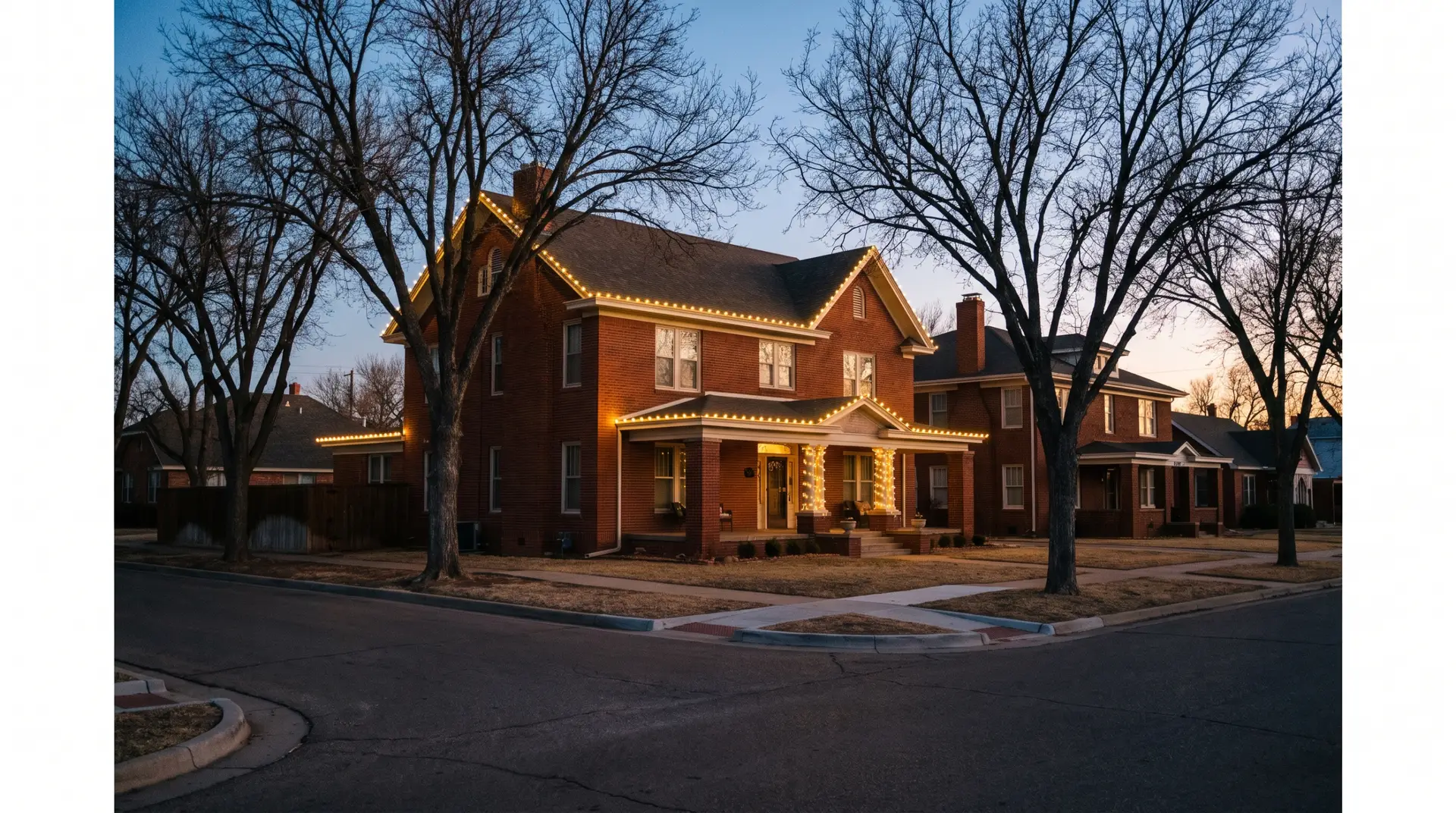
Think of a typical brick ranch in Tech Terrace or off 50th Street. The front elevation usually gives you 55 to 80 feet of straight eave, one small gable over the entry, and a porch with two posts. At 12 inch C9 spacing that is 3 strands of 25 for the eave, plus a strand for the gable, plus about 60 feet of mini lights for the posts and a shrub or two. Call it 4 C9 strands and 2 mini strands, then add one spare of each. Everything runs comfortably on one exterior circuit if you are using LED bulbs.
Two-Story with Gables, 2,400 Square Feet and Up
Newer construction in southwest Lubbock, Lakeridge, or the Frenship area usually means a taller front, multiple gables, and a mix of eave heights. Measure each level separately. A common total lands between 130 and 190 feet of roof line once the gable rakes are corrected for pitch, which is 6 to 8 C9 strands. Add columns, a second-story window row, and a tree and you are realistically at 10 to 12 strands total. This is also the point where a 24 foot extension ladder in a February wind stops being a fun Saturday.
Trees, Yard Features, and the Part That Grows
Yard elements are where budgets drift. One wrapped mesquite in the front yard can take 800 to 1,200 mini lights if you go up into the branches, and a mature live oak takes several times that. Net lights over shrubs are the efficient choice, sized to the shrub rather than free-wrapped. If you are adding a walkway, plan on a stake light every 3 to 4 feet. Decide the yard scope before you buy the roof line lights, because the total amp draw is one budget, not two.
Watts, Amps, and Keeping the Breaker Happy
Once you know how many Christmas lights do I need in strand counts, check whether your outlets can carry them. A 15-amp household circuit supplies 1,800 watts, and a display running six hours a night should stay near 80 percent of that, or about 1,440 watts. A 20-amp circuit gives you 2,400 watts with 1,920 as the working ceiling.
Incandescent C9 bulbs draw roughly 7 watts each, so a 25-bulb strand is about 175 watts. Eight of those strands fill a 15-amp circuit by themselves, which is exactly the two-story display described above. LED C9 strands typically draw a few watts for the whole strand, so the same display lands well under 100 watts total. That is not a small difference. It is the difference between running an extension cord to a second circuit and not thinking about it at all.
Split the display across circuits before you have a problem, not after. Most Lubbock houses have one or two exterior receptacles on the front and a garage circuit that can carry the rest. Note which section is on which circuit when you set it up, because when a breaker does trip on a cold night, knowing the layout turns a twenty minute hunt into a thirty second reset.
Use outdoor-rated cords sized to the run, keep every connection inside an in-use bubble cover, and make sure the receptacles feeding the display are GFCI protected. The Consumer Product Safety Commission publishes a short holiday safety section covering decorating hazards that is worth five minutes before the first ladder goes up. In our wind, the mechanical side matters as much as the electrical side: clips every 12 inches, cords secured, nothing left to whip against a gutter.
Final Word: Measure Once, Buy Once, Write It Down
The honest answer to how many Christmas lights do I need is that your house already knows and the tape measure will tell you. Twenty minutes of measuring converts a guess into a shopping list, and it stops both failure modes, the run that comes up short and the pile of returns in January.
Write the numbers on an index card and tape it inside the lid of the storage tote. Front eave in feet, gable count, post heights, strand counts by type, which circuit each section plugged into. Next year the whole planning stage takes four minutes. Label each bundle as it comes down in January with the section it came from, and the year after that is even easier.
For help picking bulbs before you calculate, our guide to C9, C7 and mini bulb types covers the look and cost of each, and our Lubbock design ideas guide is a good place to steal a layout. If two stories and a February wind are not your idea of a good time, our Christmas light installation team measures, supplies, hangs, maintains, and takes the whole display down in January, and we store it for you until next season.
Frequently Asked Questions: How Many Christmas Lights Do I Need?
Measuring, spacing and strand count questions from Lubbock homeowners
Square footage is the wrong unit, because a long single-story ranch and a compact two-story with the same floor area have very different roof lines. Measure instead. That said, a 2,000 square foot Lubbock home typically shows 90 to 140 linear feet across the front once gables are included, which is 4 to 6 C9 strands at 12 inch spacing. Add 2 to 4 mini strands for columns, shrubs, and window outlines, plus one spare of each type.
Twelve inches is the standard and the one most homeowners want. It gives distinct, evenly spaced bulbs that read clearly from the street at night, and pre-made 25-bulb strands are built to it, so a strand covers exactly 25 feet. Fifteen or eighteen inch spacing shows up on commercial spools and looks thin on a short residential eave. Tighter than twelve starts to blur the bulbs together and costs more per foot of coverage.
Measure the horizontal width of the gable at the eave line, then multiply by a pitch factor to get the true length of the angled run. Use about 1.05 for a 4:12 roof, 1.12 for a 6:12, and 1.20 for an 8:12. Double the result because a gable has two rakes meeting at the peak. A 24 foot wide gable on a 6:12 roof works out to roughly 54 feet of light, which surprises most people the first time they run it.
Check the tag at the plug, because it varies by product. Incandescent C9 sets usually cap out around three strands connected in series, and older mini incandescent sets are similar. LED strands often allow dozens because each draws so little current. Exceeding the limit blows the fuse in the plug at best and overheats the wire at worst. If a run needs more than the rated number, split it and feed the sections from separate cords.
Always, and buy them in the same trip. Add 10 to 15 percent to your calculated total for corners, dormers, and measuring mistakes, then set aside one unopened spare of each bulb type. Color varies between production runs, so a replacement bought in December may not match what is already on the roof. Store the spares with the display and you will spend one December after another swapping a bad strand in ten minutes instead of driving across town.