Choosing between siding options in Lubbock is a different exercise than it is almost anywhere else, because the wall of your house here takes a beating from three directions at once. Spring wind drives caliche dust against it at 60 miles an hour, the sun works on it at 3,200 feet of elevation, and hail arrives once or twice a decade with enough energy to crack anything brittle.
Most homeowners start this conversation after a storm, standing in the front yard looking at dents in a wall they had never really thought about. The good news is that the material choices are genuinely different from one another out here, and the right one can outlive the person who picks it. The bad news is that the cheapest bid is usually the one that will not.
On this page, a complete guide to siding options in Lubbock, TX:
- Quick Answer: The Best Siding Options for Lubbock Homes
- Six Siding Options Compared for West Texas Walls
- What Siding Actually Costs to Install in Lubbock
- How West Texas Weather Narrows the Siding Options
- Matching Siding Options to Your House and Your Budget
- Final Word: Picking Siding Options You Will Not Regret
- Frequently Asked Questions About Siding Options in Lubbock
Quick Answer: The Best Siding Options for Lubbock Homes
For most Lubbock houses, the practical siding options come down to four: fiber cement, engineered wood, vinyl, and steel or aluminum. Fiber cement is the default recommendation here because it does not dent from hail, does not feed the sun’s UV load the way vinyl does, and holds paint for a long time in dry air.
Installed pricing in this market generally runs $6–$11 per square foot for vinyl, $9–$16 for engineered wood, $10–$18 for fiber cement, and $12–$22 for steel. On a typical 1,800 square foot single-story home with roughly 1,500 square feet of wall area, that is about $9,000 to $27,000 depending entirely on which material you land on and how much trim and carpentry the job needs underneath.
Those ranges assume a straightforward tear-off and a wall that is sound once the old material comes off. They do not include replacing rotted sheathing, rebuilding trim, or re-wrapping a house that never had a weather barrier to begin with. On older Lubbock homes those extras are common enough that we treat them as likely rather than unlikely when we write a number.
Fiber cement is the safest all-round choice for West Texas walls: hail-resistant, UV-stable, and paintable. Vinyl is the budget option and performs fine on protected elevations. Steel is the most hail-proof but costs the most and dents differently than people expect.
Six Siding Options Compared for West Texas Walls
Every material below is installed somewhere in Lubbock and every one of them works on the right house. What separates them is how they behave under our specific combination of wind-driven grit, heat, and impact. Read these as trade-offs rather than a ranking, because the correct answer changes depending on which wall you are standing in front of and what your budget actually is.
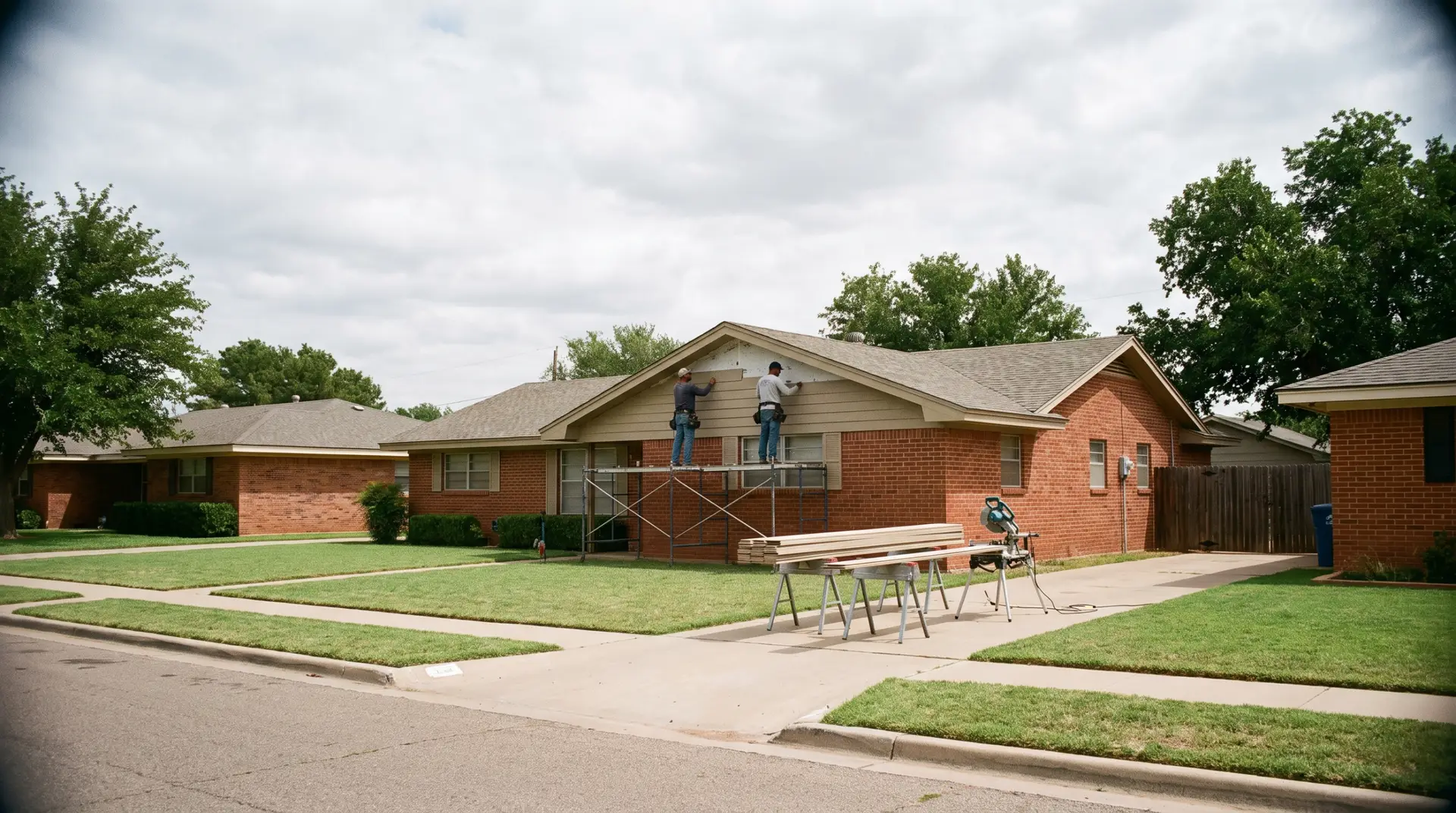
It also helps to know what you already have. A lot of the housing stock here is brick on the front with siding only on the gables, soffits and rear elevation, which means the decision covers far less square footage than homeowners assume. Walk the house and measure the actual siding area before you start comparing materials, because that number changes which options are realistic.
- Fiber cement: Cement, sand and cellulose pressed into boards. It will not dent, will not burn, and shrugs off blowing grit. Heavy to hang and it needs proper flashing and paint maintenance, but it is the most forgiving choice for a west-facing wall out here.
- Engineered wood: Resin-treated wood strands with a factory finish. Lighter and easier to cut than fiber cement, warmer looking, and reasonably impact tolerant. Keep it off the ground and keep the cut ends sealed or moisture will find the core.
- Vinyl: The value option, and better than its reputation if you buy thickness. Thin panels go brittle under UV and crack in a hard freeze; heavier extrusions with a good lock hold up. It will not rot and it never needs paint.
- Steel: The most hail-resistant material commonly installed here. It does dent, but it dents rather than shatters, and a textured finish hides small dings. Higher cost and fewer local crews who install it well.
- Brick or masonry veneer: Already on most of the housing stock here and effectively permanent. Repointing and lintel rust are the maintenance items, not replacement. Usually a repair conversation rather than a siding decision.
- Stucco and EIFS: Common on newer south Lubbock builds. Handles sun well, handles ground movement poorly. Our expansive clay opens hairline cracks that need sealing on a cycle, and water behind the system is expensive to find.
One caution on comparing quotes: two bids for the same material can differ by thousands because one includes house wrap, new flashing at every opening, and rotten sheathing replacement, and the other assumes the wall behind the old siding is perfect. Nobody knows that until the old material comes off. Ask each contractor to put their sheathing rate in writing before work starts, so the number is agreed rather than invented on the day.
What Siding Actually Costs to Install in Lubbock
Wall area, not floor area, drives the price. A single-story ranch with a simple rectangle footprint is the cheapest thing to side. Every gable, dormer, bay window and second story adds cut waste, ladder time and trim detail, and trim is where the labor hours hide. A house with fifteen windows costs meaningfully more to side than the same house with eight, because each opening needs flashing, a head detail and four cut edges.
Tear-off is its own line item. Removing old siding and hauling it off usually adds $1 to $3 per square foot, and it is the point where the job either stays on budget or does not, because the sheathing underneath finally becomes visible. Soft or delaminated sheathing has to be replaced before anything new goes on, and that is carpentry billed separately. If you have never seen behind your walls, budget a contingency rather than assuming the best case.
House wrap and flashing are not upgrades. A weather-resistive barrier behind the siding and proper flashing at every window, door and penetration are what actually keep water out of the wall. A quote that does not mention either one is not cheaper, it is incomplete. The same logic applies to the trim package, which is what most people actually look at from the street.
Access affects price more than people expect out here. A two-story wall three feet from a property line means staging rather than ladders, and a backyard gate too narrow for a dump trailer means every piece of old siding gets carried to the curb by hand. Neither shows up in a per-square-foot average, and both are real hours somebody has to pay for.
How West Texas Weather Narrows the Siding Options
Materials that are perfectly sensible in Dallas or Denver can age badly on the South Plains, and the reasons are specific rather than general. Three conditions do most of the damage here, and each one rules out a different failure mode. Understanding them makes the shortlist obvious without anybody having to sell you on a brand, and it explains why the same product can look fine on one wall of your house and worn out on another.
Hail and impact
The South Plains sits inside an active hail corridor, and siding on the storm-facing elevation takes hits that the other three walls never see. Brittle materials crack, thin vinyl punches through, and thin metal dents. Fiber cement and heavier steel hold up best. The Insurance Institute for Business & Home Safety publishes the impact testing that sits behind most manufacturer ratings, and it is worth reading before you take a salesperson’s word for a hail warranty. Ratings are earned under controlled conditions, so treat them as a comparison between products rather than a promise about your wall.
Wind-driven grit
Our spring wind does not just push on a wall, it sandblasts it. Blowing caliche dust abrades finishes on the west and southwest elevations far faster than on the sheltered sides, which is why so many Lubbock houses look like two different paint jobs. Factory-applied finishes hold up better than field paint, and darker colors show the wear sooner. If you are keeping a painted material, plan on refreshing the exposed elevations on a shorter cycle than the rest of the house rather than repainting everything at once.
Sun and thermal movement
UV at this elevation is punishing, and the daily temperature swing is wide enough that panels expand and contract noticeably. Vinyl has to be hung loose enough to move; nail it tight and it buckles by the second summer. Fiber cement barely moves, which is part of why its paint lasts. Thermal movement is also why fastener choice matters: the wrong nail in the wrong slot turns normal seasonal expansion into a wavy wall that no amount of paint will straighten out.
Matching Siding Options to Your House and Your Budget
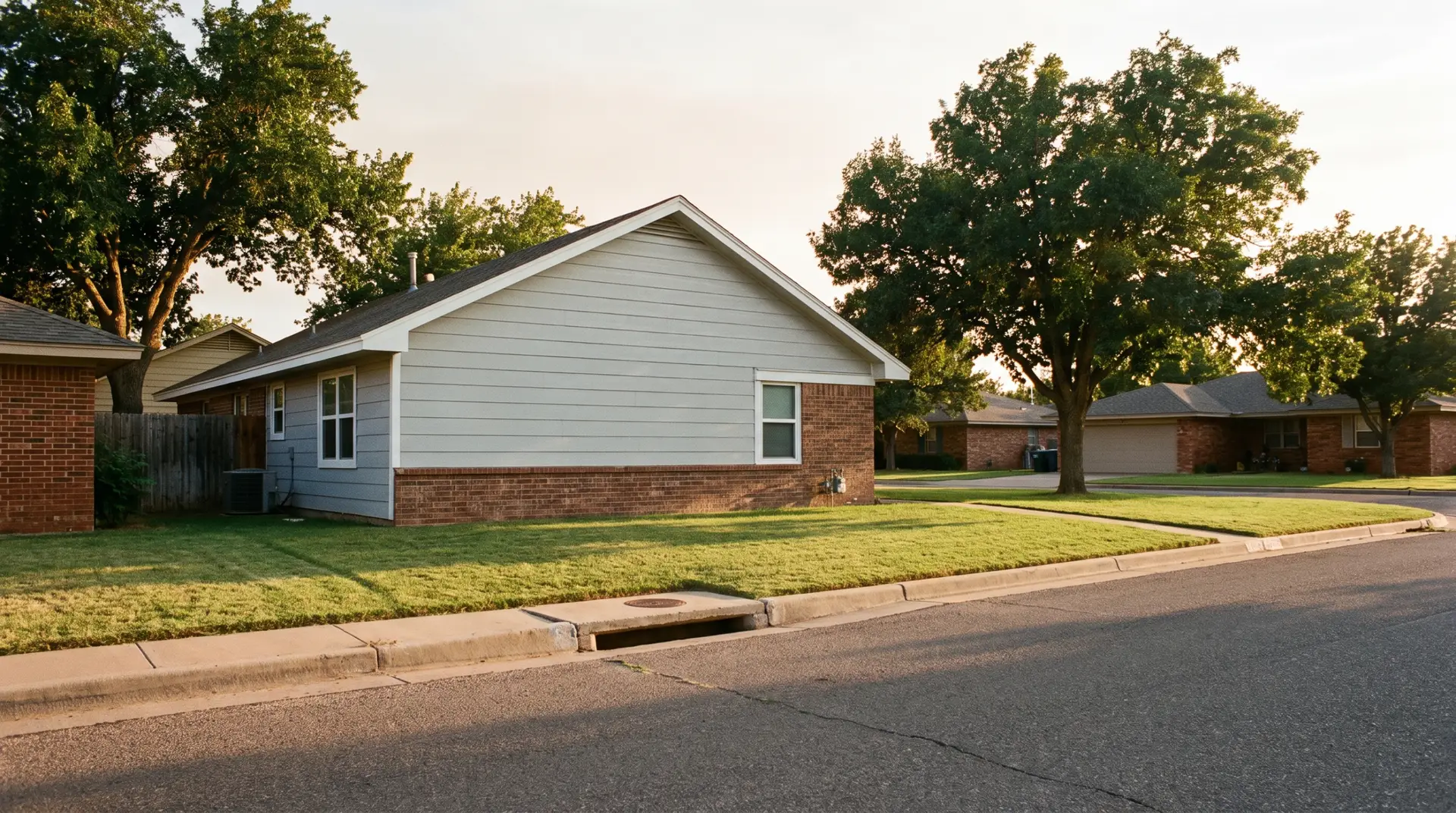
The most common mistake is treating the whole house as one decision. Plenty of Lubbock homes are brick on the front and siding on the gables, soffits and back wall, which means the actual scope is far smaller than a full wrap and the budget stretches further than people expect. Replacing only the gable ends and trim on a brick ranch is a weekend-scale job compared to siding an entire two-story.
If the house is already brick, the honest answer is usually to repair what is there and put the money into the exterior elements that are failing, which is frequently the trim, the soffit and the fascia rather than the field of the wall. If you are re-siding after a hail claim, coordinate it with the roof, because the same storm usually damaged both and one claim covering both trades is simpler than two.
Budget order matters too. Water management comes first, then impact resistance, then appearance. A beautiful material installed over bad flashing will fail at the windows, and no color choice fixes that. Get the wall dry and the details right, then spend what is left on the finish you actually want to look at. This is also the moment to think about other curb appeal upgrades, since the scaffolding and crew are already on site.
Colour and profile are the last call, not the first. Lighter colours hold up visibly better under our UV and hide dust between washes, and a wider lap or a vertical board-and-batten profile reads differently on a long ranch elevation than the narrow lap most builders default to. Look at samples on the actual wall, in afternoon light, before anybody orders material.
Final Word: Picking Siding Options You Will Not Regret
Narrow it by elevation and by failure mode rather than by brochure. Ask what happens to each material in a hail event, ask who flashes the windows and how, and ask what the crew does when they pull the old siding and find soft sheathing. The answers to those three questions tell you more about a bid than the price does.
Get the wall detail right and almost any of these materials will serve a Lubbock house well for decades. Get it wrong and the best product on the market will still let water into the sheathing. Keeping the whole exterior on one maintenance rhythm helps, and our seasonal exterior maintenance checklist lays out what to look at and when.
Timing is worth a thought as well. Fall is the easiest season to side a house here: the wind has settled, the heat is off the wall, and crews are past the summer scramble. Spring is the hardest, because hail season has every exterior trade in the region booked and material lead times stretch.
If you are weighing siding after a storm, or you want someone to look behind the trim before you commit to a material, our crews handle the full exterior across Lubbock and the South Plains. You can see everything we cover on our roofing and exterior services page, and an estimate costs nothing.
Frequently Asked Questions About Siding Options in Lubbock
Straight answers to what Lubbock homeowners ask us before choosing a siding material
Fiber cement and heavier-gauge steel hold up best against South Plains hail. Fiber cement does not dent at all because it is a rigid cement board, though a direct hit from very large stones can chip it. Steel dents rather than cracking, and a textured or stone-coated finish hides small dings well. Thin vinyl is the most vulnerable, especially in cold weather when it goes brittle. Whatever you choose, ask for the tested impact rating rather than a general hail warranty claim, and check whether that rating applies to the specific thickness being quoted.
Installed costs generally run $6 to $11 per square foot for vinyl, $9 to $16 for engineered wood, $10 to $18 for fiber cement, and $12 to $22 for steel. A typical single-story home with about 1,500 square feet of wall area lands somewhere between $9,000 and $27,000 depending on material and detail work. Tear-off adds $1 to $3 per square foot, and replacing damaged sheathing underneath is billed separately because nobody can price it until the old siding is off. Houses that are brick on the front cost considerably less, since the siding area is only the gables and rear wall.
Usually yes, when hail or wind is the cause and the policy covers that peril. Siding claims are often approved alongside roof claims from the same storm, since one event typically damages both. The sticking point is matching: if your siding is discontinued, carriers and homeowners frequently disagree about whether undamaged walls should be replaced so the house matches. Document everything with photos before any repair work starts, and get your contractor on site when the adjuster visits.
Sometimes, but we rarely recommend it here. Layering over old material hides the condition of the sheathing and the weather barrier, which is exactly where West Texas wind-driven rain causes trouble. It also makes flashing windows and doors correctly much harder, because the new surface sits proud of the original openings. Tear-off costs more up front and is usually the better decision, particularly on a house that has already been through a hail event.
Fiber cement commonly lasts 30 to 50 years with repainting every 10 to 15 years. Engineered wood runs 20 to 30 years if the cut edges stay sealed and it stays off the ground. Good vinyl reaches 20 to 30 years, though our UV load and hail exposure pull the low end of that range down. Steel can exceed 40 years. In every case the installation details, particularly flashing, decide more about lifespan than the material itself, and the west and southwest elevations will always age faster than the rest of the house.