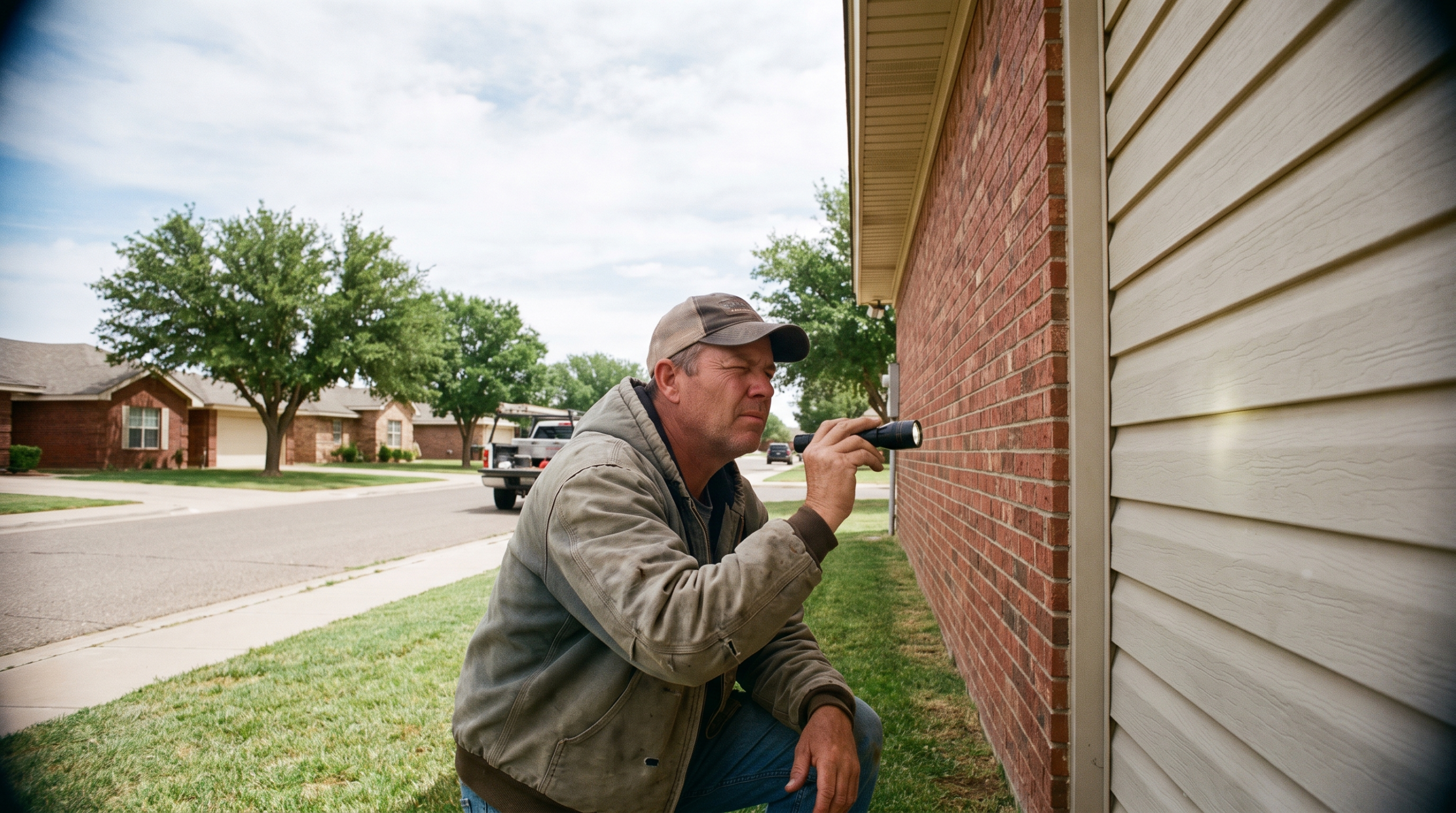
A hail damage siding claim is the part of a storm loss that Lubbock homeowners find last and argue about longest, usually weeks after the roof has already been settled. Everyone looks up after a storm. Almost nobody walks the west wall with a flashlight held flat against the surface, which is the only way most siding damage becomes visible at all.
That matters because siding and roofing are usually damaged by the same event, and a carrier is far more willing to consider both while the claim is open than to reopen it in March. If you have had hail on your street this year, the wall is worth ten minutes of your time before the filing window closes. What follows is what the damage actually looks like, what it costs to put right, and how to keep a valid claim from turning into a denied one.
On this page, a complete guide to hail damage siding in Lubbock, TX:
- Quick Answer: How Hail Damage Siding Claims Work in Texas
- What Hail Damage Siding Actually Looks Like
- Filing a Hail Damage Siding Claim Without Losing Ground
- Why the South Plains Is Hard on Siding
- Repair or Replace After Hail Damage Siding Loss
- Final Word: Move Early on Hail Damage Siding
- Frequently Asked Questions About Hail Damage Siding
Quick Answer: How Hail Damage Siding Claims Work in Texas
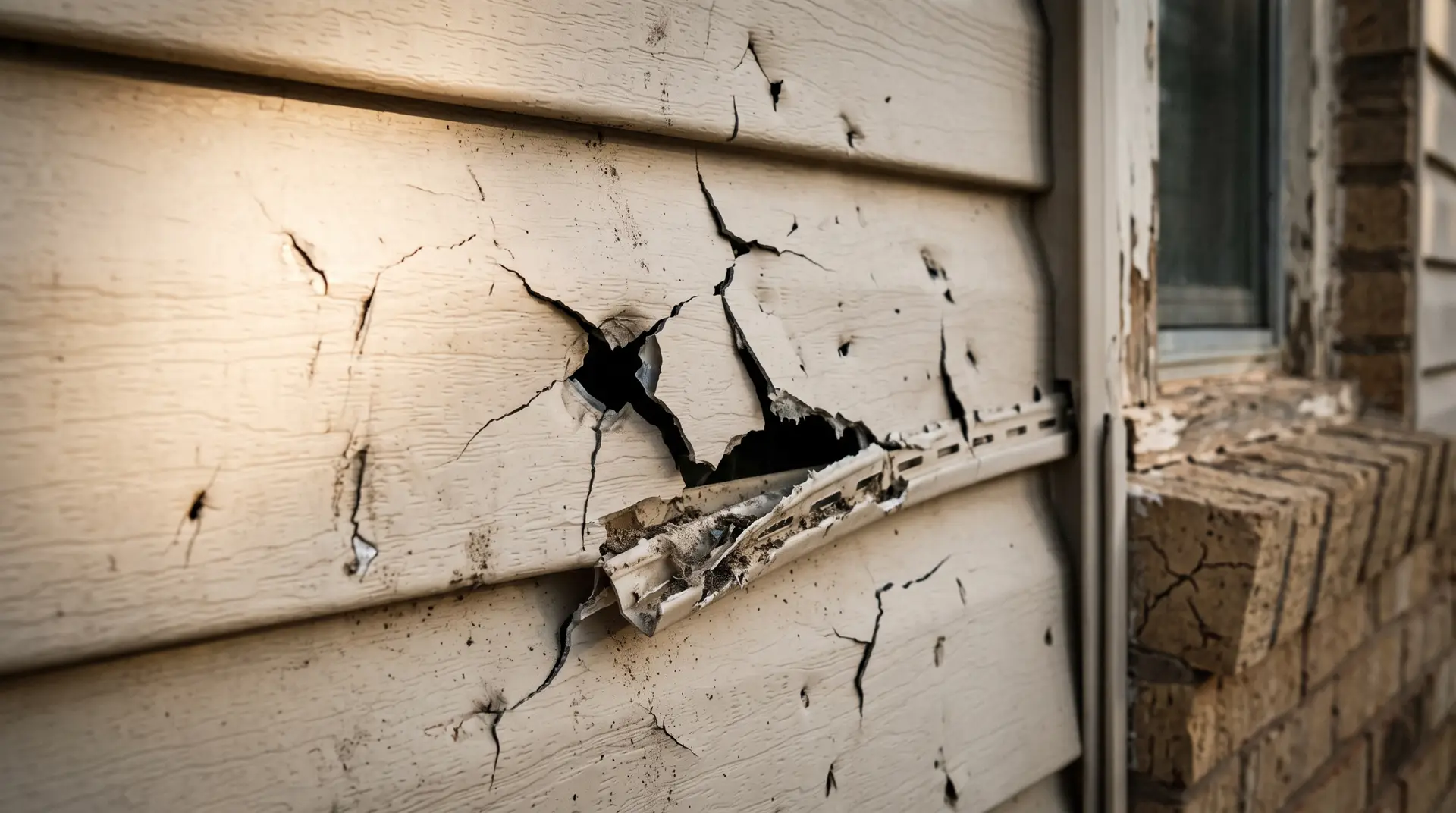
Hail damages siding by cracking, chipping, or punching through the panel face, and by breaking the locking edge that holds panels to the wall. On vinyl it shows as clean holes or spider cracks, on aluminum as dents and chalking, and on fiber cement as chips and craters where the surface has been knocked off.
In Texas, a hail loss is a covered peril under most standard homeowners policies, so siding damage is generally payable the same way roof damage is. You pay your deductible once per event, which is why filing roof and siding together nearly always makes financial sense. Repair costs commonly land between $800 and $4,000 for a single elevation and $9,000 to $27,000 for a full re-side, depending on material.
The deadline is the thing people miss. Texas policies generally require prompt notice, and most carriers apply a filing window measured from the date of loss rather than the date you noticed. Waiting a season is how a valid claim becomes a denied one.
Hail rarely destroys siding outright. It cracks panels, breaks locking edges, and removes the protective face, all of which let water into the wall. Because the deductible is per event, filing siding alongside the roof from the same storm is almost always the better move.
What Hail Damage Siding Actually Looks Like
Siding damage hides in plain sight because we look at walls straight on, and hail bruising only shows at a low angle. Stand at the corner of the house and sight down the wall, or hold a flashlight almost flat against the surface in the evening. Damage that was invisible from the driveway shows up immediately as shadows and irregularities.
Check the storm-facing elevation first, which in Lubbock is usually the west, southwest or north wall depending on the track of the cell. Damage is almost never evenly distributed across a house, and a carrier will generally only pay for the elevations that were actually hit.
Work top down on each wall. Hail driven at an angle concentrates on the upper courses and under the eave line, where a ladder is needed to see anything at all. Damage found only at ground level usually is not hail, and damage found only up high is the pattern that adjusters expect.
- Clean round holes or punctures: The clearest sign on vinyl. Large stones punch straight through a panel rather than cracking it, leaving a hole with a slightly raised lip. Water goes straight into the sheathing from here.
- Spider or star cracks: Radiating cracks around an impact point, common on vinyl hit in cold weather when the material is brittle. Often invisible head-on and obvious at a low angle.
- Broken locking edges: The hidden one. Hail can shatter the interlock at the top of a panel without marking the visible face, leaving the panel loose. Push gently on a course and see whether it rattles or has dropped.
- Dents and dimples on metal: Aluminum and steel take round dents that catch shadow at an angle. Dents alone may be cosmetic, but where the coating is broken the panel will chalk and corrode from that point.
- Chips and craters on fiber cement: Cement board does not dent, so hail knocks small craters out of the painted face instead. Each crater is an open path into an absorbent board.
- Collateral evidence: Dented gutters, downspouts, window screens, soft metal vents and an air conditioner with flattened fins. Adjusters use these as proof of hail size and direction, so photograph them before anybody straightens anything.
Keep every damaged piece you remove and do not tidy up before the adjuster visits. Straightened gutters, replaced screens and a swept driveway all remove the supporting evidence that a storm of a given severity actually hit your address. If a temporary repair is needed to stop water, photograph it thoroughly first.
Filing a Hail Damage Siding Claim Without Losing Ground
Start by pinning down the date of loss. Carriers index everything to the storm date, not the day you noticed, and National Weather Service records for Lubbock County can establish which day produced hail at your address. If two storms came through in the same spring, the one you name matters, because policy terms and deductibles may have changed between them.
Document before you call. Photograph each damaged elevation wide, then close, with something in frame for scale on at least a few shots. Include the collateral items above. This takes twenty minutes and it is the single highest-value thing a homeowner does in the whole process, because memory and weather both work against you later.
Have your contractor present for the adjuster appointment. This is standard practice and adjusters expect it. Siding damage is genuinely easy to miss at a walk-around pace, and having someone point out broken locking edges and low-angle bruising on the spot avoids a supplemental claim later. The Texas Department of Insurance publishes how the claim process and your rights as a policyholder work in this state, including what to do if you disagree with a settlement.
Get your own scope in writing before the adjuster’s arrives if you can. Two independent measurements of the same wall give you something concrete to compare, and a contractor scope written before the settlement carries more weight than one written to dispute it afterwards. Note the siding manufacturer, product line and colour if you can find them, since availability drives the whole matching discussion later.
Read what comes back carefully. A scope that pays for one elevation when three were hit, or that pays to patch a discontinued product, is a starting position rather than a final answer. Disagreement at that stage is normal and is usually resolved with better documentation rather than a fight.
Why the South Plains Is Hard on Siding
Lubbock sits in one of the more active hail corridors in the country, and our walls take a different kind of punishment than walls in wetter climates. Three local conditions decide how badly a given storm damages siding, and they explain why two identical houses on the same street can come out of one storm with very different damage. They also explain why siding damage here is so often worse than the stone size alone would suggest.
Wind direction turns hail sideways
Hail falling straight down mostly hits the roof. Hail driven by a 60 mph gust front hits the wall, and that is the normal pattern here. Storm-driven hail arrives at an angle that loads one or two elevations heavily and leaves the others untouched, which is why damage maps are so lopsided and why adjusters pay by elevation rather than by house. It also means a neighbour two doors down whose house sits at a slightly different angle to the street can have a completely different outcome from the same cell. When you photograph damage, note which direction each wall faces, because that detail supports the pattern you are claiming.
Cold makes siding brittle
Our hail season starts in March, when overnight lows still drop near freezing. Vinyl that would flex and survive a summer impact will crack and shatter at 40 degrees. That is why early-spring storms often produce far worse siding damage than a summer storm with the same stone size, and why age matters: older vinyl has already lost plasticizer to UV and breaks more easily. A wall that came through a June storm without a mark can fail badly in an April one. If your siding is more than fifteen years old, assume it is less impact tolerant than the day it went on.
Grit finishes what hail starts
Once hail has chipped a painted or coated surface, blowing caliche dust goes to work on the exposed edge every windy day after. A small crater on fiber cement or a scratched coating on steel is not just cosmetic here. It is the starting point for moisture intrusion and corrosion that a wetter, calmer climate would take years longer to produce. This is the reason we push homeowners to deal with chips rather than live with them: in West Texas the damage does not sit still, and a cosmetic crater in April is an open path into the board by the following spring.
Repair or Replace After Hail Damage Siding Loss
The repair-or-replace question turns on two things: how many elevations were hit, and whether your siding is still manufactured. Scattered damage on one wall of a common current product is a straightforward repair. Damage across three elevations of a colour discontinued in 2009 is a different conversation entirely.
Matching is where most siding claims stall. Siding fades under UV, so even genuine replacement stock will not match a wall that has been in the Lubbock sun for fifteen years. Carriers and homeowners frequently disagree about whether undamaged walls should be replaced so the house matches, and the answer depends on your policy language rather than on fairness. Ask specifically how your policy treats matching before you accept a scope.
Partial repairs do work when done honestly. Replacing a full course rather than single panels, and pulling replacement material from an inconspicuous elevation to patch a visible one, produces a far better result than scattered new panels across a faded wall. It costs a little more labor and it is usually worth it.
Consider the age of the wall in the decision as well. Putting a few new panels into siding that is twenty years old and already chalking buys you a patch on something close to the end of its life. If the claim covers a meaningful share of a re-side, adding your own money to finish the job properly is often better value than spending the same amount on repairs twice in five years.
If the roof was hit in the same storm, handle both together. The crew is already staged, the claim is already open, and the flashing where roof meets wall is easier to detail correctly when both trades are live. Our hail damage roof repair and claim guide covers the roof half of the same process.
Final Word: Move Early on Hail Damage Siding
The homeowners who do best after a Lubbock hailstorm are not the ones who argue hardest. They are the ones who documented the wall the same week, named the right storm date, and had somebody who knew what to look for standing next to the adjuster.
If a claim does come back denied or underpaid, that is not the end of it. Denials frequently turn on missing documentation or a scope that never covered the damaged elevations, both of which can be addressed. Our guide to a denied roof insurance claim in Texas walks through the same steps that apply to siding.
Before the next season starts, it is worth walking the exterior once with fresh eyes so you know what undamaged looks like on your own house. Our hail season preparation checklist covers what to photograph and when.
If you want someone to look at a wall before you file, or to meet your adjuster on site, we inspect storm damage across Lubbock and the South Plains. You can read more about how we handle storm work on our hail and storm damage page, and the inspection itself is free.
Frequently Asked Questions About Hail Damage Siding
What Lubbock homeowners ask us most after a spring hailstorm hits the wall
Stand at a corner and sight down the wall rather than looking at it straight on, or hold a flashlight nearly flat against the surface in the evening. Hail bruising only shows at a low angle. Look for clean punctures, spider cracks around an impact point, and panels that rattle because the hidden locking edge is broken. Then check the gutters, downspouts, window screens and the air conditioner fins, since those confirm both the size and the direction of the hail. Photograph the whole wall as well as the close-ups, because adjusters need to see the pattern of impacts and not only individual hits.
Generally yes. Hail is a covered peril under most standard Texas homeowners policies, and siding is part of the dwelling coverage, so it is handled the same way a roof claim is. You pay one deductible per storm event, which is why filing roof and siding damage from the same storm together almost always makes sense. What varies between policies is how matching is treated when your siding is discontinued, so read that section before you accept a settlement. If you are unsure whether to file, an inspection costs nothing and gives you a documented record either way.
Most Texas policies require prompt notice after a loss, and carriers commonly apply a filing window measured from the date of the storm rather than from when you noticed the damage. Waiting a full season is one of the most common reasons an otherwise valid claim gets denied. If you know hail hit your street this year, get the wall inspected now even if you are not sure you will file, so the documentation exists while the evidence is still on the house. Keep a copy of every email and note the date and name of everyone you speak to at the carrier.
Not usually, and this is the most common point of disagreement. Carriers typically pay to repair the elevations that were actually hit. The problem is matching: siding fades under our UV, and a discontinued colour cannot be matched at all. Some policies contain matching language that addresses this and some do not. A practical middle path is pulling replacement material from a hidden elevation to patch the visible wall, then siding the hidden one with new stock. Ask for the matching decision in writing rather than over the phone, since it directly affects the settlement amount.
Yes, though often not immediately. A puncture or crack lets wind-driven rain past the siding and onto the weather barrier and sheathing. If the house wrap behind is intact, you may see nothing for a year or two while the sheathing quietly stays damp. On older Lubbock homes with no weather barrier at all, water reaches the sheathing directly. That delay is exactly why siding damage gets discovered late and why filing promptly matters. A moisture reading on the sheathing during the inspection settles the question faster than any argument about appearances.